



You wouldn't build a house without a skilled construction crew, right? The same logic applies to your body after a tough workout. True strength isn't built during that final, grueling rep—it’s forged in the hours and days that follow. Every intense session creates microscopic tears in your muscle fibers, and this is where the real work begins.
Recovery isn't just about resting. It's an active, nutrient-driven process. Think of specific vitamins and minerals as your body's specialized construction crew, showing up to the job site to manage inflammation, clear out debris, and rebuild everything stronger than before.
Your Blueprint For Faster Muscle Recovery
The whole point of this "damage" is to trigger a repair cycle that makes you stronger. But for that to happen efficiently, your construction crew needs the right tools and a clear plan.
The process unfolds in a few key phases: first, managing the initial inflammation, then rebuilding the damaged tissue, and finally, clearing out all the metabolic waste. Each step is critical.
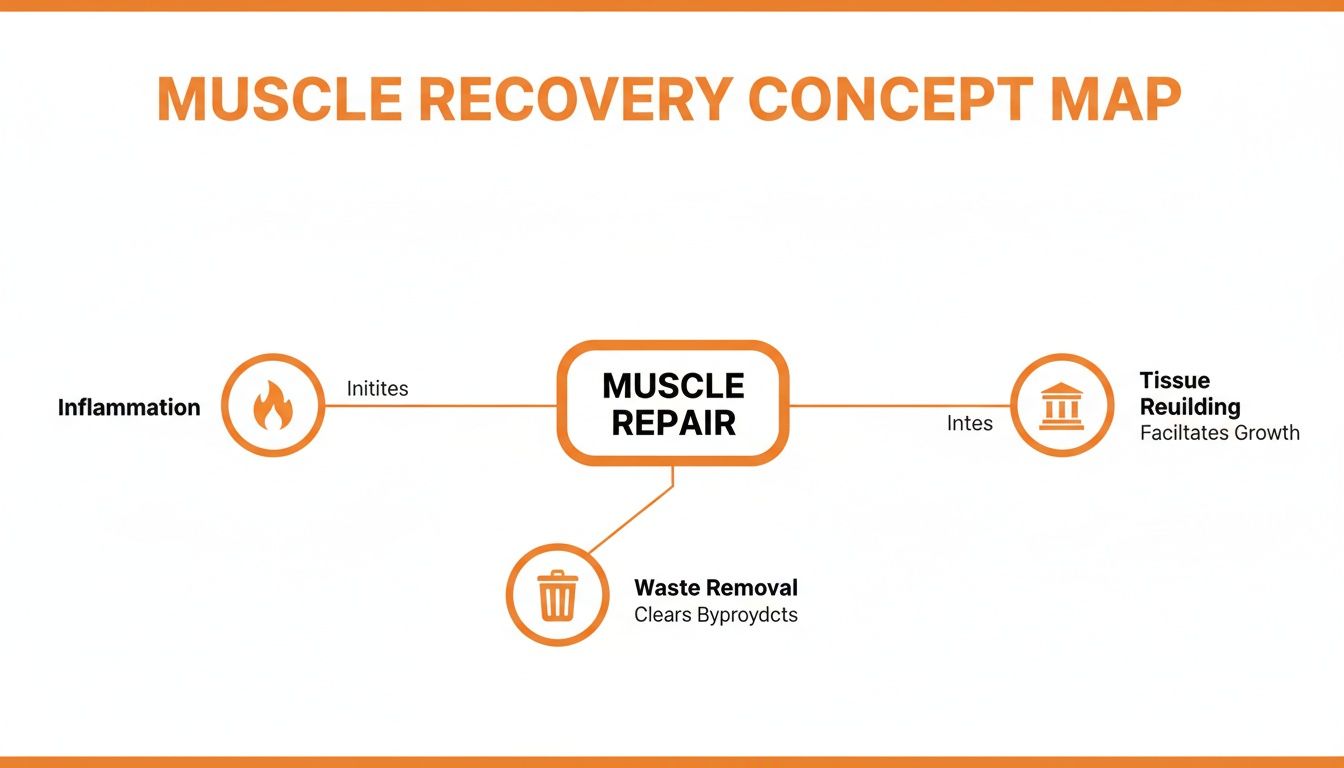
As you can see, a smooth recovery hinges on supporting these distinct phases. If any one of them stalls out due to a lack of resources, the whole project gets delayed. That's where targeted nutrition comes in.
The Key Players In Your Recovery Strategy
An effective recovery plan is all about giving your internal "crew" the right tools for each specific job. Different nutrients play very different roles:
- Controlling Inflammation: Antioxidants like Vitamin C act as the site managers, calming excessive inflammation and oxidative stress. This prevents the kind of prolonged soreness that can sideline you.
- Rebuilding Tissue: Protein provides the raw building materials, but it's minerals like Zinc and vitamins like Vitamin D that act as the foremen, directing protein synthesis to weave those muscle fibers back together—stronger than before.
- Clearing Metabolic Waste: Proper hydration and key electrolytes help flush out the byproducts generated during intense exercise, clearing the job site so the real repair work can begin.
Simply swallowing a handful of pills doesn't always cut it, though. The digestive system can be a major bottleneck, meaning a good portion of those nutrients may never even reach your muscle cells. This is where advanced delivery methods, like those we specialize in at Elite Bioscience, can be a game-changer.
By ensuring these critical nutrients get exactly where they're needed, you can supercharge every phase of your recovery. Timing is also huge. To get the most out of your supplements, check out our guide on the best time to take vitamins to maximize their impact.
Quick Guide To Top Muscle Recovery Vitamins and Nutrients
To give you a clearer picture, here’s a quick rundown of the heavy hitters in muscle recovery and the specific roles they play. Think of this as the roster for your all-star recovery team.
| Vitamin/Nutrient | Primary Role in Recovery | Key Benefit |
|---|---|---|
| Vitamin D | Regulates muscle repair and growth signals. | Supports protein synthesis and reduces inflammation. |
| Vitamin C | Fights post-workout oxidative stress. | Protects cells from damage and supports collagen formation. |
| Vitamin E | Stabilizes cell membranes. | Reduces muscle damage caused by free radicals. |
| B-Complex Vitamins | Facilitate energy metabolism. | Helps convert food into the energy needed for repair. |
| Magnesium | Aids in muscle relaxation and protein synthesis. | Reduces muscle cramps, soreness, and fatigue. |
| Zinc | Supports protein synthesis and immune function. | Essential for rebuilding muscle tissue and wound healing. |
Each of these nutrients brings something unique to the table, and they often work together to accelerate the recovery process. A deficiency in any one of them can create a weak link in the chain, slowing down your progress and keeping you sore for longer than necessary.
How Vitamin D Dominates Muscle Repair
Most people think of Vitamin D as the “sunshine vitamin,” a nutrient that’s all about bone health. While that's true, it’s also a quiet powerhouse in the world of muscle recovery. Its influence goes way beyond your skeleton; it acts as a master regulator for muscle cell function, directly controlling how fast and how well you bounce back after a tough workout.
Think of Vitamin D as the foreman of your body's cellular repair crew. When you push your muscles to their limits, you’re creating microscopic tears that signal an urgent need for repair. Vitamin D is what flips the switch, activating the machinery needed to rebuild those damaged fibers and keep the resulting inflammation under control.
This job is critical for minimizing downtime and making real progress. If your Vitamin D levels are low, your body's response can be sluggish and disorganized. The result? You stay sore for longer, and your gains start to slow down.
The Science of Strength Regeneration
So, how does this "master switch" actually work? Vitamin D gets directly involved in the entire lifecycle of your muscle cells—a process covering their creation, specialization, and fusion into existing muscle fibers. In simple terms, it helps build new muscle cells and weave them into your existing tissue, making your muscles stronger and more resilient with each recovery cycle.
It also plays a huge role in managing pro-inflammatory cytokines, the chemical messengers that cause that lingering soreness and swelling. By reining in this inflammatory response, Vitamin D allows the rebuilding phase to start sooner and run more smoothly. That means less time feeling stiff and more time being ready for your next session.
Vitamin D isn’t just a background player; it’s a frontline commander in muscle repair. Its ability to manage inflammation and directly support muscle protein synthesis makes it one of the best vitamins for muscle recovery available.
This isn't just theory—the hard data shows a clear link between Vitamin D levels and how quickly athletes get their strength back. A pivotal 2013 study found that physically active adults with higher vitamin D levels recovered muscle strength 25-30% faster after intense leg workouts compared to those with lower levels. The group with enough Vitamin D was back to their baseline force output in three days, while the deficient group took a full week. You can explore the full research findings on Vitamin D and muscle strength recovery for a deeper dive.
Why Optimal Levels Matter
For anyone serious about performance, hitting optimal Vitamin D levels is non-negotiable. Deficiency is surprisingly common, even among athletes, and it can create a major bottleneck in your recovery. The benefits of keeping your levels topped up are clear and impactful:
- Faster Strength Return: As the research shows, you can get back to peak performance days earlier than someone with suboptimal levels.
- Reduced Muscle Soreness: By managing inflammation more effectively, it helps cut down the duration and intensity of delayed onset muscle soreness (DOMS).
- Enhanced Muscle Function: Proper levels support the fundamental processes of muscle contraction and protein synthesis, leading to better overall performance.
Ignoring a potential Vitamin D shortfall means you're just leaving recovery time on the table. It’s like sending your repair crew to a job site without their foreman—the work might get done eventually, but it will be slow, sloppy, and far less effective. Making sure your levels are where they need to be is one of the smartest moves you can make to build a truly robust recovery protocol.
The Antioxidant Power of Vitamin C

Every tough workout does more than just build muscle and burn calories; it kicks up a storm of cellular chaos called oxidative stress. Think of your hard-working muscles as a clean-burning engine. Even the best engines produce some exhaust, and in your body, this "exhaust" comes in the form of unstable molecules known as free radicals.
If you leave them unchecked, these free radicals ricochet around your cells, causing damage that keeps inflammation high and puts the brakes on your recovery. This is where Vitamin C comes in, acting as your body's dedicated cleanup crew. It's one of the best vitamins for muscle recovery precisely because it neutralizes these damaging compounds before they can cause more trouble.
By quenching free radicals, Vitamin C helps calm that post-workout inflammatory fire. This lets your body switch from damage control to active repair much more quickly, which means less lingering soreness and a faster return to peak performance.
More Than Just An Antioxidant
While its role as a free radical scavenger is critical, Vitamin C wears another hat that's just as important for muscle repair. It’s an essential cofactor for producing collagen, the most abundant protein in your body.
Collagen is the structural "glue" that holds your connective tissues together—your tendons, ligaments, and the fascia wrapping your muscles. When you train hard, these tissues get stressed and damaged, too.
Without enough Vitamin C, your body simply can't produce the collagen needed to effectively repair this framework. This can lead to weaker connective tissues and a higher risk of injury over time. So, getting enough Vitamin C ensures that both your muscle fibers and their supporting structures are rebuilt to be strong and resilient.
Vitamin C's dual-action capability—combating oxidative stress while simultaneously rebuilding the collagen matrix—makes it an indispensable tool for comprehensive tissue repair and accelerated muscle recovery.
The evidence backing Vitamin C is compelling. Integrated studies show that supplementing with 500-1000 mg per day after exercise can slash muscle soreness by 20-30% within 24 to 48 hours. Research also confirms that smart timing—taking it within 60 minutes after a workout—can boost overall recovery markers by nearly 27%. You can dive into the full research on antioxidants in exercise recovery for a detailed breakdown of these findings.
Maximizing Vitamin C's Impact
To get the most out of this powerhouse antioxidant, you need to think about how it plays with other nutrients. Its benefits are often amplified when paired with other compounds that support recovery.
- Synergy with Vitamin E: Vitamin E is another potent antioxidant that works right alongside Vitamin C to shield cell membranes from oxidative damage. They essentially "recharge" each other, creating a much more robust defense system.
- Pairing with Bioflavonoids: Often found in citrus fruits, these compounds boost the absorption and use of Vitamin C, making it even more effective.
- Timing is Key: As the studies suggest, consuming Vitamin C shortly after your workout helps you capitalize on the "anabolic window," when your muscles are primed to soak up nutrients for repair.
Adding Vitamin C to your post-workout routine isn't just about managing soreness; it’s about creating a better environment for growth. By cleaning up metabolic waste and supplying the raw materials for tissue repair, you ensure your body can rebuild itself stronger, session after session.
Essential Minerals That Support Recovery
While vitamins like D and C tend to get most of the attention, they’re only half of the muscle recovery story. To build a truly resilient system, you need the right minerals in your corner. Think of them as the specialized tools on your body's construction site—the nuts, bolts, and power drivers needed to assemble the raw materials that proteins and vitamins provide.
Without these crucial catalysts, the whole rebuilding process can grind to a halt. A shortage in key minerals creates a serious bottleneck, leaving you sore and run-down even if your vitamin intake is perfect. Two of the biggest players here are magnesium and zinc, each handling a distinct but vital job in getting you back to 100%.
Getting a handle on their roles gives you a much clearer picture of what your body needs not just to recover, but to actually adapt and come back stronger.
Magnesium: The Master Muscle Relaxant
After a tough workout, your muscle fibers are on high alert, still contracted and firing. Magnesium is the mineral that steps in and tells them it’s time to stand down. It works as a natural calcium channel blocker, helping to regulate muscle contractions and shut down the involuntary tightness that leads to cramps and lingering soreness.
This job is incredibly important after you train. When magnesium is in short supply, calcium can run wild, leaving your muscles stuck in a semi-contracted state. This doesn't just feel uncomfortable; it also chokes off blood flow, slowing down the delivery of other critical nutrients to your damaged muscle tissue.
Magnesium is essentially the 'off switch' for muscle tension. By helping your muscles fully release after a workout, it opens the door for efficient repair, cuts down on cramping, and even improves your sleep quality—a non-negotiable part of any solid recovery plan.
A huge number of people, athletes included, simply don't get enough magnesium from their diet. Add in the fact that intense exercise and sweating drain your stores even faster, and you can see why targeted supplementation is such a smart move.
Zinc: The Protein Synthesis Foreman
If magnesium is the relaxation specialist, then zinc is the on-site foreman for building new muscle. This mineral is a critical piece of the enzymes responsible for taking amino acids—the building blocks from your protein shake—and weaving them into fresh muscle tissue.
When you train hard, you're sending a signal to your body that it needs to rebuild bigger and stronger. Zinc is the agent that makes sure that command gets executed. It also plays a key role in propping up your immune system, which takes a temporary hit after strenuous exercise. A solid immune response is what you need to manage inflammation and clear out damaged cells like a well-oiled machine.
Fall short on zinc, and your body's ability to repair and build muscle is directly compromised. Even with plenty of protein in your diet, the rebuilding process will be sluggish and inefficient, shortchanging all that hard work you put in at the gym.
Quercetin: The Potent Flavonoid Ally
Beyond the usual minerals, other natural compounds can offer some serious backup. One standout is quercetin, a flavonoid found in foods like apples and onions. While it isn't technically a mineral or vitamin, it’s a common ingredient in the best recovery formulas for its impressive anti-inflammatory and antioxidant powers.
Quercetin works by calming the inflammatory pathways that are responsible for that deep, lasting muscle soreness and swelling. By neutralizing free radicals, it helps protect your muscle cells from secondary damage, allowing the repair process to move forward without any extra interference.
The performance data on quercetin is pretty compelling. A 2023 meta-analysis confirmed that supplementing with 1000 mg/day significantly sped up the return of muscle function and cut soreness at the 24-hour mark by over 50% compared to a placebo. It also lowered key markers of muscle damage more effectively than several other popular recovery aids. You can learn more about quercetin's impact on muscle repair in this comprehensive study.
By combining the muscle-relaxing power of magnesium, the protein-building support of zinc, and the anti-inflammatory action of quercetin, you’re hitting recovery from every angle. This multi-faceted strategy ensures every part of the repair process is covered, turning your downtime from a passive waiting game into an active, efficient period of real growth.
Getting Nutrients Where They Actually Count

Knowing the best vitamins for muscle recovery is a great start. But here’s the real question: how much of that nutrient actually makes it to your muscle cells? Taking a supplement is easy, but getting your body to absorb and use it is a completely different challenge.
When you swallow a pill or mix a powder, that supplement has to survive a long, tough journey through your entire digestive system. Think of it like trying to send a critical package through a chaotic mailroom—some of it is bound to get lost or damaged along the way.
Things like your gut health, what you ate for lunch, and the form of the vitamin itself can drastically cut down on how much your body absorbs. This means you might only be getting a fraction of the dose printed on the bottle, which can seriously slow down your recovery.
The Bioavailability Problem
The official term for this is bioavailability—it’s the percentage of a substance that actually enters your bloodstream to be used. For oral supplements, that percentage can be shockingly low. Your stomach acid and liver are designed to break things down, and they often get to work on your vitamins before they ever have a chance to help.
This "first-pass" effect through the digestive system is a huge bottleneck. For a serious athlete or anyone pushing for peak results, it's a major setback. You could be doing everything right—training hard, eating well, taking your vitamins—and still not see the recovery you expect because the delivery method itself is holding you back.
The biggest weakness of oral supplements isn't the nutrients themselves, but the inefficient route they take. The only way to guarantee 100% bioavailability is to bypass the digestive system entirely, ensuring every milligram gets put to work.
This is exactly where injectable vitamin therapies come in. By delivering nutrients straight into the bloodstream or muscle, they completely sidestep the digestive gauntlet. This guarantees maximum, immediate absorption, giving you a far more precise and powerful tool to accelerate recovery.
A Modern, Targeted Approach to Recovery
For those who refuse to settle for average performance, the guessing game of oral supplements just isn't good enough. Elite Bioscience offers a scientifically grounded alternative: doctor-prescribed injectable therapies designed for your specific physiology. It closes the gap between what you take and what your body actually gets.
Our platform makes it simple and secure to access these advanced therapies, combining expert medical oversight with total convenience, all handled remotely.
- Confidential Health Assessment: It all starts with a private online health form. This gives our medical team the information they need to review your case.
- Doctor-Prescribed Protocols: A licensed physician evaluates your health profile and goals to prescribe a precise therapy for you. If you're not sure what your body is missing, we can guide you through the process of testing for vitamin deficiency to get a clear picture.
- Discreet Doorstep Delivery: Once approved, your personalized therapy is shipped directly to your home in discreet packaging, complete with easy-to-follow instructions for safe administration.
This approach takes all the guesswork and variability out of the equation. Instead of just hoping for the best, you get a targeted, potent solution that delivers the exact nutrients your muscles need to repair, rebuild, and come back stronger than before. It’s a precise strategy for anyone who won't leave their recovery to chance.
Building Your Personal Recovery Protocol
Putting all this knowledge into action is the final, crucial step. A truly effective recovery strategy starts with something simple: listening to your body and learning to recognize the subtle signals it sends when your nutrient reserves are getting low.
Think about it. Persistent muscle soreness that hangs around for more than 72 hours, a nagging fatigue that just won't quit, or a noticeable drop in strength—these aren't just signs of a tough workout. They're your body's way of telling you that its repair crews don't have the tools they need to do their job. While a solid diet is your foundation, intense training can burn through resources faster than any meal can replenish them.
Translating Knowledge into Action
So, how do you turn this information into a real-world system? The goal is to build a resilient framework that anticipates what your body needs before, during, and after you train.
Let's quickly recap what you've learned about the heavy hitters in muscle recovery:
- Vitamin D: It’s the foreman, directing muscle protein synthesis and keeping inflammation in check.
- Vitamin C: This is your cleanup crew, neutralizing the oxidative junk left behind by training and helping to build new collagen.
- Magnesium: The muscle relaxant. It’s essential for preventing cramps and easing that post-workout tension.
- Zinc: Think of this as the construction manager, responsible for weaving amino acids into strong, new muscle tissue.
Recognizing these distinct roles allows you to move beyond just popping a generic multivitamin. It empowers you to build a targeted protocol that addresses the specific demands your training places on your body, ensuring no weak links are holding back your progress. For a deeper dive, check out our guide to the best vitamins for athletes.
Elevate Your Recovery with Precision
When you're ready to close the gap between your effort in the gym and the results you see, professional guidance is key. While oral supplements can help, their effectiveness is often a roll of the dice due to digestive absorption. For maximum impact, you need a delivery method that guarantees your muscles get what they need.
This is where Elite Bioscience offers a serious advantage. Our doctor-prescribed injectable vitamin therapies bypass the digestive system completely, ensuring 100% bioavailability. This means your muscles get a direct, potent supply of the exact nutrients required for accelerated repair and growth. No guesswork, no wasted ingredients.
Our telehealth service makes accessing these advanced therapies simple and discreet. From a confidential health assessment to a personalized prescription from a licensed physician, we help you build a recovery protocol that is as serious as your training. Explore our therapies today to elevate your performance safely and effectively.
Your Questions Answered: Expert Insights on Recovery Vitamins
Navigating the world of supplements always brings up practical questions. Knowing the real story behind dosages, safety, and different delivery methods is what separates a smart strategy from a shot in the dark. Let's tackle some of the most common questions about using vitamins for muscle recovery.
The answers here will help you build an effective supplementation plan, reinforcing the core ideas we've covered and giving you a clear path forward to optimize your body's repair process.
Can I Get All My Recovery Vitamins From Diet Alone?
A well-balanced diet is the foundation of any solid health plan, but relying on it alone for optimal muscle recovery can be a tough sell, especially if you're serious about training. The demands of intense exercise can push your nutrient needs far beyond what a typical diet can supply.
For instance, getting therapeutic amounts of Vitamin D from food alone is notoriously difficult. At the same time, heavy training can burn through crucial minerals like magnesium and zinc much faster than you can replenish them through your meals. This is exactly where targeted supplementation steps in to bridge the gap.
The challenge with diet isn't about getting some nutrients; it's about getting enough at the right time. For peak recovery, your muscles need higher concentrations of specific vitamins and minerals than most diets can consistently deliver.
This is also why advanced delivery methods can be so effective. Injectable therapies bypass the digestive system entirely, sending a potent, undiluted dose of nutrients directly into your bloodstream. Your muscles get immediate access, ensuring you're not leaving any recovery potential on the table because of absorption issues.
How Do I Know If I Have a Vitamin Deficiency?
Your body is pretty good at sending signals when it’s running low on the resources it needs to repair itself. The classic signs are persistent muscle soreness (DOMS) that sticks around for more than 72 hours, a constant feeling of fatigue even with enough rest, or hitting a frustrating plateau in your strength gains.
Another clue can be getting sick more often, since your immune system is also taxed by intense exercise and relies on many of the same nutrients. The problem is, these symptoms can be subtle and are easy to mistake for simple overtraining.
The only way to know for sure is through a professional blood test. A comprehensive panel gives you the hard data, accurately measuring your levels of key recovery nutrients like Vitamin D, B12, and magnesium, and taking all the guesswork out of the equation. Consulting with a medical professional, like the doctors at Elite Bioscience, allows you to get a proper interpretation of these results. This leads directly to a personalized therapy plan designed to fix your specific shortfalls for a faster, more efficient recovery.
Are Injectable Vitamins Safe and More Effective?
Yes—when they are prescribed by a licensed physician and sourced from a reputable, certified provider. In that context, injectable vitamins are both safe and exceptionally effective. Their main advantage comes down to one word: bioavailability. This is the amount of a nutrient that actually makes it into your circulation to be used.
With an injection, you get nearly 100% of the dose absorbed and ready for immediate use. This is a huge difference compared to oral pills, where absorption can be a gamble, often significantly lower due to things like your gut health, what you've eaten, and the supplement's formulation.
This direct-to-bloodstream delivery means your muscles get a more powerful and reliable dose of what they need to repair and rebuild. It cuts through the uncertainty of oral supplements and makes sure your body gets the full benefit of the best vitamins for muscle recovery, right when it matters most.
At Elite Bioscience, all our therapies are prescribed by licensed doctors and are third-party lab tested for purity and potency. We provide safe, medical-grade products tailored to help you achieve your health goals. Take control of your recovery by exploring our personalized injectable therapies.