



Finding the right dosage for CJC-1295 and Ipamorelin isn't about a single magic number—it’s about creating a personalized plan. Think of it like a nutrition strategy. The approach for a competitive athlete looks very different from that of someone focused on long-term wellness and anti-aging.
A typical starting point is 100-200 micrograms (µg) of each peptide, administered once or twice daily. This combination is usually cycled for 8-12 weeks to support goals ranging from better body composition to enhanced recovery. But your specific objective is the single most important factor in determining where you should begin.
Answering Your Core CJC Ipamorelin Dosage Questions

This guide will walk you through the typical dosage ranges and the core concepts you need to know, helping you understand how to align your protocol with your goals for the best possible results.
Understanding Dosing Basics
First things first, peptide doses are measured in micrograms (µg), which is one-thousandth of a milligram (mg). This isn't a place for guesswork; precision is essential, as even small variations can influence your results.
A well-structured dosage protocol is built on three pillars: the right amount, the right timing, and consistent administration. Getting these elements correct is the foundation for achieving your desired outcomes safely and effectively.
Your specific goals will directly shape the dosage strategy you and your provider decide on:
- Anti-Aging and Wellness: This usually involves lower, less frequent doses that prioritize long-term consistency over intense, short-term impact.
- Body Composition and Fat Loss: Protocols for this goal typically require a moderate dosage to support metabolic function and lean mass.
- Performance and Muscle Gain: To maximize growth hormone pulses for recovery and growth, these plans may use doses at the higher end of the standard range.
Typical Dosage Ranges
If you're new to this peptide stack, a conservative approach is always the smartest way to start. A common protocol involves 100-200 µg of each peptide (CJC-1295 and Ipamorelin), injected subcutaneously 1-2 times daily. This is typically done for cycles lasting 8-12 weeks.
Splitting the dose—once in the morning and once before bed—helps mimic the body's natural growth hormone (GH) release patterns, which can lead to better results. Taking it on an empty stomach is also key, as food can blunt the GH pulse.
Understanding the full scope of CJC Ipamorelin benefits can also help you align your dosage with the specific outcomes you're looking for.
CJC 1295 and Ipamorelin Dosage At A Glance
To give you a clearer picture, this table provides a quick reference for common daily dosages based on experience level and goals. Think of it as a starting point for a conversation with your healthcare provider.
| User Level | Common Daily Dosage (Each Peptide) | Primary Goal |
|---|---|---|
| Beginner | 100 µg | Anti-Aging & Wellness |
| Intermediate | 100-200 µg | Fat Loss & Body Composition |
| Advanced | 200-300 µg | Performance & Muscle Gain |
Remember, these are general guidelines, not strict rules. Your ideal protocol will depend on your individual response, and a personalized plan from a qualified professional is crucial for both safety and success.
How CJC-1295 and Ipamorelin Create a Synergistic Effect
To really nail down your CJC-1295/Ipamorelin dosage, you first have to get a feel for how these two peptides work as a team. On their own, each one has a specific job. But when you put them together, they create an effect that’s far more powerful than what either could do alone. This teamwork is the secret to getting a strong, natural release of growth hormone (GH).
Think of your pituitary gland as a symphony orchestra, all set to play a masterpiece. In this scenario, CJC-1295 is the conductor. Its role is to get the orchestra warmed up by increasing the baseline level of growth hormone-releasing hormone (GHRH). It’s tapping the podium, getting the musicians ready, and making sure every instrument is tuned for a powerful performance.
Then you have Ipamorelin, which acts as the lead musician. It steps into the spotlight at the perfect moment to kick off the performance—the actual release of growth hormone. Ipamorelin is a selective mimic of ghrelin, a natural hormone, triggering a clean, precise GH pulse from a pituitary gland that’s already primed and ready to go.
This partnership results in a much stronger, more rhythmic pulse of growth hormone than you could ever get from just one of the peptides.
The Power of Pulsatility
Your body doesn’t release growth hormone in a steady stream; it does so in pulses, with the biggest surge happening when you’re in deep sleep. The CJC-1295 and Ipamorelin combination is engineered to amplify this natural rhythm, not create a constant, artificial flood of GH.
This pulsatile release is absolutely critical for a few key reasons:
- Mimics Natural Rhythms: It works with your body’s internal clock, not against it. This enhances the effects without messing up your delicate hormonal balance.
- Prevents Desensitization: If you constantly bombard your body’s receptors with a signal, they can start to tune it out. Pulsing helps keep them sensitive and responsive for long-term results.
- Optimizes Results: By aligning with your body's built-in processes, this stack is much more efficient at supporting goals like muscle repair, fat metabolism, and cellular regeneration.
At its core, CJC-1295 sets the stage, and Ipamorelin delivers the show. This coordinated effort is precisely why getting your CJC-1295/Ipamorelin dosage right is so important—it keeps both members of the team working in perfect harmony.
Why This Combination Is a Modern Choice
Older generations of peptides, like GHRP-6 or GHRP-2, were effective but came with some baggage. They were known for stimulating other hormones you don’t necessarily want more of, like cortisol (the stress hormone) and prolactin. This could lead to side effects like gnawing hunger, water retention, and mood swings.
The precision of the CJC-1295 and Ipamorelin stack is its greatest strength. It generates a significant GH pulse without significantly raising cortisol or prolactin, offering a cleaner, more targeted approach to hormone optimization.
Ipamorelin is incredibly selective, meaning it almost exclusively targets GH release. This specificity makes the combination a top choice for anyone looking for the benefits of higher growth hormone without the unwanted hormonal static.
You get the targeted effects you’re after—like better recovery, improved skin elasticity, and a leaner body composition—with a much lower risk of side effects. Understanding this is foundational to appreciating why the timing and consistency of your dosage protocol are so crucial for unlocking everything this duo has to offer.
Nailing Down Your Ideal Dosage Protocol
Now that we've covered how CJC-1295 and Ipamorelin work together, let's translate that science into a practical, real-world plan. Your ideal CJC Ipamorelin dosage isn't a fixed number; it's a flexible strategy built around your goals. The key is to start conservatively and pay close attention to what your body is telling you.
Think of it like tuning a high-performance engine. You don’t just slam the pedal to the floor from a cold start. Instead, you make small, calculated tweaks to find that sweet spot where you get maximum performance without putting the system under needless stress.
Dosage Protocols Based on Your Goals
The single biggest factor in setting up your protocol is what you're trying to accomplish. A plan for general wellness and anti-aging is going to look a whole lot different from one designed for peak athletic performance. Below are a few common frameworks to use as a starting point for a conversation with your healthcare provider.
-
Anti-Aging and General Wellness: For this goal, the name of the game is long-term consistency, not short-term intensity. A typical starting point is 100 µg of CJC-1295 and 100 µg of Ipamorelin, taken once per day right before bed. This approach is fantastic for supporting deeper sleep, speeding up recovery, and promoting healthier skin.
-
Body Composition and Fat Loss: If you're looking to boost your metabolism and hang onto lean muscle while cutting fat, a slightly higher or more frequent dose might be in order. This often means 100-150 µg of each peptide, administered once or twice daily. The evening dose is standard, with a second optional dose in the morning on an empty stomach.
-
Performance and Muscle Gain: Athletes or anyone laser-focused on maximizing muscle repair and growth may land at the higher end of the standard range. This could look like 200-300 µg of each peptide, often split into two daily injections to trigger multiple growth hormone pulses. For a deeper dive into the math behind this, check out our comprehensive peptide dosage guide.
Your body is giving you the best feedback you could ask for. Subtle cues like deeper, more restorative sleep, less joint soreness, or even a mild tingling in your hands (a classic sign of increased GH) are all indicators that the protocol is working. Listen to these signals as you dial in your perfect dose.
The Critical Role of Injection Timing
When you inject is just as important as how much you inject. The whole idea is to time your dose to create the biggest possible growth hormone pulse without anything getting in the way. The two golden rules are to inject on an empty stomach and to wait at least 30-60 minutes before eating afterward.
Why? Because carbs and fats trigger the release of insulin, a hormone that can seriously blunt the GH pulse you’re trying to create.
Optimal Injection Windows:
- In the Morning: Take your dose at least 30-60 minutes before you eat breakfast. This timing can help get your metabolism fired up for the day.
- Before Bed: This is often seen as the most effective time. Your body’s largest natural GH pulse happens during deep sleep, and an evening injection amplifies this natural rhythm, supercharging recovery and regeneration overnight.
For example, a 40-year-old focused on recovery might start with a simple, single injection of 100 µg of each peptide right before turning in for the night. This protocol works in perfect synergy with the body's natural processes.
Understanding Cycle Length and Titration
Peptide protocols aren't meant to be run forever. Cycling is crucial for keeping your body sensitive to the compounds, which ensures they stay effective in the long run. Research has shown that even single subcutaneous doses can produce significant spikes in GH and IGF-1 for several days, which just goes to show how powerful and lasting their effects can be. You can learn more about these research findings on Bodyspec.com.
A common cycle structure is running the protocol for three to four months, followed by a one-month break. This "off" period gives your pituitary receptors a chance to reset.
It's also smart to start at the lower end of your goal-based dosage range for the first week or two. This process, known as titration, lets you gauge your tolerance before slowly stepping up to your target dose. It's the best way to ensure a smooth and effective experience.
Mastering Reconstitution and Injection Technique
Let's be honest, the practical side of using peptides—the mixing and injecting—can feel a little intimidating at first. But with a methodical approach, you'll build confidence in no time. Getting this part right is just as important as the dose itself. Think of it like a precise recipe: getting the details right is the key to a safe and successful outcome.
The first step is called reconstitution. It’s just a fancy word for mixing the freeze-dried peptide powder (lyophilized powder) with a sterile liquid. This simple step transforms the stable powder into a solution that's ready to go.
The Reconstitution Process Explained
The go-to liquid for this is bacteriostatic water, or BAC water for short. This is just sterile water that contains 0.9% benzyl alcohol, a simple agent that stops bacteria from growing. This is what keeps your reconstituted solution safe to use more than once.
When you look at your peptide vial, you'll see a small, dry puck of powder settled at the bottom. The goal here is to gently add the BAC water without being too rough and damaging the delicate peptide molecules.
Step-by-Step Reconstitution Guide:
- Gather Your Supplies: You’ll need your peptide vial, a vial of bacteriostatic water, and a few alcohol prep pads.
- Prep the Vials: Pop the plastic caps off both vials. Give the rubber stoppers on top a thorough wipe with an alcohol pad to make sure they're completely sterile.
- Draw the Water: Using a clean syringe, draw up your required amount of bacteriostatic water. A common amount is 1mL or 2mL, but always stick to the specific instructions for your product.
- Inject the Water: Carefully push the needle through the rubber stopper of the peptide vial. Here's a pro tip: angle the needle so the water trickles slowly down the inside wall of the vial, not straight onto the powder. This gentle introduction is crucial for protecting the peptide chains.
- Mix Gently: Whatever you do, do not shake the vial. Instead, just roll it gently between your fingers or give it a slow swirl until all the powder has dissolved. The final solution should be perfectly clear.
Once it's mixed, the peptide solution needs to be stored in the refrigerator to keep it potent and stable.
This infographic gives you a great visual for how different dosing protocols are often structured, depending on the main goal.
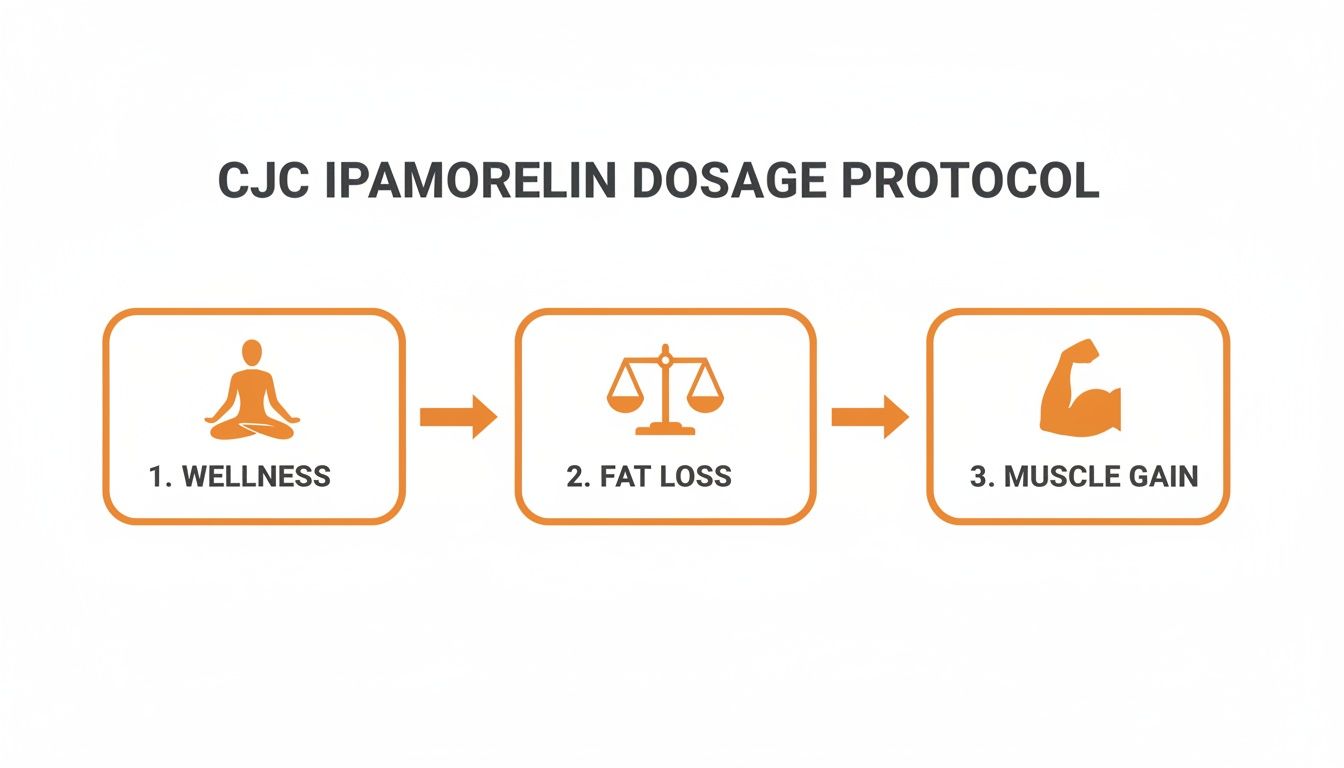
As you can see, the strategy really depends on the desired outcome, whether it's for general wellness or more targeted goals like fat loss and muscle building.
Calculating Your Precise Dose
The math for your CJC Ipamorelin dosage might seem a bit tricky at first, but it's actually quite simple once you get the hang of it. It all comes down to the relationship between the total amount of peptide in the vial and how much water you added.
Let's walk through a common example. Say you have a vial with 2mg (2000µg) of peptide and you add 2mL of bacteriostatic water. In this case, every 1mL of solution now holds 1000µg of the peptide.
On a standard U100 insulin syringe, 1mL is marked as 100 units (IU). So, in our example, each 10-unit mark (which is 0.1mL) on your syringe would deliver exactly 100µg of the peptide.
Nailing this calculation is empowering because it means you can accurately draw your prescribed dose every single time, without any guesswork.
Here's a quick reference chart to make these calculations even easier.
Sample Reconstitution Calculation Chart
| Vial Size (mg) | Bacteriostatic Water Added (mL) | Dosage per 0.1 mL (10 IU) | Dosage per 0.05 mL (5 IU) |
|---|---|---|---|
| 2 mg (2000µg) | 1 mL | 200 µg | 100 µg |
| 2 mg (2000µg) | 2 mL | 100 µg | 50 µg |
| 5 mg (5000µg) | 1 mL | 500 µg | 250 µg |
| 5 mg (5000µg) | 2.5 mL | 200 µg | 100 µg |
| 10 mg (10000µg) | 2 mL | 500 µg | 250 µg |
| 10 mg (10000µg) | 5 mL | 200 µg | 100 µg |
This table helps you quickly see how much peptide you're getting in each unit, which takes the stress out of dosing. For even more in-depth information, you can explore our detailed peptide handling guidelines.
Subcutaneous Injection Best Practices
Subcutaneous injections, which go into the fatty tissue just under the skin, are the standard way to administer peptides. It’s a technique that allows for slow, steady absorption into your system.
Common Injection Sites:
- Abdomen: This is the most common and easiest spot. Just pinch a fold of skin about two inches away from your belly button.
- Thigh: Pinch the fatty tissue on the top or outer part of your thigh.
- Glute: The upper, outer area of the buttock is another good option.
It’s really important to rotate your injection sites. Using the same spot over and over can cause irritation or a buildup of fatty tissue.
To do the injection, clean your chosen spot with an alcohol pad and let it air dry. Pinch about a one-inch fold of skin, insert the needle at a 45 to 90-degree angle, and slowly push the plunger to administer the solution. Once you withdraw the needle, make sure to dispose of it safely in a designated sharps container. This clean, consistent technique is the final piece of the puzzle to mastering your protocol.
Navigating Cycles, Potential Side Effects, and Safety

A smart peptide strategy is always a safe one. Getting your CJC Ipamorelin dosage right is just one piece of the puzzle; knowing how to use it responsibly over the long haul is what truly creates sustainable results. This means structuring your protocol in cycles, knowing what side effects to expect, and making product quality your top priority.
This balanced, safety-first approach is how you build confidence in your protocol and ensure a positive, effective experience from start to finish. Let's walk through the essentials of a well-managed and safe peptide journey.
The Importance of Cycling Your Protocol
You wouldn't train at maximum intensity every single day of the year without a break, and the same logic applies to peptide therapy. Running a protocol indefinitely isn't the best approach. Cycling is a critical concept for keeping your body responsive to the peptides and ensuring they remain effective long-term.
Think of it as a "deload week" for your pituitary gland. Taking planned breaks gives your body's receptors a chance to reset. This simple step prevents them from becoming desensitized, which could weaken the growth hormone response over time.
A standard cycle usually looks something like this:
- On-Cycle: A typical protocol runs for 12 to 16 weeks of consistent, daily administration.
- Off-Cycle: This is followed by a 4-week break where you stop administration completely.
This structure helps ensure that when you start your next cycle, your body is primed to respond just as effectively as it did at the very beginning.
Common and Mild Side Effects
One of the main reasons CJC-1295 and Ipamorelin are held in such high regard is their excellent safety profile. Most of the common side effects are mild, temporary, and often disappear as your body gets used to the protocol. Knowing what to expect helps you recognize these as normal physiological responses.
The vast majority of reported side effects are temporary and dose-dependent. They are often signs that the peptides are actively stimulating the intended pathways, rather than indicators of a problem.
Some common, mild effects you might experience include:
- Injection Site Redness: A small, localized red mark or a bit of irritation at the injection site is perfectly normal and usually fades quickly.
- Head Rush or Flushing: A feeling of warmth or a brief head rush shortly after injection is common, particularly with CJC-1295, as it can cause a temporary release of histamine.
- Increased Appetite: Since Ipamorelin mimics ghrelin (the "hunger hormone"), you might notice a slight increase in appetite, though it's much less intense than with older peptides.
- Water Retention: Some users may notice mild fluid retention, sometimes described as a feeling of fullness in their hands and feet, which typically resolves on its own.
These effects generally aren't a cause for concern and often subside within the first couple of weeks.
Safety, Contraindications, and Sourcing
While this peptide combination is well-tolerated by most healthy adults, it isn't the right choice for everyone. Responsible use means knowing the contraindications and understanding who should avoid this therapy. Anyone with a history of cancer or active tumors should not use GH-releasing peptides, as growth hormone can influence cell growth pathways.
Beyond that, the quality of your peptides is absolutely non-negotiable. Sourcing from a reputable, licensed provider like Elite Bioscience is the only way to guarantee you're getting a pure, accurately dosed, and sterile product. The unregulated market is a minefield of products that could be underdosed, contaminated, or something else entirely.
The strong safety profile of Ipamorelin, in particular, has been documented in clinical settings. A 2011 Phase 2 clinical trial involving 117 patients tracked safety up to a 14-day follow-up. It showed good tolerability even at high intravenous doses, which informs the strong safety profile we see with the much lower subcutaneous doses used in wellness protocols, where less than 2% of users report significant issues. You can learn more about Ipamorelin's safety findings by reading the details of this trial.
Your Questions Answered: Getting the Details Right
Even with the best plan laid out, questions always pop up when you're starting something new. That's a good thing—it means you're taking this seriously. This section is here to tackle the most common questions we hear about CJC Ipamorelin dosing.
Think of this as your go-to guide for those "what if" moments. We’ll give you quick, clear answers so you can spend less time second-guessing and more time focused on your goals.
What Is The Best Time of Day to Administer CJC Ipamorelin?
Timing is everything with this protocol. You want to work with your body's natural growth hormone (GH) rhythms to amplify what it's already doing, not fight against them.
There are two optimal windows for administration:
- In the morning: At least 30-60 minutes before you eat anything. Injecting in a fasted state takes advantage of low blood sugar, allowing for a much stronger GH release to kickstart your day.
- At night: Right before you go to sleep. This is often considered the powerhouse timing. Your body releases its largest natural GH pulse during deep sleep, and an evening dose acts as a powerful amplifier for this peak, maximizing recovery and repair while you rest.
Administering on an empty stomach is critical. The insulin your body releases after eating carbs or fats will blunt the GH pulse you're trying to create, significantly reducing the effectiveness of your dose.
How Long Until I See Results from My Protocol?
Results with CJC Ipamorelin show up in stages, and everyone's timeline is a little different. This is a marathon, not a sprint. The real keys to success are patience and consistency, as the benefits build on each other week after week.
Most people first notice the non-physical benefits, like deeper, more restful sleep or faster recovery after workouts. These usually appear within the first 1-2 weeks and are a great sign that the protocol is working.
More visible changes, like better skin quality, improved muscle tone, and a subtle drop in body fat, often start to become apparent between weeks 4 and 8.
The most significant and noticeable shifts in body composition—like real gains in lean muscle and more obvious fat loss—typically emerge after 3 or more months of consistent use. Long-term dedication is what truly unlocks the most profound results.
Can I Combine CJC Ipamorelin With Other Peptides or TRT?
Yes, stacking CJC Ipamorelin with other compounds is a common practice, but it's an advanced strategy that needs to be approached carefully, preferably with professional guidance. Combining therapies can create a powerful synergistic effect, but it also adds layers of complexity to your protocol.
It pairs exceptionally well with Testosterone Replacement Therapy (TRT). The two work on different but complementary pathways to boost energy, build muscle, and shed fat. TRT handles the androgenic side of things, while CJC Ipamorelin optimizes the GH axis.
Another popular stack includes BPC-157, a peptide famous for its incredible injury repair and systemic healing benefits. Combining these can be a game-changer for athletes or anyone dealing with nagging injuries.
Just remember, adding more variables makes it harder to tell what's working and what isn't. It's always a good idea to master a foundational protocol like CJC Ipamorelin on its own before you start adding other elements into the mix.
What Should I Do If I Miss An Injection?
Don't sweat it. Missing a single dose is not a big deal, so there's no need to panic. Life gets in the way, and perfect adherence isn't always realistic. The goal is long-term consistency, not flawless execution every single day.
If you miss an injection, just get back on track with your next scheduled dose.
Do not "double up" to make up for the missed one. Taking a double dose won't provide much extra benefit, but it will increase your risk of side effects like a head rush, flushing, or a nasty headache.
One missed dose won't derail your progress. The cumulative effect of the protocol over weeks and months is what drives results. Just get right back on your schedule, and you'll stay on the path to your goals.
Will CJC Ipamorelin Affect My Natural Hormone Production?
This is an excellent and important question. Unlike injectable synthetic HGH, which can shut down your body's own production, the CJC Ipamorelin stack works by stimulating your own pituitary gland. It enhances your body's innate ability to produce and release growth hormone.
Because it works with your body's natural feedback loops, the risk of suppressing your own GH production is much, much lower. This is precisely why cycling—taking planned breaks from the protocol—is a recommended best practice. These breaks give your system time to reset, ensuring your pituitary gland stays sensitive and responsive for the long haul.
At Elite Bioscience, we're committed to providing you with the highest-purity peptides and the expert guidance you need to safely achieve your health and wellness goals. Our products are rigorously third-party tested to ensure you receive a pure, accurately dosed, and effective product every single time.
Ready to take the next step in optimizing your health? Explore our premium peptide therapies today at https://elitebioscience.co.