


The difference between testosterone and steroids often gets blurry, but it boils down to two things: medical purpose and dosage.
While testosterone itself is a natural steroid hormone, the way it’s used in Testosterone Replacement Therapy (TRT) is worlds apart from how anabolic steroids are abused for performance. One is a medical treatment; the other is a high-stakes gamble.
Understanding The Key Differences

People throw these terms around interchangeably, but that confusion can be dangerous. This isn't just about semantics; it’s about health, safety, and legality. One path involves a doctor’s supervision to fix a diagnosed deficiency. The other involves self-administering powerful synthetic drugs with zero clinical guidance.
Technically, testosterone is a steroid hormone your body makes. But TRT is fundamentally different from using illicit anabolic steroids, and the main reason is the dose. Research shows that anabolic steroids are often taken in amounts that are 10 to 100 times higher than what the body produces or what a doctor would prescribe for therapy.
One study even found that a 600mg weekly dose of testosterone—three to six times a typical TRT amount—led to significant muscle gains without any exercise at all. You can get a better sense of how medical doses compare by reading the full research on testosterone and steroids on hims.com.
To make these critical distinctions crystal clear, let’s break it down side-by-side.
Quick Look: Testosterone Therapy vs. Anabolic Steroids
This table gives you a snapshot of the core differences between a legitimate medical treatment and illicit performance enhancement.
| Aspect | Testosterone Replacement Therapy (TRT) | Anabolic Steroids (Performance Use) |
|---|---|---|
| Primary Goal | Restore normal physiological hormone levels for medical reasons. | Achieve supraphysiological muscle growth and strength. |
| Dosage | Clinically determined doses to mimic natural production. | Extremely high doses, often stacked with other compounds. |
| Supervision | Prescribed and monitored by a licensed medical professional. | Typically used without medical guidance or supervision. |
| Legality | Legal with a valid prescription for a medical condition. | Illegal to possess or distribute without a prescription. |
| Source | Sourced from a licensed pharmacy with quality controls. | Often acquired from unregulated, black-market sources. |
As you can see, these two paths could not be more different. One is about restoring balance, while the other is about pushing the body to its absolute limits, often with serious consequences.
The most common form used in therapy is Testosterone Cypionate, a bioidentical hormone designed to replicate what your body naturally produces. If you're curious, you can learn more about the specifics of what is Testosterone Cypionate in our detailed guide. Understanding these compounds helps highlight the enormous gap between controlled medical treatment and illicit abuse.
The core takeaway is this: TRT is about restoring health and hormonal balance under medical care. Illicit steroid use is about pushing the body far beyond its natural limits, inviting serious health risks for the sake of performance.
The Biological and Chemical Divide
To really get the difference between medical testosterone and anabolic steroids, you have to look at their chemistry and how they behave inside your body. At its core, testosterone is the main male sex hormone, a natural steroid hormone that your body uses to run everything from muscle mass and bone density to sex drive and mood. It’s the original blueprint.
When a doctor prescribes Testosterone Replacement Therapy (TRT), the goal is to use a bioidentical hormone. This means the molecule is a perfect chemical match to the testosterone your body makes naturally. It fits into your body’s androgen receptors like a key in a lock, restoring normal function. This is a precise, medically guided approach designed for balance, not for overwhelming force.
The Synthetic Alteration of Anabolic Steroids
Anabolic-androgenic steroids (AAS), on the other hand, are synthetic versions of testosterone. Scientists deliberately tinker with the original testosterone molecule to crank up its anabolic (muscle-building) properties, sometimes while trying to dial down its androgenic (masculinizing) side effects. This chemical modification creates compounds that the body doesn’t recognize.
These changes can make the steroid far more potent or allow it to hang around in your bloodstream longer, sending unnaturally powerful and prolonged signals for muscle growth. But it’s this modified structure that also leads to a much wider and more severe range of side effects, as the body struggles to deal with these foreign substances.
The image below illustrates the concept of natural versus synthetic compounds at a molecular level. Medical testosterone therapies aim to replicate the natural hormone your body already knows.

Synthetic steroids are created by altering this foundational structure, often by adding or changing chemical groups to amplify certain effects far beyond what's natural.
A Tale of Two Engines: Restoring vs. Redlining
Maybe the easiest way to see the biological difference is with an analogy.
Think of your body as a high-performance car engine. TRT is like a skilled mechanic carefully topping off the engine oil to the exact level the manufacturer recommends. This keeps the engine running smoothly, efficiently, and for its full intended lifespan.
Abusing anabolic steroids, in contrast, is like force-feeding the engine a high-octane, unapproved fuel additive while overfilling the oil way past the max line. The goal is to redline the engine for a short blast of extreme performance, but this incredible strain will inevitably lead to overheating, blown gaskets, and total engine failure.
This comparison gets right to the heart of the difference in both intent and outcome:
- Testosterone Replacement Therapy (TRT) is all about restoring your body's systems to their normal, healthy operating range under strict medical supervision.
- Anabolic Steroid Abuse is about pushing those systems far beyond their natural limits, sacrificing long-term health for short-term, superhuman gains.
This deep biological and chemical divide explains why one is a respected medical treatment and the other is a dangerous gamble. TRT works with your body’s natural design. Steroid abuse tries to aggressively override it.
Comparing Purpose: Medical Treatment vs. Performance Enhancement
The line between medical testosterone and anabolic steroids is drawn by one simple thing: intent. One is a precise medical tool used to bring a man’s health back into balance. The other is an unregulated gamble to push the human body far past its natural design. This core difference in purpose dictates everything, from the dosage and supervision to the final impact on a person's life.
Testosterone Replacement Therapy (TRT) is strictly a medical treatment. A doctor will only prescribe it after blood tests confirm a diagnosis of hypogonadism—clinically low testosterone. The goal here is simple and clear: return a patient’s hormone levels to a normal, healthy range.
This isn't about building a superhuman. It’s about giving a man his life back. Men with low testosterone often wrestle with crippling fatigue, brain fog, depression, a nonexistent libido, and a frustrating inability to maintain muscle and bone density. TRT is designed to fix these problems, restoring a person's quality of life and baseline health.
The Goal of Normalization vs. Amplification
The entire objective of TRT is normalization. A physician carefully calculates a dose that mimics what the body should be producing on its own, aiming for hormonal stability. This is a tightly controlled process, with regular blood work to ensure levels stay within a safe and effective window, preventing the exact side effects that steroid abusers often experience.
In complete contrast, the goal of anabolic steroid use is amplification. Users aren't trying to correct a deficiency; they are intentionally creating a supraphysiologic state where their androgen levels are far beyond what the body could ever produce naturally. The goal is purely about performance: explosive muscle gain, extreme strength, and enhanced athletic ability.
The core difference is simple: Medical testosterone therapy is about restoring what is lost to bring you back to your healthy self. Anabolic steroid abuse is about adding what was never there to push you beyond your natural limits, often at a great cost.
This chase for extreme results leads to dangerous habits that have no place in medicine. Anabolic steroid users often rely on "stacking" and "cycling" to force maximum gains.
- Stacking means taking multiple types of anabolic steroids at once, often mixing oral and injectable forms, with the belief that they’ll create a more powerful muscle-building effect.
- Cycling refers to taking steroids for a set period, like 6-12 weeks, and then stopping for a while. This is an attempt to reduce side effects and "reset" the body, but it causes wild hormonal swings.
Unsupervised Risks and Dangerous Protocols
These protocols are pieced together from locker room talk and anonymous online forums, completely outside of any medical supervision. Dosages can be 10 to 100 times higher than anything a doctor would prescribe for TRT. It’s this massive hormonal overload that drives the extreme muscle growth but also triggers the severe, and often permanent, side effects.
While TRT helps men feel healthy and revitalized, steroid abuse is a high-stakes bet with your long-term health. The difference in purpose—restoring normalcy versus forcing extreme enhancement—is the bright red line between legitimate medicine and dangerous self-experimentation. For those considering medical options, understanding how to approach this journey safely is key. For a deeper look, check out our guide on building muscle with testosterone injections under proper medical guidance.
Health Risks: A Tale of Two Realities
When you start digging into the difference between testosterone and steroids, the conversation always lands on health risks. This is where the two paths don't just diverge—they lead to entirely different destinations.
One path involves a medically supervised therapy designed to restore health, where side effects are anticipated, monitored, and managed by a doctor. The other is a high-stakes gamble with your body, chasing extreme results with unregulated substances and zero medical oversight. The consequences can be severe and, in many cases, irreversible.
With Testosterone Replacement Therapy (TRT), safety is the entire point. While no medical treatment comes with zero risk, the potential side effects are well-documented and typically manageable. A responsible doctor is constantly monitoring your health to make sure the benefits far outweigh any potential downsides.
On the flip side, anabolic steroid abuse happens in a wild-west environment. The doses are often sky-high, the quality of the substances is a total mystery, and the lack of medical supervision creates a perfect storm for catastrophic health problems, both now and down the road.
Risks Associated with Medical TRT
Under a doctor's care, the side effects of prescribed testosterone are usually mild and easily handled by tweaking the dose or protocol. Your healthcare provider is actively looking for these changes through regular blood work and check-ins, which keeps the entire process safe and controlled.
Common, manageable side effects might include:
- Minor Injection Site Reactions: A little redness, swelling, or soreness where you inject is pretty common and almost always temporary.
- Changes in Blood Composition: TRT can raise your red blood cell count (hematocrit). This is closely monitored to ensure your blood doesn't get too thick.
- Skin Changes: Some guys might see a bit of acne or oily skin, much like what they experienced during puberty.
- Fluid Retention: A slight increase in water weight is possible but is usually minor and easily managed.
It's crucial to remember these are potential side effects, not guaranteed outcomes. For a complete picture, you can learn more about the potential side effects of testosterone therapy in our detailed guide and see how medical supervision is key to managing them.
This infographic does a great job of visualizing the core difference between restoring your health with TRT and forcing muscle growth with steroids.
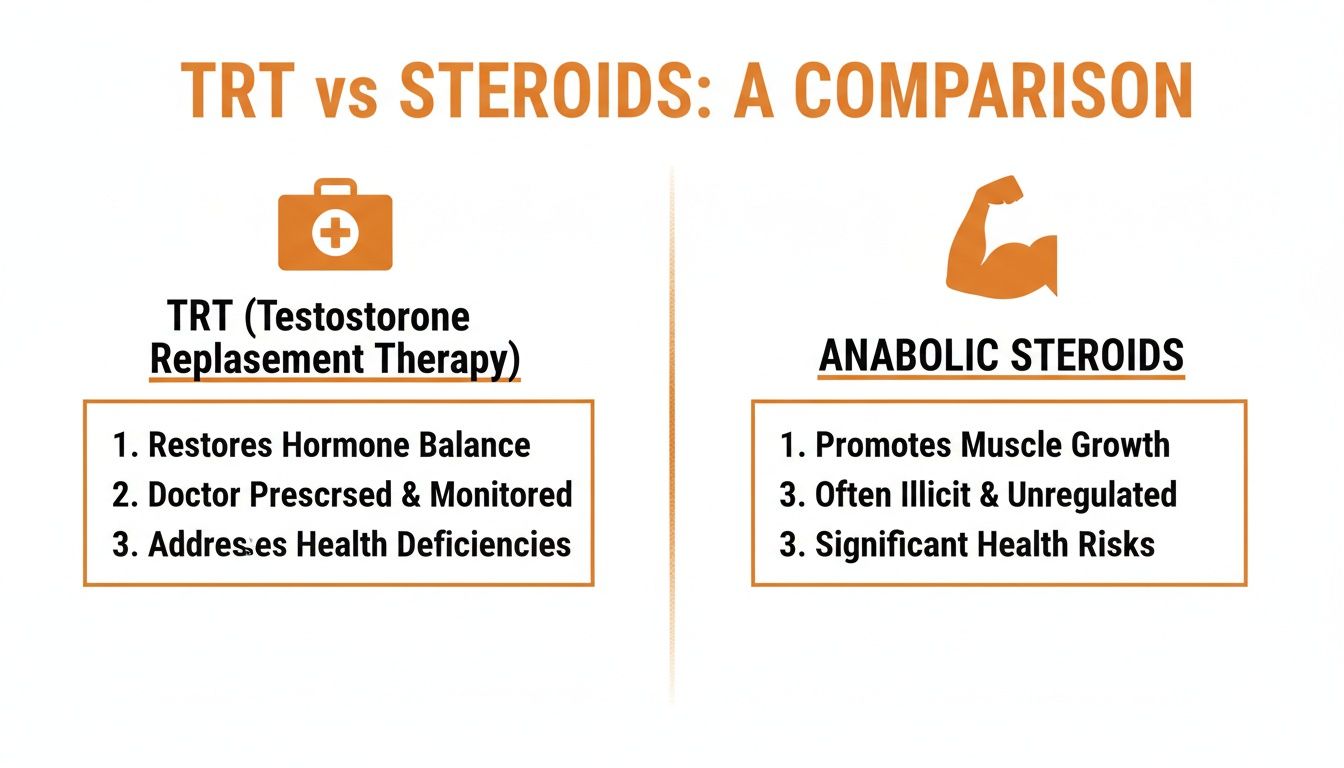
As you can see, one is a medical treatment aimed at restoring normal function. The other is a non-medical pursuit of extreme performance that opens the door to severe health consequences.
The Severe Consequences of Steroid Abuse
The health risks tied to anabolic steroid abuse aren't just more common—they're in a completely different league of severity. Pushing supraphysiological doses of synthetic hormones puts an immense strain on nearly every system in your body.
This leads to a whole host of dangerous and often permanent conditions. The research is clear and consistent. Users face a high risk of liver damage, heart attack, stroke, testicular shrinkage, and gynecomastia (enlargement of male breast tissue).
The psychological damage is just as devastating. While properly managed TRT often improves mood and mental clarity, steroid abuse is linked to extreme aggression and mood swings known as "'roid rage," paranoia, and crippling depression, especially when cycling off.
The most significant difference is this: TRT risks are monitored and managed by a doctor to preserve your health. Steroid abuse risks are ignored and compounded in the pursuit of physical enhancement, often leading to irreversible damage.
Health Risk Profile: TRT vs Anabolic Steroid Abuse
The gap between the two becomes crystal clear when you compare the risks side-by-side. Medically supervised TRT is designed to keep you within safe, physiological ranges, while steroid abuse throws all caution to the wind.
This table breaks down the dramatic difference in safety, highlighting how one approach prioritizes health while the other sacrifices it.
| Health Risk | Medically Supervised TRT (Risk Level) | Anabolic Steroid Abuse (Risk Level) |
|---|---|---|
| Cardiovascular Damage | Low (Monitored for changes in cholesterol and blood pressure) | High to Severe (Increased risk of heart attacks, strokes, and heart failure) |
| Liver Toxicity | Very Low (Especially with injectable bioidentical testosterone) | High (Oral steroids are particularly damaging to the liver) |
| Hormonal Shutdown | Managed (Natural production is suppressed, but therapy is managed by a doctor) | Severe & Often Permanent (Complete shutdown of natural hormone production) |
| Infertility | Possible (Can be managed with adjunctive therapies like HCG) | High & Often Permanent (Drastic reduction in sperm count and testicular atrophy) |
| Psychological Effects | Low (Often improves mood and cognitive function) | High to Severe ('Roid rage,' depression, anxiety, psychosis) |
| Gynecomastia | Low (Managed with estrogen blockers if needed) | High (Common due to massive hormonal imbalances) |
Looking at this comparison, the takeaway is undeniable. TRT, when prescribed and monitored by a qualified medical professional, is a safe and effective therapy. Anabolic steroid abuse, however, is a dangerous path with a high probability of causing long-term, serious harm to your body and mind.
Long-Term Impact on Your Body's Natural Hormones
One of the most critical differences between testosterone therapy and steroid abuse is the lasting impact on your body's ability to produce its own hormones. Your endocrine system is a finely tuned feedback loop, and introducing hormones from an outside source always has consequences. But the severity—and permanence—of those consequences couldn't be more different.
Any time you introduce an external androgen like testosterone, your body’s own production line slows down or shuts off completely. This is a normal, predictable response managed by the Hypothalamic-Pituitary-Gonadal (HPG) axis, the command center for your body’s hormone regulation. Your brain senses that testosterone levels are high enough and simply tells the testes to stop working.
How TRT Manages Hormonal Suppression
In a medically supervised TRT program, this shutdown isn't a problem to be solved; it's an expected and managed part of the treatment. The entire point of TRT is not to add to your natural production, but to replace it with a stable, consistent dose that brings you back to a healthy baseline.
A doctor navigates this by:
- Maintaining Physiological Levels: Doses are carefully calculated to keep your testosterone within a healthy, normal range—not to blast it into superhuman territory. This avoids the hormonal chaos that comes with supraphysiological levels.
- Creating a Long-Term Strategy: TRT is understood from the start to be a long-term commitment. The treatment plan is built around the fact that natural production will cease, providing a steady external supply to maintain your health.
- Constant Monitoring and Adjustment: Regular blood work is non-negotiable. It ensures your hormone levels, including estrogen and other key markers, stay balanced and prevents negative side effects.
This approach works with your body's feedback system, accepting the shutdown and replacing what’s lost in a controlled, sustainable way. It's a strategy designed for long-term health when your body can no longer handle the job on its own.
The Destructive Force of Anabolic Steroid Abuse
Anabolic steroid abuse, on the other hand, takes a sledgehammer to this delicate system. The ridiculously high doses of synthetic androgens completely overwhelm the HPG axis, triggering a severe and often permanent shutdown. The body is so flooded with powerful hormonal signals that it slams the brakes on all natural production—and sometimes, the machinery breaks for good.
This is where the real danger lies. While on a cycle, the user might feel invincible. But the moment they stop, they discover their natural production is completely offline, leading to a hormonal crash that can be devastating, both physically and mentally.
The core difference is this: TRT is a controlled replacement for a failing system, managed for long-term stability. Steroid abuse aggressively breaks the system, often leaving it permanently damaged and unable to restart.
Many former steroid users face a grim reality years later. Research consistently shows long-term suppression of natural testosterone, with a shocking number of men never returning to normal levels. One key clinical study found that former anabolic steroid abusers had significantly lower total and free testosterone levels than non-users. In fact, 27.2% of former abusers had testosterone levels below the normal range, a condition not seen in any of the men who hadn't used steroids. You can dive into the full findings on long-term hormonal effects of steroid use on pmc.ncbi.nlm.nih.gov.
Even with so-called "Post-Cycle Therapy" (PCT)—using other drugs to try and jumpstart natural production—the results are often disappointing. The damage from prolonged, high-dose cycles can be too much for the HPG axis to ever fully recover, leaving many former users with a lifelong dependency on TRT—not because of an underlying medical condition, but as a direct consequence of their past steroid abuse.
Answering Your Biggest Questions About Testosterone and Steroids
When you're trying to separate medical facts from gym-floor myths, a lot of questions come up. The confusion is understandable, especially when the lines between testosterone and steroids get blurred in online forums and fitness articles.
Let's clear the air and tackle the most common questions head-on. Getting these answers right is crucial for anyone considering treatment or just trying to understand the real health implications.
Is TRT Just a Low-Dose Steroid Cycle?
This is easily the biggest misconception out there, and the answer is a hard no. While testosterone is technically a steroid hormone, comparing Testosterone Replacement Therapy (TRT) to a steroid cycle is like comparing a prescribed painkiller for an injury to a recreational drug habit. The substance might be related, but the goal, dose, and outcome are worlds apart.
The entire difference comes down to one word: intent.
TRT is a medical treatment focused on normalization. Its only job is to take a man’s testosterone from a deficient, unhealthy level and bring it back into a normal, healthy range. A doctor uses precise, clinical doses to fix the symptoms of hypogonadism and restore balance—not to create a superhuman.
A steroid cycle, on the other hand, is all about amplification. The user intentionally takes supraphysiological doses—often 10 to 100 times higher than a medical dose—to force the body far beyond its natural capacity for muscle growth and strength.
At its core, TRT is about restoring you to your natural, healthy baseline. A steroid cycle is about creating a temporary, unnatural state at the cost of your long-term health and hormonal balance. They are fundamentally different things.
Is Using Testosterone Always Legal?
The legality of testosterone all boils down to a single piece of paper: a valid medical prescription. In the United States, testosterone is classified as a Schedule III controlled substance, meaning its use and distribution are tightly regulated by federal law because of its potential for abuse.
It is 100% legal to use testosterone when a licensed doctor diagnoses you with a medical condition like hypogonadism and writes you a prescription. The medication you receive comes from a regulated pharmacy, so you know its purity and dosage are accurate and safe.
However, possessing or using testosterone without that prescription is a federal crime. This includes buying it from an unregulated website, a guy at the gym, or any other black-market source. The legal risks are serious, but the health risks are even bigger—illicit products are notorious for being contaminated, dosed incorrectly, or containing completely different substances. The only safe and legal path is through a doctor.
Can a Former Steroid User Get TRT?
Yes, absolutely. A history of anabolic steroid use doesn't disqualify someone from getting TRT—in fact, it’s often the very reason they need it. Long-term steroid abuse can permanently shut down the body's natural ability to produce testosterone, a condition called steroid-induced hypogonadism.
For a doctor to prescribe TRT in this situation, the process has to be built on complete honesty. A physician will need to run thorough blood work to confirm that testosterone levels are clinically low and haven't bounced back on their own.
It's critical for the patient to be upfront about their past steroid use. This isn't about judgment; it's about context. That history helps the doctor make the right diagnosis and create a safe treatment plan. Hiding it only increases the risk of misdiagnosis and getting the wrong care. A history of abuse doesn't bar you from legitimate medical help; it just makes it even more important to work with a knowledgeable provider who can help you safely manage the long-term consequences.
At Elite Bioscience, we provide a secure and confidential path to medically supervised hormone therapies. If you are experiencing symptoms of low testosterone and want to explore your options with a team of experts, we are here to help. Our streamlined telehealth platform connects you with licensed physicians who can guide you through diagnosis and treatment, with all products delivered discreetly to your door. Take control of your health journey by visiting https://elitebioscience.co to learn more.