



Choosing the right needles for your testosterone injections really comes down to two things: where the shot is going (the injection method) and the thickness of the testosterone oil itself. As a rule of thumb, intramuscular (IM) injections call for a 22-25 gauge, 1 to 1.5-inch needle, while subcutaneous (SubQ) injections use a much smaller 27-30 gauge, 0.5 to 5/8-inch needle. Getting this match right is the key to a safe and effective injection every single time.
A Practical Guide to Testosterone Needle Selection
Starting Testosterone Replacement Therapy (TRT) is a big step, and while it's empowering, the nuts and bolts—like picking out the right gear—can feel a little overwhelming at first. The world of needles, gauges, and lengths might seem technical, but it doesn't have to be confusing. This guide is here to clear things up and give you the confidence to manage your therapy like a pro.
Think of it this way: you wouldn't use a sledgehammer to hang a picture frame. In the same way, the needle you use has to be perfectly suited for its final destination, whether that’s deep inside a muscle or just below the skin. Your choice has a direct impact on your comfort, your safety, and how well the medication works.
Why the Right Needle Matters
Picking the correct needle is more than just a tiny detail; it's fundamental to making your TRT protocol work. If you use a needle that’s too short for an intramuscular shot, you might end up delivering the testosterone into the fat layer by mistake, which can completely change how your body absorbs it. On the flip side, using a needle that's too long for a subcutaneous injection can cause unnecessary pain and bruising.
This is especially critical because intramuscular injections are still the gold standard in the TRT world. In the fast-growing field of testosterone therapy, IM injections hold a commanding 56.0% share of the market, thanks to their reliable results and affordability. This just goes to show why needles designed for deep muscle delivery are so essential for most guys managing low testosterone. You can dive deeper into the data on the TRT market and its trends on Mordor Intelligence.
The goal is simple: deliver the full dose of medication to the intended location with minimal discomfort and maximum safety. Understanding your options is the first step toward achieving this.
This guide will break down the two main types of needles you’ll encounter for testosterone injections, helping you and your doctor make the best choice for your protocol. We'll cover:
- Intramuscular (IM) Needles: The traditional choice for delivering testosterone deep into large muscles like the glutes or deltoids.
- Subcutaneous (SubQ) Needles: A modern, less invasive option that delivers testosterone into the fatty tissue just under the skin.
By getting a handle on these core differences, you can navigate your TRT journey with total confidence.
To make things even easier, here's a quick cheat sheet you can reference.
Testosterone Needle Selection Cheat Sheet
This table gives you a quick summary to help you choose the right needle based on your injection type and body composition.
| Injection Type | Common Needle Gauge | Common Needle Length | Best For |
|---|---|---|---|
| Intramuscular (IM) | 22g – 25g | 1" – 1.5" | Delivering testosterone deep into large muscles like the glutes, deltoids, or quads. Ideal for most TRT protocols. |
| Subcutaneous (SubQ) | 27g – 30g | 1/2" – 5/8" | Delivering smaller, more frequent doses into the fatty tissue of the abdomen or thigh. A great option for comfort. |
| Drawing Needle | 18g – 21g | 1" – 1.5" | Quickly drawing thick testosterone oil from the vial without dulling the injection needle. Never use for injecting. |
Remember, this chart is a starting point. Always follow the specific guidance provided by your healthcare provider, as they will tailor their recommendation to your body and treatment plan.
Decoding Needle Gauge and Length
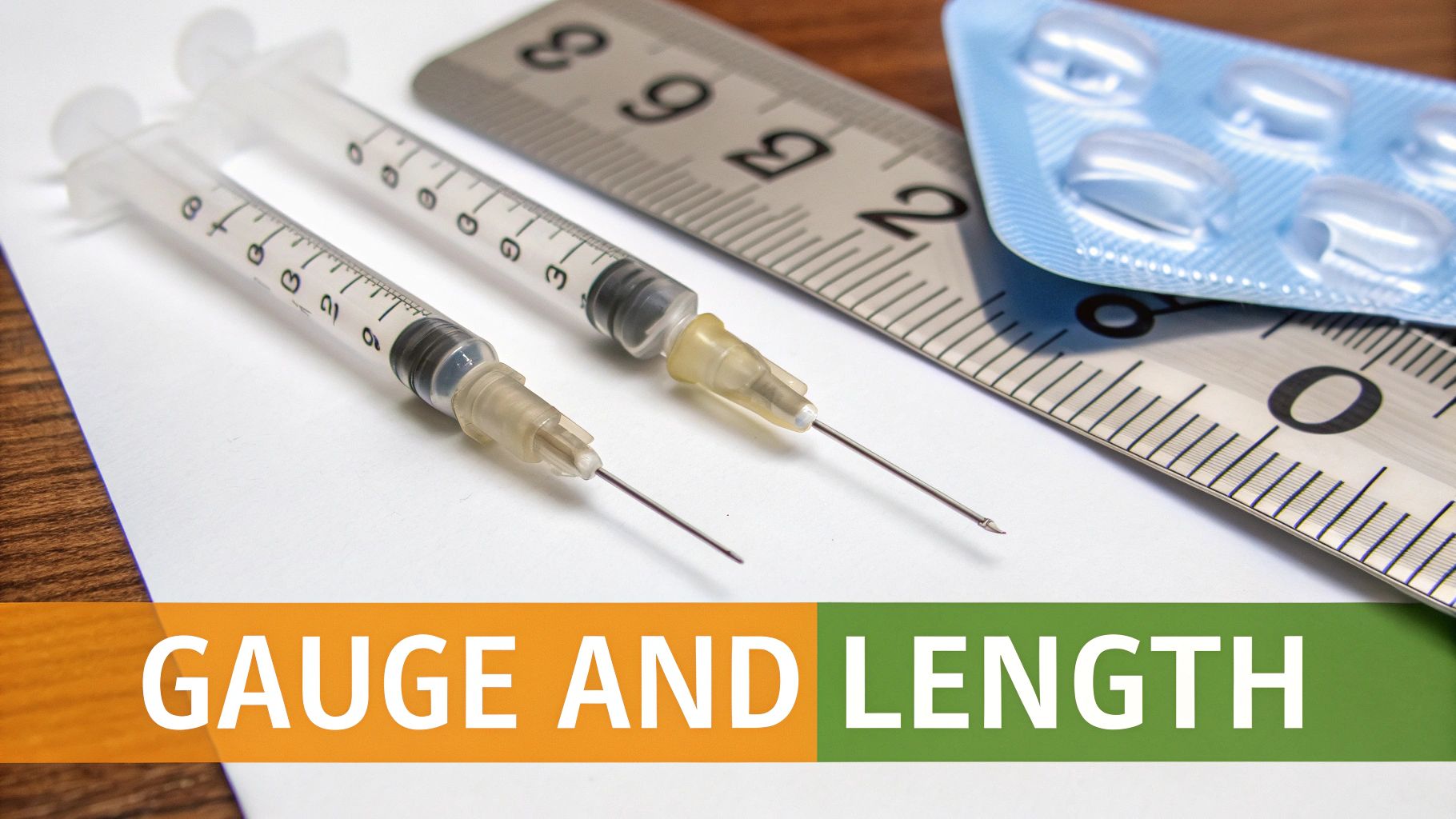
When you first look at a pack of needles, the numbers can feel like a foreign language. But once you understand two simple terms—gauge and length—you'll be fluent. Getting these right is the difference between a smooth, comfortable injection and a frustrating one.
Think of needle gauge like the diameter of a garden hose, but with a twist. It’s a bit counterintuitive: the smaller the gauge number, the wider the needle. It's an old measurement system where the number relates to how many needles can fit side-by-side in a small area.
This means a low-gauge needle, like an 18G or 21G, has a very wide opening. That makes it perfect for quickly drawing a thick, oil-based solution like testosterone cypionate out of the vial. On the flip side, a high-gauge needle, such as a 27G, is much thinner, creating a smaller puncture and a far more comfortable injection.
Understanding Needle Gauge in Practice
The gauge you pick directly impacts both the speed of your prep and your comfort level. Using a wide, low-gauge needle to inject can be needlessly painful and cause more tissue trauma. But trying to draw thick testosterone oil with a thin, high-gauge needle can feel like sucking a milkshake through a coffee stirrer—it’s painfully slow and frustrating.
This is exactly why so many guys on TRT adopt the two-needle method.
- Drawing Needle (Low Gauge): First, you use a wide 18G or 21G needle. Its large bore lets you fill the syringe from the vial quickly and without a struggle.
- Injecting Needle (High Gauge): After drawing the testosterone, you carefully swap that wide needle for a fresh, thinner one—like a 23G, 25G, or 27G—for the actual injection.
This technique ensures the injection needle stays perfectly sharp and sterile, since its tip never has to puncture the tough rubber stopper of the vial. A sharper needle means less resistance and a much smoother entry into the skin.
Finding the Perfect Needle Length
While gauge is all about thickness, needle length is about reaching the right destination. The length you need is determined entirely by your injection method—either deep into the muscle (intramuscular) or into the fatty layer just beneath the skin (subcutaneous).
For intramuscular (IM) injections, the goal is to deposit the testosterone deep inside a large muscle, like your glute or deltoid. This requires a longer needle to get past the skin and subcutaneous fat.
- Common IM Lengths: 1 inch to 1.5 inches are the standard. Guys with lower body fat might find a 1-inch needle is plenty, while those with more adipose tissue may need a 1.5-inch needle to ensure the dose gets deep into the muscle where it belongs.
For subcutaneous (SubQ) injections, the target is the layer of fatty tissue, which is much closer to the surface. This method allows for a much shorter and less intimidating needle.
- Common SubQ Lengths: 1/2 inch to 5/8 inch are the most common choices. These short needles are designed to deliver the testosterone precisely into the fat layer without ever hitting the muscle underneath.
The ability to self-administer with less pain is a major reason SubQ injections are becoming so popular, especially with the growth of telehealth. In fact, the global market for syringes and needles hit $5.1 billion in 2023, with a huge amount of that demand driven by hormone therapies. Needles commonly used for SubQ testosterone, like a 25-27 gauge needle at 5/8-inch length, are perfectly suited for easy and comfortable self-administration—a critical feature for modern TRT. For more on this, you can explore the market trends shaping hormone therapy on idataresearch.com.
Intramacular vs. Subcutaneous Injections
When it comes to taking your testosterone, you’ve got two main routes: the traditional path deep into a large muscle, known as an Intramuscular (IM) injection, or a more modern approach into the fatty layer right under the skin, called a Subcutaneous (SubQ) injection.
Think of them as two different highways to the same destination. Both get the job done effectively, but the journey—the procedure, the tools, and how it feels—is totally different. This choice isn't just about what you prefer; it can affect your comfort, how often you inject, and even the way your body uses the testosterone. Knowing the pros and cons of each helps you have a smarter conversation with your doctor about what’s best for your body and lifestyle.
The Intramuscular Route: A Time-Tested Method
For decades, intramuscular injections have been the go-to method for testosterone replacement therapy. This technique uses a longer needle, usually 1 to 1.5 inches, to deliver the testosterone deep into a big, dense muscle like the glute, thigh, or shoulder.
Why go so deep? Large muscles are packed with blood vessels, which means the testosterone gets absorbed into your bloodstream quickly. This has always been the standard for administering testosterone cypionate or enanthate, typically on a weekly or bi-weekly schedule.
But this old-school method has a few trade-offs:
- Potential for Discomfort: Let's be honest, a longer needle going through more tissue can be more painful for some guys.
- Risk of Scar Tissue: Sticking the same muscle over and over can lead to a buildup of tough scar tissue, which might make future injections harder and absorption less reliable.
- Post-Injection Soreness: It’s pretty common to feel sore or achy in the muscle for a day or two afterward, kind of like you just had a tough workout.
Even with these points, IM is still a highly effective and reliable method trusted by millions of men. The technique is straightforward, and it has a long history of clinical success.
The Subcutaneous Path: A Modern Alternative
Subcutaneous injections are a newer approach that's quickly becoming popular because they're so much more comfortable and convenient. Instead of aiming for a deep muscle, this method uses a much smaller and thinner needle—often just 1/2 to 5/8 of an inch long—to deliver testosterone into the fatty layer of tissue, usually in the belly or thigh.
Picture the testosterone oil forming a small pocket in that fatty tissue. From there, it gets absorbed into the bloodstream more slowly and steadily than with an IM shot. This slower, more consistent release can lead to more stable hormone levels all week long, helping to smooth out the "peaks and valleys" some men feel with less frequent IM injections. For more on this, explore our guide on how to inject testosterone subcutaneously.
SubQ injections are a game-changer when it comes to comfort. The short, thin needles are way less intimidating and cause very little pain, making it much easier for many people to handle their own injections.
This method often involves splitting your weekly dose into two or more smaller, more frequent shots (like every 3.5 days). It means more pokes, but each one is significantly less invasive.
Comparing IM and SubQ Testosterone Injections
To really see the differences side-by-side, let’s break down how the two injection methods stack up against each other.
| Feature | Intramuscular (IM) Injection | Subcutaneous (SubQ) Injection |
|---|---|---|
| Injection Site | Deep into large muscles (glutes, thighs, deltoids) | Into the fatty layer just under the skin (abdomen, thighs) |
| Needle Size | Longer and thicker (e.g., 23-25g, 1" – 1.5") | Shorter and thinner (e.g., 27-30g, 1/2" – 5/8") |
| Pain Level | Moderate; can cause muscle soreness | Minimal; often described as a slight pinch |
| Absorption Rate | Faster absorption from vascular muscle tissue | Slower, more gradual absorption from fatty tissue |
| Dosing Frequency | Typically once every 7-14 days | Often smaller doses 2-3 times per week |
| Hormone Levels | Can create more noticeable peaks and troughs | May lead to more stable and consistent levels |
| Ease of Self-Injection | Can be more difficult due to site location and needle size | Generally easier and less intimidating to self-administer |
At the end of the day, there’s no single “best” method for everyone. The right choice comes down to your specific TRT protocol, how comfortable you are with needles, and how your body responds. An IM shot might be perfect for someone who just wants to get it done once a week, while SubQ could be a better fit for someone looking to minimize discomfort and keep their hormone levels as stable as possible.
Your Step-By-Step Guide to a Safe Injection
Picking the right needles for your testosterone injection is half the battle. The other half? Using them safely and correctly every single time. This is your practical roadmap for performing an injection with confidence. We’ll walk through each critical step, from start to finish, with clear, easy-to-follow instructions.
Mastering this routine isn't just about technique—it's about ensuring you get the full benefit of your therapy while minimizing any discomfort or risk.
Step 1: Gather and Prepare Your Supplies
Before you do anything else, set up a clean, organized workspace. Think of it as your pre-flight check. Lay out all your supplies on a disinfected surface so everything is accounted for and within easy reach.
Here’s what you'll need:
- Your vial of testosterone
- Two sterile, sealed needles (one for drawing, one for injecting)
- A sterile, sealed syringe
- Alcohol prep pads
- A sterile cotton ball or gauze pad
- An FDA-approved sharps container for disposal
Always inspect your equipment. Check the expiration dates on everything, especially the testosterone vial. If any needle or syringe package is open, torn, or damaged in any way, don't use it. Grab a new one.
Step 2: Maintain Sterile Conditions
Sterility is absolutely non-negotiable. The number one rule of safe injections is preventing infection, and that starts with clean hands.
Wash your hands thoroughly with soap and warm water for at least 20 seconds. Dry them off with a clean paper towel. This simple act is your first and best line of defense against introducing harmful bacteria into your body.
Next, take a fresh alcohol pad and vigorously scrub the rubber stopper on top of your testosterone vial. Let it air dry completely on its own—don't blow on it or wipe it. Once it's clean, do not touch it again.
Step 3: Draw the Testosterone Correctly
Drawing testosterone can be tricky since it's a thick, oil-based solution. Using the right technique here will save you a lot of frustration and help you avoid pesky air bubbles. This is where the two-needle method really proves its worth.
- Attach the Drawing Needle: Twist your wider gauge drawing needle (something like an 18G or 21G) onto the syringe.
- Inject Air Into the Vial: Pull back the plunger to draw an amount of air into the syringe that’s equal to your prescribed dose. For example, if your dose is 1 mL, draw up 1 mL of air.
- Pressurize the Vial: Push the needle through the center of the rubber stopper and inject all the air into the vial. This equalizes the pressure inside, making the thick oil much easier to pull out.
- Draw the Testosterone: With the needle still in the vial, flip it upside down. Slowly pull back the plunger to draw your precise dose into the syringe. It helps to draw slightly more than you need to account for any small air bubbles.
- Remove Air Bubbles: Gently tap the side of the syringe to make any bubbles float to the top. Carefully push the plunger to expel only the air until you see a tiny droplet of oil at the needle's tip.
- Swap the Needles: Now for the switch. Carefully remove the drawing needle and immediately dispose of it in your sharps container. Attach your fresh, sterile injection needle (e.g., a 23G or 25G for IM; a 27G for SubQ). You're now ready to inject.
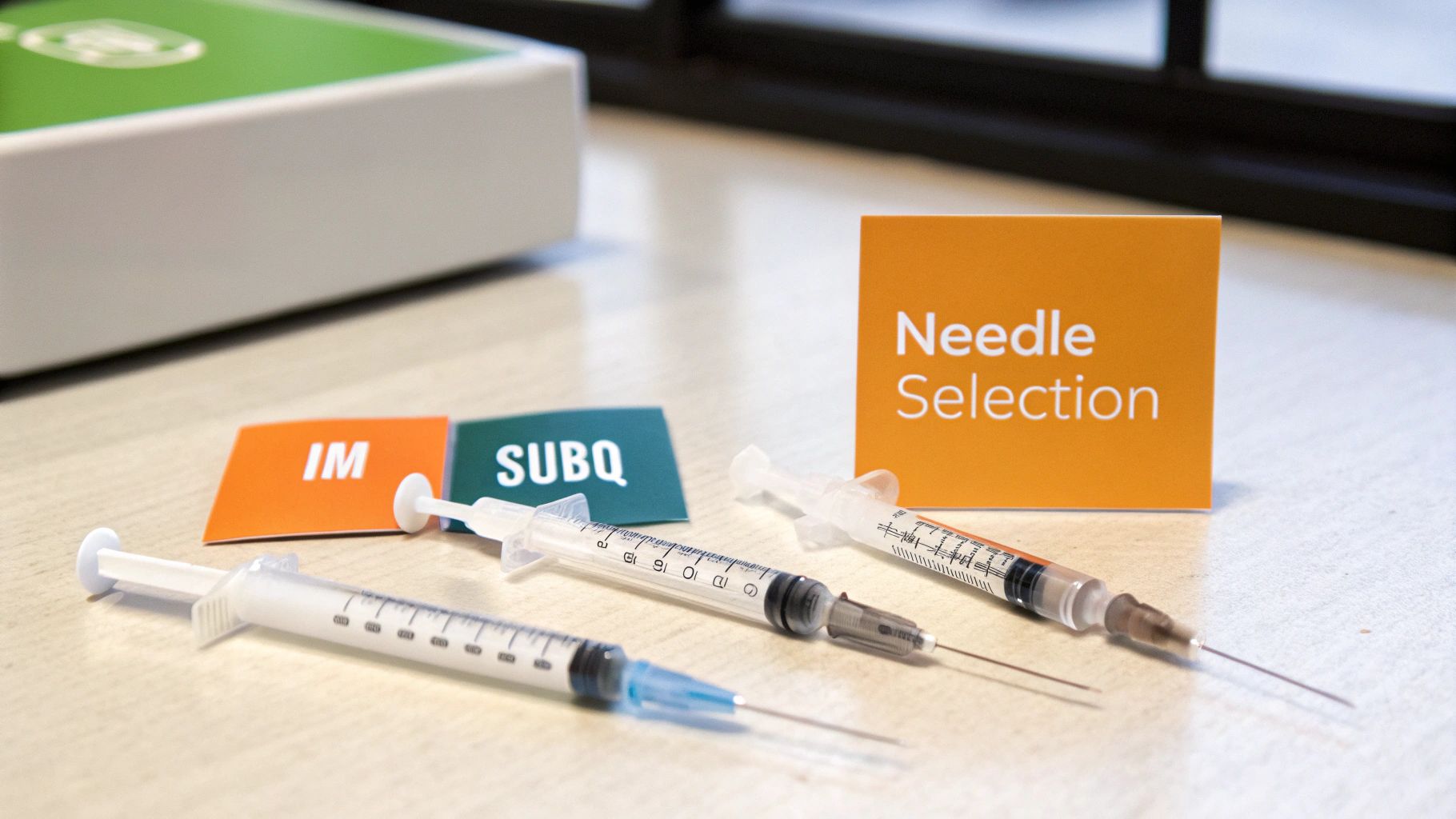
This handy visual guide breaks down the key differences between the two main injection types you'll be preparing for.
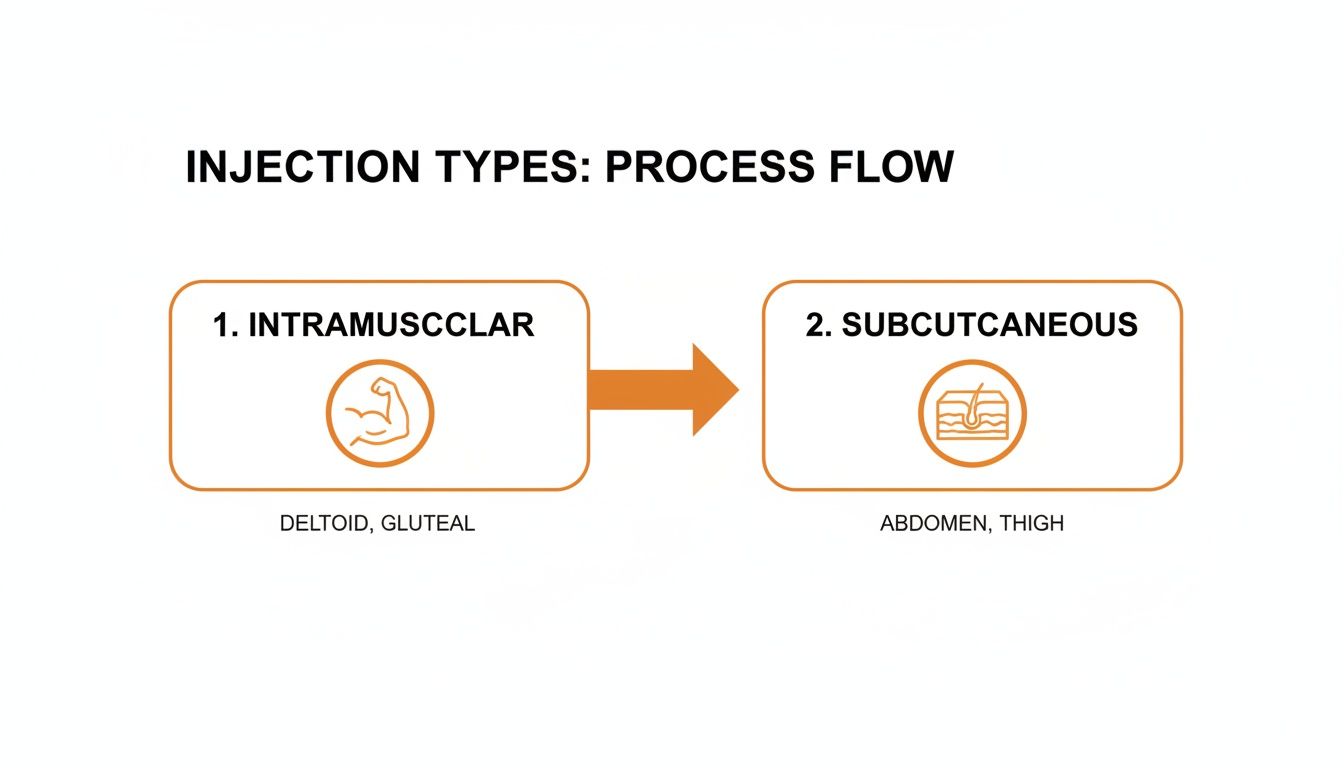
This process flow highlights that while both methods deliver testosterone effectively, the target tissue—deep muscle versus the fatty layer just under the skin—dictates the entire technique, from your needle choice to how you prepare the site.
Step 4: Prepare the Injection Site
Choosing and cleaning your injection site is the final prep step before the main event. For a complete breakdown of performing testosterone injections at home, including how to rotate sites, be sure to check out our in-depth guide.
- Select Your Site: Pick an appropriate injection spot based on your method (IM or SubQ) and your rotation schedule. Common IM sites are the glute or thigh; common SubQ sites include the abdomen or love handles.
- Clean the Area: Use a new alcohol pad to clean the skin. Start at the center of where you plan to inject and wipe in an outward spiral, covering a two-inch diameter.
- Let It Dry: Allow the alcohol to air dry completely. This gives it enough time to disinfect the skin and prevents the stinging sensation that happens if you inject while the area is still wet.
Don't blow on or fan the area to speed up drying—that just reintroduces germs. Patience is key to a clean and comfortable injection.
Step 5: Perform the Injection
With everything prepped, the injection itself is quick and straightforward. Hold the syringe like a dart at a 90-degree angle for an IM injection. For a SubQ injection, hold it at a 45 to 90-degree angle, depending on your body fat.
Insert the needle with a swift, steady motion. Push the plunger down at a controlled pace to inject the testosterone. Once the syringe is empty, pull the needle straight out at the same angle it went in.
Immediately apply gentle pressure to the site with a sterile cotton ball or gauze. A tiny bit of bleeding or even a small drop of oil leakage is perfectly normal. Hold pressure for about a minute. Do not rub or massage the area, as this can cause bruising and irritation.
Finally, dispose of the used needle and syringe in your sharps container. You're all done.
Picking the Right Tools for the Job
Beyond just the needles, the other gear you use for your testosterone injection—especially the syringe—plays a huge role in making the whole process smooth and safe. Getting comfortable with your equipment is key to making sure every step, from drawing your dose to the actual injection, goes off without a hitch.
The syringe is basically the engine of this operation, and you'll typically run into two main types: Luer Lock and Luer Slip. A Luer Slip syringe has a simple, smooth tip that the needle just pushes onto. It works, but it's only held in place by friction.
A Luer Lock syringe, on the other hand, is the professional standard for a reason. It has a threaded tip that lets you screw the needle hub on, creating a rock-solid connection. When you're dealing with a thick, oil-based solution like testosterone, that secure fit is a game-changer. It completely prevents the needle from popping off under pressure—a surprisingly common and messy frustration with the slip-tip style.
Why the Two-Needle Technique is Non-Negotiable
We’ve mentioned it before, but the two-needle technique is a best practice that's absolutely worth repeating. It’s a simple concept that makes a world of difference in your comfort and safety. The idea is to use two separate, sterile needles for every single injection.
- The Drawing Needle: You'll use a wider, lower-gauge needle (like an 18G or 21G) first. Its only job is to easily puncture the tough rubber stopper on the vial and quickly draw the thick testosterone oil into the syringe.
- The Injection Needle: After you've drawn your dose, you swap out that drawing needle for a brand-new, thinner one. This second needle is perfectly sharp and sterile, since its tip has never been dulled or contaminated by punching through the vial's stopper.
This method is the secret to a much cleaner and less painful injection. A needle that's been even slightly blunted needs more force to pierce the skin, which leads to more tissue irritation and that lingering post-injection soreness. Using a fresh needle every time is a small step with a massive payoff in comfort.
The Future of Injections Is Already Here
While the classic syringe-and-needle setup is tried and true, technology is always moving forward to make self-administration easier. The biggest leap in recent years has been the rise of injector pens, which are pre-filled or cartridge-based devices designed for ultimate simplicity and comfort.
These pens are quickly becoming the go-to for self-managed care. In fact, the global market for pen needles was valued at $2.28 billion in 2024 and is projected to skyrocket to $3.89 billion by 2032. This explosive growth points to a clear demand for more patient-friendly solutions.
For testosterone, these pens often use ultra-thin 32-gauge needles, which makes subcutaneous injections incredibly comfortable. It’s no surprise that in developed nations, over 90% of users now prefer pens to the old-school syringe. This shift also supports the broader move away from deep IM injections and toward less invasive, more convenient subcutaneous pen use. You can dive deeper into this evolving market with this pen needles market report from Fortune Business Insights.
As these technologies become even more common, they offer a fantastic alternative for anyone looking for a simpler, less intimidating way to manage their TRT protocol.
Safe Needle Disposal and Sourcing Supplies
Managing your TRT journey correctly doesn't stop once the injection is done. What you do with your used equipment is just as critical for your safety and the well-being of your community. It’s a responsibility that should never be taken lightly.
Used needles and syringes are considered biohazardous waste. They must never be tossed into your regular household trash can or recycling bin. Doing so creates a serious health hazard for sanitation workers, family members, or anyone else who might come into contact with the garbage.
The Right Way to Dispose of Sharps
The only acceptable way to get rid of used needles is with an FDA-cleared sharps container. These are tough, puncture-proof containers made specifically to hold used needles for testosterone injection and other medical sharps. You can easily find them at most pharmacies or online.
Once your sharps container is about three-quarters full, it's time to dispose of the entire container properly. You can find a local program by searching online for "sharps disposal near me" or by getting in touch with:
- Your local health department
- Nearby hospitals or clinics
- Your area's waste management services
Safe disposal is a non-negotiable part of your TRT routine. It protects you and others from accidental needle sticks and the potential spread of infection, ensuring your therapy is managed responsibly from start to finish.
How to Get Your TRT Supplies
Trying to source all your supplies on your own can feel like putting together a complicated puzzle. You have to track down the right syringes, drawing needles, and injection needles, all while making sure they're sterile and high-quality. This is where working with a telehealth clinic like Elite Bioscience makes a world of difference.
A good clinic sends you a complete, prescribed kit with everything you need. This setup ensures you always have the correct, sterile, and high-quality equipment on hand, delivered discreetly to your door. It takes all the guesswork out of the equation and guarantees you’re using the right tools for the job, every single time. This approach also covers other practical details, like giving you clear guidance on how to store testosterone vials to keep them safe and effective.
Common Questions About Testosterone Needles
Getting the hang of TRT always brings up a few questions, especially around the day-to-day routine of injections. Feeling confident and comfortable is key, so we’ve put together some of the most common questions guys have about testosterone needles, with clear, straight-to-the-point answers.
Can I Reuse a Needle for My Testosterone Injections?
This one’s a hard no. It’s probably the single most important safety rule for anyone self-injecting. Needles are designed, manufactured, and sterilized for one use and one use only.
The tip of a sterile needle is precision-engineered to be incredibly sharp. Even a single pass through skin and a rubber stopper dulls that point dramatically. Using a blunted needle doesn't just cause more pain; it creates more tissue damage and bruising. More importantly, it’s an open invitation for bacteria to contaminate your vial and injection site, which can lead to nasty skin infections or painful abscesses.
For your own safety and comfort, always use a brand-new, sterile needle for every step. That means one fresh needle to draw your testosterone from the vial and another fresh one for the actual injection. No exceptions.
What Is the Best Injection Site to Minimize Pain?
Pain is subjective, but many guys find that subcutaneous injections into the abdomen are the most comfortable. The fatty tissue in this area has fewer nerve endings, and the short, thin needle used for SubQ injections makes it feel more like a quick, gentle pinch than a shot.
If you’re doing intramuscular injections, the ventrogluteal (hip) site is often what medical professionals recommend. It’s a large muscle with very few major nerves or blood vessels, which seriously lowers the odds of hitting a sensitive spot.
But no matter which method you go with, the real secret to minimizing pain over the long haul is rotating your injection sites. Sticking to the same spot every time leads to soreness and the buildup of scar tissue, making future injections a lot more difficult and uncomfortable.
What if I See a Little Blood or Oil After Injecting?
Seeing a tiny drop of blood or a small bead of oil at the injection site is completely normal and usually nothing to worry about. It just means the needle passed through a tiny capillary on its way in or out.
Once you’ve removed the needle, just apply gentle, firm pressure to the spot with a sterile cotton ball or gauze for about a minute. Don’t rub or massage the area—that can actually increase irritation and bruising. If you ever notice persistent bleeding, significant swelling, or signs of an infection, that’s when you should contact your healthcare provider for guidance.
How Do I Avoid Hitting a Nerve During an IM Injection?
The best way to avoid hitting a nerve is by sticking to medically approved injection sites and using proper technique. Locations like the ventrogluteal (hip) and the vastus lateralis (outer thigh) are specifically recommended because they are anatomically safe and located far away from major nerve pathways, like the sciatic nerve.
Some older techniques taught people to aspirate—pulling back the plunger to check for blood—but that's not a universal recommendation for self-injectors anymore. The most reliable way to stay safe is to follow the exact injection mapping instructions your doctor gives you. They will show you precisely how to find the safest landmarks on your body, so you can perform every injection with confidence.
At Elite Bioscience, we take the guesswork out of your therapy by providing complete, prescribed kits with all the necessary supplies, ensuring you always have the right tools for a safe and effective protocol. Learn more about our streamlined TRT programs at https://elitebioscience.co.