


Some peptides can help your body produce more of its own testosterone, working with your system rather than just replacing what’s missing. Instead of acting as a direct replacement, peptides like Gonadorelin and Kisspeptin are designed to stimulate your body’s natural hormone production pathways. It’s a more strategic way to encourage hormonal balance from within.
How Peptides Naturally Boost Testosterone
When you’re looking at peptides to increase testosterone, it’s important to see how they differ from traditional testosterone replacement therapy (TRT). TRT is like dropping off a shipment of finished goods at a factory. Peptides, on the other hand, act as precise signaling molecules that tell the factory to start up its own production line.
Think of your body’s hormone system—the Hypothalamic-Pituitary-Testicular Axis (HPTA)—as that factory. Peptides are like specific work orders sent straight to the command center, telling it to ramp up its own natural output. This approach doesn’t just manage a symptom; it aims to restore the internal communication that keeps the entire system running smoothly.
Restoring Your Body's Natural Rhythm
The main goal of using peptides like Gonadorelin or Kisspeptin is to restart or fine-tune your body's built-in ability to make testosterone. This has become particularly relevant as more people look for alternatives to direct hormone replacement. With traditional testosterone therapy prescriptions soaring past 5 million annually in the U.S. by 2023, there's a growing demand for different approaches that offer a more targeted effect. You can find more insights on testosterone trends and their health implications on ebsco.com.
The core advantage of peptide therapy is its focus on stimulating your body's own machinery. It's about fixing the signaling problem at its source rather than just patching over the symptom of low testosterone.
This is a crucial distinction for anyone exploring how to increase testosterone naturally, as it's all about supporting the body's own biological processes. These peptides offer a sophisticated way to address hormonal imbalances without creating a dependency on an outside hormone source.
To give you a clearer picture, here’s a quick overview of the key peptides we’ll be covering and how each one fits into this natural signaling process.
Overview of Key Testosterone-Boosting Peptides
This table summarizes the main peptides used to stimulate testosterone, highlighting where they act and what they're designed to accomplish.
| Peptide | Primary Target | Mechanism of Action | Main Goal |
|---|---|---|---|
| Gonadorelin | Pituitary Gland | Mimics GnRH to stimulate LH and FSH release | Restore pituitary function and restart HPTA signaling |
| Kisspeptin | Hypothalamus | Acts as a master regulator of the entire HPTA cascade | Initiate and amplify the body's testosterone production signal |
| hCG | Testes (Leydig Cells) | Mimics Luteinizing Hormone (LH) directly | Stimulate the testes to produce testosterone and maintain size |
Each of these peptides offers a unique way to interact with your HPTA, providing tailored options for restoring your body's own hormone production.
The Science of Natural Hormone Production
To really get how a peptide can increase testosterone, you first have to understand your body's own command center for hormone production. This system is called the Hypothalamic-Pituitary-Testicular Axis (HPTA), and it’s a beautifully balanced feedback loop designed to keep your hormones in check. Forget the complicated biology textbook diagrams for a minute; let's think of it as a world-class orchestra.
Every part has a specific role, and they all have to work in perfect harmony to create the symphony of healthy testosterone levels. If one section is out of tune or misses its cue, the whole performance falls flat.
Your Body's Hormonal Orchestra
Imagine your brain is home to the conductor and the lead musician, while the most powerful section of the orchestra is located a bit further south.
- The Conductor (Hypothalamus): This is the master controller, the brains of the operation. It kicks off the performance by releasing Gonadotropin-Releasing Hormone (GnRH). Think of GnRH as the musical score—it tells the next section exactly what to play and when.
- The First Violin (Pituitary Gland): After getting the score from the conductor, the pituitary gland plays its part by releasing two crucial hormones: Luteinizing Hormone (LH) and Follicle-Stimulating Hormone (FSH). These hormones are the notes that travel down through the body to the percussion section.
- The Percussion Section (Testes): When the testes get the signal from LH, they start their booming performance: producing testosterone. This is the powerful sound that gives the symphony its strength and character.
A breakdown anywhere in that chain can silence the music. If the conductor (hypothalamus) stops sending signals, or if the first violin (pituitary) can’t read the music, the percussion (testes) won't play. The result? Low testosterone.
This is where peptides step in. They don't replace the music; they help the orchestra play it correctly again. A specific peptide might act like a guest conductor, reminding the hypothalamus to send its signal, or as a master musician showing the pituitary how to play its notes perfectly.
This visual shows that top-down flow, from the initial peptide signal to the final hormonal output.
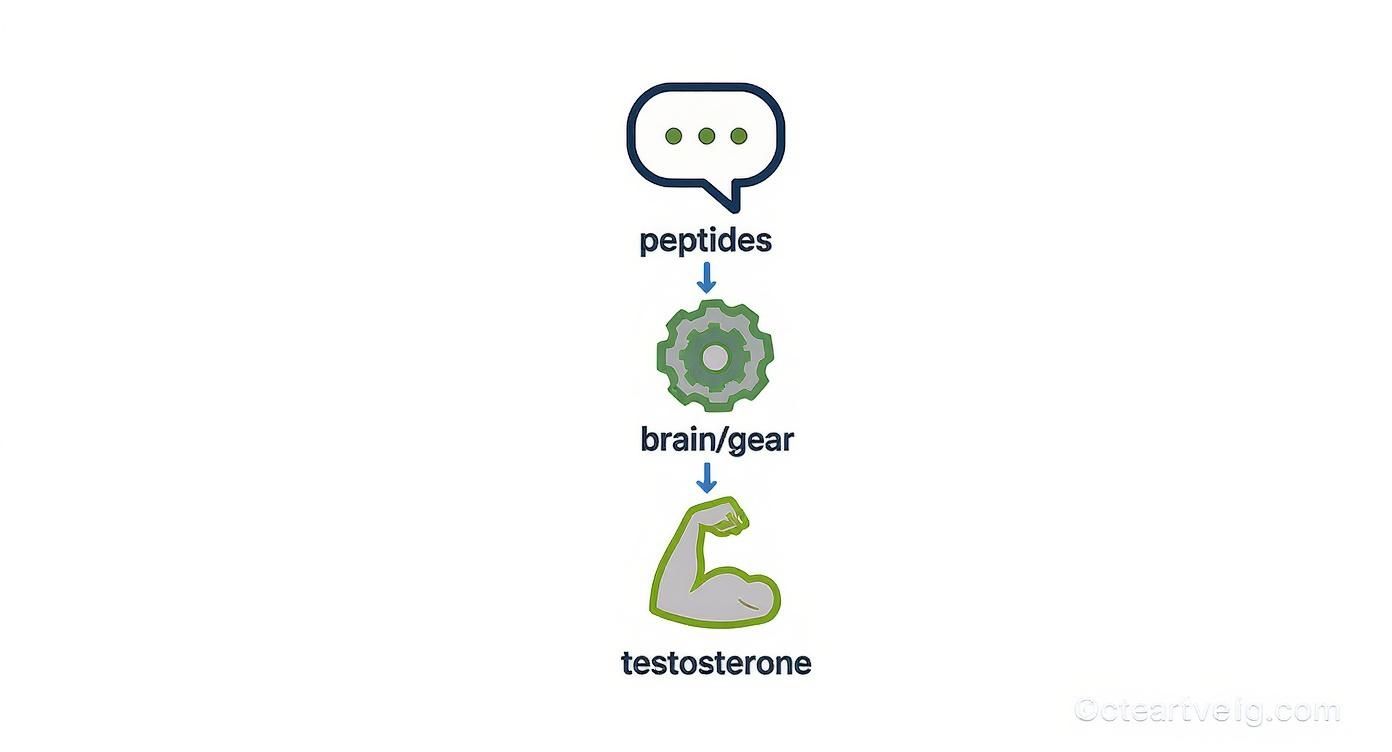
The diagram simplifies the process, showing how peptides act as messengers that engage with the HPTA to ultimately fire up your body's own testosterone production.
Restoring the Natural Rhythm
That orchestra analogy is really the key here. When you use a peptide to increase testosterone, you’re not just pumping in an artificial hormone from the outside. You’re using a precision tool to restore the natural conversation within your HPTA.
This approach works with your body’s biology, nudging each part of the axis to do the job it was designed for. It’s all about bringing the entire system back into harmony so the conductor, musicians, and instruments can work together to produce that powerful, balanced symphony of optimal testosterone. This is exactly why a medical evaluation is so important—to figure out which part of your orchestra needs a little help.
A Closer Look at Key Testosterone Peptides
While the idea of signaling your body to make more testosterone sounds simple, the peptides that get the job done are highly specialized. Each one targets a different part of the HPTA, giving clinicians a precise tool to fix the root cause of a hormonal imbalance. Think of them as different experts, each skilled at coaching a specific section of an orchestra back to peak performance.
Let's break down the three main peptides used to boost testosterone. We'll explore how they work, who they’re best for, and why a doctor might choose one over the others. This closer look will clarify their unique roles in getting your body's natural hormonal rhythm back on track.
Gonadorelin: The Pituitary Gland Activator
Gonadorelin is a synthetic form of Gonadotropin-Releasing Hormone (GnRH), which is like the "conductor's score" released by the hypothalamus. Its main job is to talk directly to the pituitary gland, telling it to release Luteinizing Hormone (LH) and Follicle-Stimulating Hormone (FSH). This makes it a perfect choice when the hypothalamus is working fine, but the pituitary needs a clear, consistent signal.
By giving Gonadorelin in small, timed pulses, a physician can mimic the body's natural GnRH rhythm. This gentle, rhythmic nudging coaxes a sluggish pituitary back into action, restarting the entire testosterone production process from the top down.
- Best For: Men with secondary hypogonadism where the pituitary gland is the weak link in the HPTA chain.
- Mechanism: Directly stimulates the pituitary to release LH and FSH.
- Application: Often used in a pulsatile way to restore natural hormone cycles without overwhelming the system.
Kisspeptin: The Master Conductor
If Gonadorelin is the musical score, Kisspeptin is the master conductor who tells the hypothalamus to write that score in the first place. This peptide works upstream from everything else, regulating the release of GnRH from the hypothalamus itself. It's one of the most powerful initiators of the entire reproductive axis.
Because it sits at the very top of the command chain, Kisspeptin has a profound, cascading effect on the entire HPTA. A doctor might use Kisspeptin to "reboot" the whole system when the problem starts at the highest level—the hypothalamus. The power of these targeted compounds is a major focus of ongoing research.
Peptide research has shown incredible results, with some studies demonstrating testosterone level increases of up to 500% compared to controls. In one 88-day study, rats receiving specific TV-peptides showed testosterone levels approximately 10 times higher than the control group, highlighting just how potent these compounds can be.
This powerful upstream action makes Kisspeptin a key peptide for increasing testosterone by addressing the system's primary control center. While it's a potent tool for hormonal health, its benefits often extend to other areas, which is why many also explore the best peptides for muscle growth and fat loss to complement their wellness goals.
HCG: The Direct Testicular Signal
Human Chorionic Gonadotropin (hCG) takes a completely different route than Gonadorelin and Kisspeptin. Instead of signaling the brain, hCG bypasses the hypothalamus and pituitary entirely and communicates directly with the testes. It’s a powerful LH mimetic, meaning it acts just like Luteinizing Hormone.
When hCG reaches the testes, it binds to LH receptors and directly stimulates the Leydig cells to produce testosterone and maintain testicular size. This makes it extremely useful in situations where testicular function needs to be preserved, like during TRT, or when the goal is to kick-start testosterone production right at the source.
Real-World Benefits of Balanced Testosterone
Using a peptide to increase testosterone isn't about chasing a number on a lab report. The real goal is to feel and perform better in your day-to-day life. When you translate the clinical data into real-world outcomes, it's easy to see why so many men are exploring these therapies—it’s about getting your quality of life back.

Balanced testosterone levels are tied to massive improvements in physical strength, mental clarity, mood, and even your long-term health. These aren't abstract ideas; they are measurable changes that affect everything from your performance in the gym to your focus at work.
Enhancing Physical Performance and Body Composition
One of the most well-documented benefits of healthy testosterone is its profound effect on your physique. It’s a key player in both building muscle and burning fat, which is the one-two punch for fundamentally changing your body composition and metabolic health.
The clinical research backs this up with hard numbers. For instance, studies show that testosterone therapy can increase lean body mass by an average of 2.21 kilograms after just 24 weeks. That’s nearly five pounds of pure muscle, which fires up your metabolism, boosts your strength, and improves your ability to handle just about any physical task. You can dive into the specifics of these physiological benefits from the detailed clinical research on pmc.ncbi.nlm.gov.
This gain in lean mass translates directly to real-world advantages:
- Greater Strength: Lifting heavier, carrying groceries without a second thought, and keeping up with physically demanding hobbies.
- Improved Metabolism: More muscle means your body burns more calories even when you’re resting, making it far easier to maintain a healthy weight.
- Faster Recovery: Testosterone helps with tissue repair, so you can bounce back quicker from those tough workouts.
Boosting Mental and Emotional Well-Being
The benefits go way beyond the physical. Testosterone is a key neurosteroid, meaning it directly influences brain function, mood, and your cognitive edge. It’s no surprise that many men with low T report experiencing "brain fog," irritability, and a general lack of motivation.
Restoring hormonal balance often feels like lifting a mental cloud. Men frequently report sharper focus, a more stable mood, and a renewed sense of drive and confidence. It’s not just about feeling stronger; it’s about feeling more like yourself again.
These cognitive and emotional benefits are just as important:
- Sharper Cognitive Function: Think improved memory, better concentration, and faster mental processing speed.
- Elevated Mood: You’ll notice less irritability and fewer depressive feelings, replaced by a much greater sense of well-being.
- Increased Libido and Vitality: A restored sex drive and overall energy are huge contributors to life satisfaction.
Ultimately, using a peptide to increase testosterone is a strategy for holistic health. The entire point is to restore the vitality, strength, and mental sharpness that let you show up fully and confidently in every single part of your life.
Understanding the Safety of Peptide Therapy
When you're exploring any powerful medical treatment, a straight-up conversation about safety is non-negotiable. Using a peptide to boost testosterone is no different. A huge piece of their safety profile comes from how they work: they're designed to stimulate your body’s own systems, not just dump an external hormone into your bloodstream.
This “indirect” approach is a game-changer. Instead of shutting down your natural production like traditional TRT can, these peptides gently nudge it back online. That single difference means they work with your body’s built-in feedback loops, drastically reducing the risk of testicular atrophy and other common issues linked to direct testosterone therapy.
Common and Manageable Side Effects
Even though peptide therapy is generally well-tolerated, it’s not completely without potential side effects. The good news is that most are mild, temporary, and tend to resolve on their own as your body gets used to the new signals. Knowing what to expect lets you have a smart, informed chat with your doctor.
The most common issues people report include:
- Injection Site Irritation: A bit of redness, swelling, or itching right at the injection spot is the most frequent side effect. Think of it as a temporary local reaction that usually fades quickly.
- Mild Headaches or Dizziness: Some people might feel temporary headaches or a little lightheadedness, especially when they first start the therapy.
- Water Retention: A slight increase in water retention can happen, but this is usually easy to manage by adjusting the protocol.
It's vital to remember that these are powerful medical tools. For a deeper dive into what to expect, our guide on whether peptide therapy is safe offers a lot more detail on safety protocols and patient experiences.
The Importance of Medical Supervision
Here’s the single most important safety factor in all of this: professional medical guidance. These are prescription-only treatments for a very good reason. An experienced doctor is absolutely essential for a few critical jobs that keep you safe and ensure the therapy actually works.
The greatest risks with peptide therapy come not from the compounds themselves, but from improper use. Self-prescribing, buying from unregulated online sources, or using the wrong dose can lead to pituitary desensitization—a condition where your glands become less responsive to stimulation.
A qualified doctor will manage your therapy by:
- Performing Comprehensive Blood Work: You can't know where you're going if you don't know where you're starting. Blood work establishes your baseline and is crucial for monitoring your hormone levels to fine-tune your protocol.
- Prescribing Precise Dosing: Your doctor will calculate the exact dose and frequency you need to get results without overstimulating your system. It's a delicate balance.
- Conducting Regular Follow-Ups: Ongoing monitoring makes sure the therapy stays effective and allows your doctor to make small adjustments to minimize any side effects you might experience.
Under proper medical supervision, using a peptide to increase testosterone can be a responsible and highly effective way to restore your hormonal balance and get back to feeling your best.
If you’re thinking about using peptides to boost your testosterone, this isn’t a journey you should start with guesswork. This is a precise medical therapy, not a supplement you can just grab off a shelf. To do it right—and safely—you need a structured, professional game plan from the very beginning.

Your first move is to connect with a qualified endocrinologist or a reputable telehealth clinic that specializes in hormone optimization. This ensures you’re working with an expert who truly understands the fine-tuned mechanics of the HPTA and can read the unique signals your body is sending. Everything should kick off with a deep-dive consultation where you discuss your symptoms, health history, and what you’re hoping to achieve.
The Clinical Pathway to Treatment
Before a single peptide is prescribed, there’s a clear, evidence-based process that has to be followed. This is non-negotiable for doing things the right way.
- Comprehensive Blood Work: Your doctor will order a full hormone panel. This isn’t just about checking your testosterone. It’s a complete look under the hood that must include Luteinizing Hormone (LH), Follicle-Stimulating Hormone (FSH), and estradiol to map out exactly how your HPTA is performing.
- Official Diagnosis: Using your symptoms and lab results, the clinician makes an official diagnosis. This step is the key to everything because it tells you why your testosterone is low, which points directly to the right treatment.
- Personalized Protocol: If peptide therapy is a good fit for you, a personalized treatment plan is built from the ground up. This will outline the specific peptide, the exact dosage, and how often you’ll need to inject, all tailored to your body’s needs.
A one-size-fits-all approach is a recipe for disaster in hormone health. The real goal is to restore your body’s unique rhythm, and that demands a protocol designed just for you, based on the hard data from your blood work.
Ongoing medical supervision is just as critical as the initial setup. You’ll need regular follow-ups and periodic blood tests to track your progress, tweak the dosing as needed, and head off any potential side effects. This structured clinical pathway is the only responsible way to begin peptide therapy, keeping you far away from shady online sources and guiding you toward real, legitimate results.
Your Questions Answered: Expert Insights on Testosterone Peptides
Diving into the world of hormone optimization can feel like learning a new language. When you're considering something as important as testosterone-boosting peptides, it's normal to have a lot of questions. Let's cut through the noise and get you the clear, straightforward answers you need to feel confident.
We'll tackle the big questions head-on, explaining how these peptides differ from other treatments, where they fit in, and what you can realistically expect.
Are Testosterone-Boosting Peptides a Type of Steroid?
No, and this is probably the most important distinction to make. They are fundamentally different.
Anabolic steroids are synthetic versions of the testosterone hormone itself. When you use them, you’re putting an external, ready-made hormone directly into your system.
Peptides like Gonadorelin or Kisspeptin are completely different. Think of them as signaling molecules—like sending a text message to your own body's hormone production factory. They don't contain any testosterone at all. Instead, they act as messengers that instruct your glands to get back to work and produce more of your own natural testosterone. It's a completely different mechanism that works with your body's regulatory system, not against it.
Can Peptides Be Used Instead of TRT?
For the right person, absolutely. Using a peptide as the sole treatment—what we call monotherapy—can be a great option for men with secondary hypogonadism. This is when your testes are perfectly capable of making testosterone, but they just aren't getting the "start production" signal from your brain. Peptides are designed to restart that conversation.
However, it's a different story for men with primary hypogonadism, or testicular failure. In this case, the testes can't produce testosterone no matter how loud the signal is. For these men, Testosterone Replacement Therapy (TRT) is usually the necessary path. Getting a thorough diagnosis from a qualified doctor is the only way to know which approach is right for your specific situation.
The choice between peptide monotherapy and TRT isn't a matter of preference; it's a clinical decision based on a precise diagnosis of why your testosterone is low. Restoring the signal only works if the receiver is functioning correctly.
How Long Does It Take to See Results?
This isn't an overnight fix, and patience is key. While some guys report feeling better—more energy, better mood, a bump in libido—within just a few weeks, the measurable changes take a bit longer.
Objective improvements that show up in your blood work, along with noticeable gains in muscle mass or shifts in body composition, typically require a few months of consistent therapy. The process is gradual because the goal is to restore your body's natural rhythm. It's a more sustainable approach than direct TRT, but it's definitely a marathon, not a sprint.
Ready to explore how a personalized peptide protocol can help restore your vitality? The team at Elite Bioscience is here to guide you through a safe, effective, and medically supervised journey to better health. Learn more and get started today at https://elitebioscience.co.