




When it comes to tesamorelin, dosing isn't about guesswork—it's a science. The standard, clinically proven tesamorelin peptide dosage is a 2 mg injection, taken subcutaneously once a day. Think of this specific dose as a precise key, cut to unlock your body's natural ability to target stubborn visceral fat.
Understanding the Standard Tesamorelin Dose
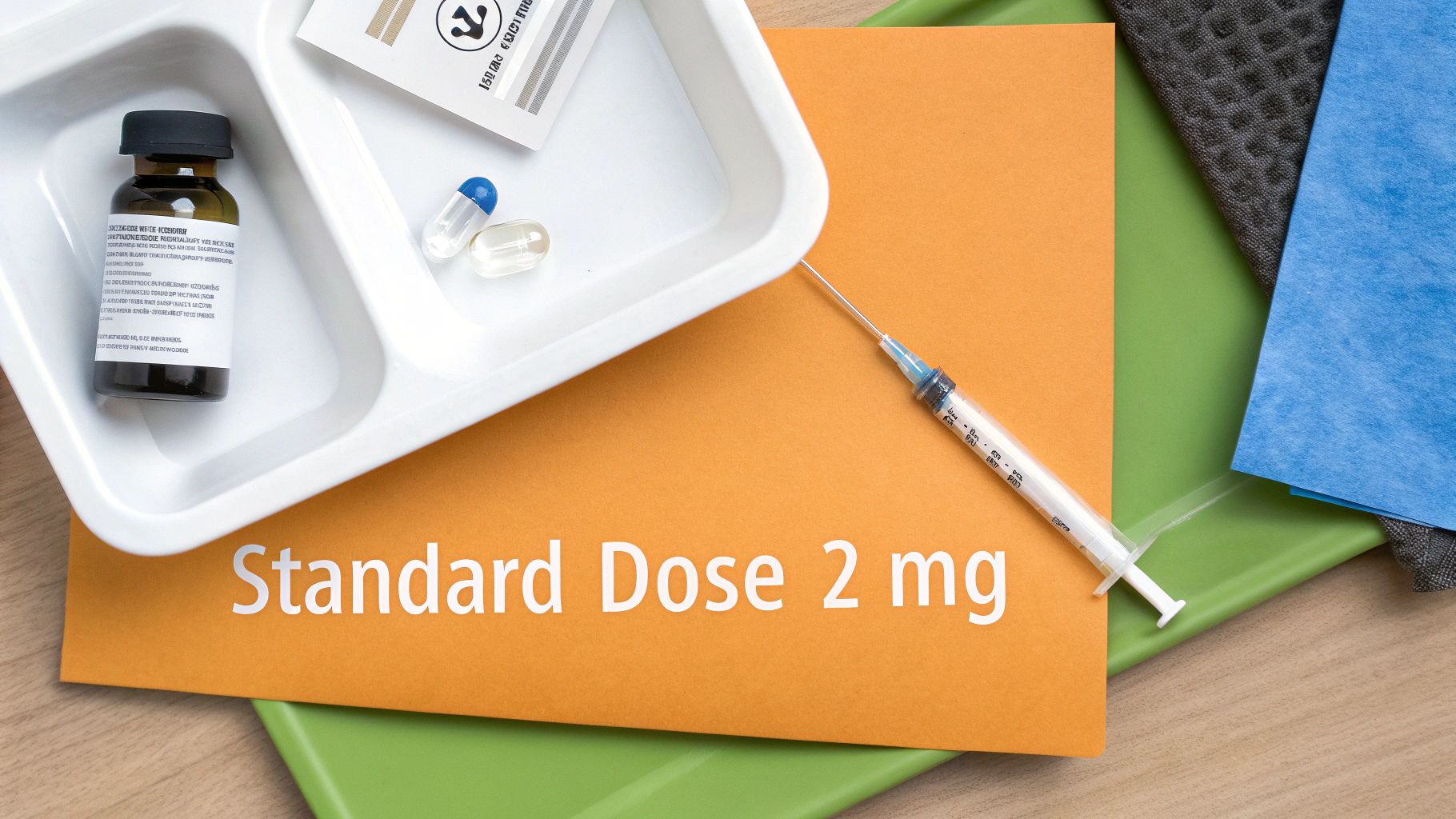
The goal of tesamorelin therapy is to gently nudge the pituitary gland—just enough to produce a therapeutic amount of growth hormone without sending the system into overdrive. It's all about maintaining a delicate hormonal balance while working toward specific goals, like reducing dangerous fat around your organs.
That 2 mg daily dose was pinpointed through rigorous clinical trials. This research confirmed it could deliver significant, measurable results when compared to a placebo. That’s exactly why healthcare providers almost always start here; it's the proven launchpad for effective therapy.
The Foundation of Effective Treatment
This 2 mg daily regimen is the cornerstone of successful tesamorelin therapy. Its power comes from how it syncs up with your body's natural rhythms. When you administer it once a day, it sends a consistent, reliable signal to your pituitary gland.
This regularity is the secret to achieving a gradual, steady reduction in visceral adipose tissue (VAT), the type of fat that crowds your internal organs and poses serious health risks.
The effectiveness of this specific dosage isn't just theory—it's backed by hard data. For instance, in one major clinical study involving 412 patients, the 2 mg dose led to an average VAT reduction of 15% over 26 weeks. Meanwhile, the group taking a placebo actually saw their VAT increase by 5%. This data is available directly from the FDA and highlights why precision dosing is absolutely critical.
Standard Tesamorelin Dosing Protocol At a Glance
To make it simple, the standard protocol is straightforward and consistent. Following these guidelines is key to ensuring both the safety and effectiveness of your treatment. For a wider look at other peptide therapies and their dosing, you can explore our comprehensive peptide dosage guide.
The consistency of a daily 2 mg dose is what allows tesamorelin to effectively and safely signal the body to reduce visceral fat over time, making adherence to the protocol a key factor in achieving successful outcomes.
Here’s a simple table to break down what the typical tesamorelin dosing protocol looks like.
| Parameter | Standard Recommendation |
|---|---|
| Dose Amount | 2 mg |
| Frequency | Once daily |
| Administration Method | Subcutaneous injection |
| Best Practice | Rotate injection sites on the abdomen |
Sticking to this proven protocol is the most reliable way to get the results you're looking for while keeping safety as the top priority.
How Tesamorelin Works at a Clinical Dose
Understanding the tesamorelin peptide dosage goes way beyond just the numbers. It’s about getting a feel for the clever science of how it works with your body, not against it. Unlike treatments that involve directly injecting synthetic growth hormone, tesamorelin takes a smarter, more natural approach.
Think of your pituitary gland as a sophisticated factory that produces your body's own growth hormone. Instead of kicking the factory doors down and flooding the system, tesamorelin acts like an expert factory manager. It sends a clear, precise request for the factory to gently ramp up its own production.
This difference is everything. Tesamorelin is a growth hormone-releasing hormone (GHRH) analogue, which is a technical way of saying it mimics your body’s own natural signals. It doesn't hijack your biology; it optimizes it. This method helps keep your body’s delicate feedback loops intact, which is key to avoiding overstimulation.
Finding the Hormonal Sweet Spot
That standard 2 mg clinical dose wasn't pulled out of a hat. It’s the result of extensive research to find the hormonal "sweet spot"—the point where you get the maximum therapeutic benefit with the most minimal side effects. This dose is carefully calibrated to give the pituitary gland just the right amount of encouragement without overwhelming it.
Imagine you're trying to nurture a garden. You could blast it with a firehose, but that would just damage the plants. A consistent, gentle watering schedule, on the other hand, allows the roots to absorb exactly what they need to thrive. The 2 mg tesamorelin dose works the same way, providing a steady, gentle signal that your body can respond to productively.
This targeted nudge results in a pulsatile release of growth hormone that mirrors your body's own natural rhythm. It’s a world away from the constant, flat-line elevation you might get from other methods. By working in harmony with your body’s internal hormonal clock, tesamorelin achieves its results much more naturally. You can learn more about how to support these processes in our guide on how to increase growth hormone naturally.
The Proof Is in the Clinical Data
The real-world impact of this precise dosing is clearest when you look at the clinical outcomes, especially when it comes to visceral adipose tissue (VAT)—the dangerous fat wrapped around your internal organs. Study after study has shown the 2 mg dose to be incredibly effective.
A landmark Phase 3 clinical trial is the perfect example. In this 26-week study, 412 patients dealing with HIV-associated lipodystrophy were given either tesamorelin or a placebo. The results couldn't have been clearer: the group taking tesamorelin saw a mean VAT decrease of 15%. Meanwhile, the placebo group actually saw their VAT increase by 5%, creating a massive 20-percentage-point difference between the two groups. You can dive into the full study on the NCBI website.
This dose-response relationship is fundamental. It shows that the 2 mg daily dose isn't just effective, but that it delivers clinically meaningful results that blow a placebo out of the water, cementing its role as the gold-standard dosage.
This data really drives home why sticking to the prescribed tesamorelin peptide dosage is so important. It’s a carefully calculated amount designed to:
- Maximize Efficacy: Deliver a strong enough signal to make a real dent in visceral fat.
- Minimize Side Effects: Avoid putting the pituitary gland into overdrive.
- Promote Natural Rhythms: Work in sync with your body’s own hormonal patterns.
When you understand this mechanism, you can see that tesamorelin’s power isn’t about brute force. It’s about an intelligent, targeted approach to optimizing your hormones.
A Step-By-Step Guide to Tesamorelin Administration
Knowing the right tesamorelin peptide dosage is one thing, but knowing how to properly administer it is what actually delivers results. This guide breaks down the process into clear, simple steps so you can handle your medication with confidence and safety.
Proper technique is everything. Think of it like watering a plant—you wouldn't just spritz the leaves and hope for the best. You water the soil where the roots can actually absorb it. A subcutaneous injection works on the same principle, delivering tesamorelin just beneath the skin where your body can absorb it most effectively.
Preparing Your Tesamorelin Dose
Before you do anything, you have to prepare your dose. Tesamorelin arrives as a lyophilized (freeze-dried) powder and needs to be reconstituted, which is just a technical term for mixing it with a sterile liquid like bacteriostatic water.
- Gather Your Supplies: Get your vial of tesamorelin powder, a vial of bacteriostatic water, alcohol prep pads, and a sterile syringe.
- Prep the Vials: Wipe the rubber stoppers on both vials with an alcohol pad. This simple step is critical for preventing contamination.
- Draw the Liquid: Use your syringe to draw the precise amount of bacteriostatic water needed. The exact volume will be specified with your prescription.
- Mix the Solution: Now, slowly inject the bacteriostatic water into the tesamorelin vial. Here’s a pro tip: angle the needle so the water runs down the side of the glass instead of spraying directly onto the powder. This helps it dissolve without foaming.
- Gently Swirl: Never shake the vial. That can damage the delicate peptide molecules. Instead, gently roll it between your hands or swirl it until the powder is completely dissolved and the liquid is clear.
For a more detailed walkthrough, Elite Bioscience has an excellent resource that shows you how to properly mix peptides for correct dosage.
This visual guide shows how your administered dose signals the brain to trigger the natural release of growth hormone.
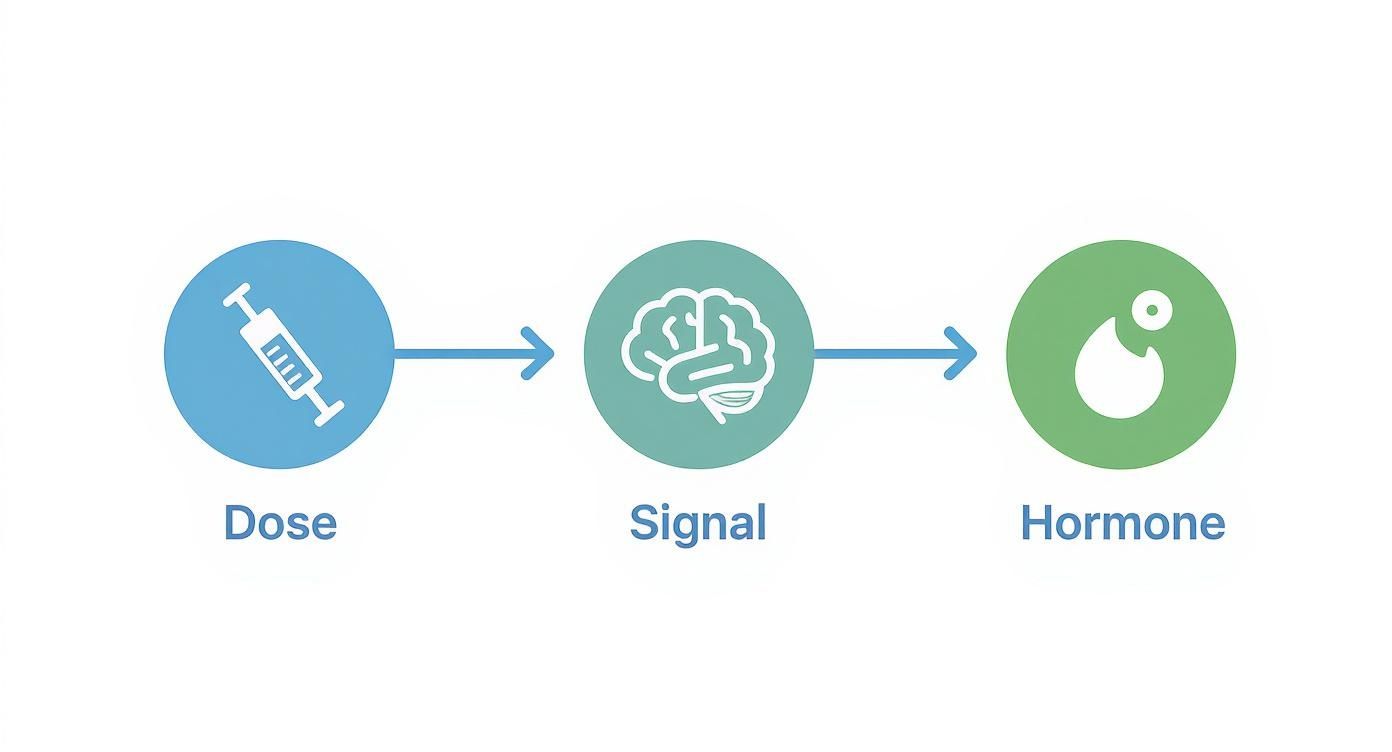
As you can see, the process starts with the dose you administer, which acts as the initial signal for your body’s endocrine system to get to work.
Performing the Subcutaneous Injection
Once your dose is mixed and ready, the injection itself is straightforward. The key is to inject the solution into the fatty tissue layer just between your skin and muscle.
- Select an Injection Site: The abdomen is the most common and recommended spot. Pick a place at least two inches away from your belly button to avoid the denser tissue there.
- Clean the Area: Use a fresh alcohol prep pad to thoroughly clean the spot you’ve chosen. Let it air dry completely before injecting.
- Pinch the Skin: Gently pinch about an inch of skin and fat. This simple move lifts the subcutaneous tissue up and away from the muscle underneath.
- Insert the Needle: Hold the syringe like a dart and insert the needle at a 45 to 90-degree angle into the pinched skin. If you have more subcutaneous fat, a 90-degree angle usually works best.
- Inject the Medication: Slowly push the plunger all the way down to inject the full tesamorelin peptide dosage.
- Withdraw and Dispose: Pull the needle out at the same angle it went in. Immediately and safely dispose of the used syringe in a designated sharps container.
Rotating your injection sites isn't just a suggestion—it's essential. Using the same spot over and over can lead to lipohypertrophy, a buildup of fatty tissue under the skin that can mess with absorption and cause irritation.
Proper Storage for Maximum Potency
How you store your tesamorelin directly impacts its effectiveness. The rules change slightly once you’ve mixed it, so pay close attention here.
Before Mixing:
Keep the unmixed, powdered vials of tesamorelin in the refrigerator, somewhere between 36°F and 46°F (2°C and 8°C). Whatever you do, don't freeze them. Freezing can destroy the fragile peptide structure.
After Mixing:
The reconstituted solution must also be kept refrigerated at the same temperature. Once mixed, it’s typically stable for up to 14 days, but you should always follow the specific instructions that come with your medication. Proper storage ensures that every single dose is just as potent as the first.
How Your Provider Monitors and Adjusts Your Dosage
Effective peptide therapy isn’t a “set it and forget it” process. Think of it as a dynamic partnership between you and your provider, where your tesamorelin peptide dosage is carefully managed to stay both safe and effective for your unique body.
It’s a bit like a musician fine-tuning a high-performance instrument. Your provider starts with the standard, clinically proven note—the 2 mg daily dose—but then listens carefully to the feedback from your body to make small, precise adjustments. This ensures your therapy is always hitting the right notes, giving you the results you want without unwanted side effects.
The Role of Lab Work in Dosage Management
The key to this fine-tuning is objective data from regular lab work. Your provider isn't just guessing; they are tracking specific biomarkers that paint a clear picture of how your body is responding to the treatment. It's this data-driven approach that allows for precise, personalized adjustments.
Two of the most important markers they monitor are Insulin-like Growth Factor 1 (IGF-1) and glucose levels. These numbers are the main feedback mechanism, telling your provider everything they need to know.
- IGF-1 Levels: Tesamorelin works by stimulating your pituitary gland to produce more growth hormone. IGF-1 is a downstream hormone that rises in response, so tracking its level confirms the peptide is working as intended. The goal is to keep your IGF-1 within a healthy, optimal range—not too low and not too high.
- Glucose and HbA1c: Because growth hormone can influence how your body handles sugar, it's critical to keep an eye on your blood glucose and HbA1c (a measure of your average blood sugar over three months). This ensures your metabolic health stays stable and well-supported throughout your treatment.
These lab tests provide the crucial information needed to dial in your therapy, making sure your tesamorelin peptide dosage is perfectly aligned with what your body needs.
Your Follow-Up and Consultation Schedule
Consistent communication and follow-up are the cornerstones of a successful and safe treatment plan. Here at Elite Bioscience, our telehealth model is structured to give you continuous support, making the whole process convenient and straightforward.
Your journey will typically follow a structured monitoring schedule.
- Baseline Labs: Before you even begin, your provider will order a comprehensive set of baseline labs. This initial snapshot gives them a clear starting point to measure your progress against.
- Initial Follow-Up: After the first month or two of therapy, you’ll have your first follow-up consultation. This is a chance to discuss how you're feeling, review any early changes, and get your next set of labs ordered.
- Ongoing Monitoring: Depending on your initial results and individual needs, you can expect to have follow-up labs and consultations every three to six months. This regular cadence allows your provider to track your progress long-term and make any necessary adjustments to your protocol.
This structured monitoring plan is what transforms your treatment from a standard prescription into a personalized, responsive therapy. It's designed to help you achieve your health goals while prioritizing your long-term well-being.
By staying engaged with this process, you and your provider can work together to ensure your treatment is always optimized. This collaborative approach is what ultimately leads to the most successful and sustainable outcomes.
Understanding the Safety Profile of Tesamorelin

Starting any new therapy means taking a clear-eyed look at the benefits versus the potential risks. When it comes to the standard tesamorelin peptide dosage, an informed patient is a safe patient. Having a solid grasp of the complete safety profile helps you know what to expect, what to keep an eye on, and when it’s time to reach out to your provider.
This transparent approach lets you move forward with confidence. You'll be equipped with the knowledge to tell the difference between a minor hiccup and a genuine concern. Let's break down the safety considerations into a simple, easy-to-follow framework.
Green Light: Mild and Common Side Effects
Think of these as "green light" issues. They're the most common side effects, are generally mild, and often fade away on their own as your body gets used to the therapy. They aren’t typically a reason to stop treatment, but they are worth noting.
The most frequently reported side effects are directly related to the injection itself. These can include:
- Injection Site Reactions: You might see some temporary redness, swelling, itching, or bruising right where you inject. This is totally normal for any subcutaneous injection and you can minimize it by rotating your injection sites on your abdomen.
- Mild Joint or Muscle Pain: Some people feel temporary stiffness or aches in their joints or muscles, a sensation known as arthralgia. This is often linked to the hormonal shifts and usually gets better with time.
- Fluid Retention: Minor swelling, especially in your hands or feet, can happen. This is usually transient and resolves as your body finds its new equilibrium.
These green light effects are generally manageable. Still, keeping your provider in the loop during check-ins allows them to track your progress and offer tips for comfort.
Yellow Light: Reportable Symptoms
Next up are the "yellow light" symptoms. These are less common but more significant, and they absolutely warrant a conversation with your healthcare provider. They don't automatically mean you have to stop treatment, but they do require a medical check to ensure everything is okay.
It's crucial to report these symptoms promptly. Your provider can determine if they are related to the medication and decide if any adjustments to your care plan are needed. Communication is your best tool for navigating these situations safely.
Key "yellow light" signs to watch for include:
- Increased Blood Sugar (Hyperglycemia): Signs like unusual thirst, needing to urinate frequently, or unexplained fatigue could point to an impact on your glucose levels. Our regular lab monitoring is designed to catch this, but you should always report new symptoms.
- Numbness or Tingling: Sensations like pins and needles, particularly in the hands or fingers (similar to carpal tunnel symptoms), should be discussed with your doctor.
- Pounding Heartbeats: If you notice a fluttering in your chest or a pounding heartbeat, it's important to get it checked out.
Reporting these issues right away allows your provider to make informed decisions, ensuring your treatment stays both effective and safe.
Red Light: Absolute Contraindications
Finally, we have the "red light" conditions—the absolute contraindications. This means tesamorelin should not be used if you have any of these conditions, as it could pose a serious health risk.
Your Elite Bioscience provider will screen you for these thoroughly during your initial consultation.
- Active Malignancy (Cancer): Because tesamorelin stimulates growth hormone, it is contraindicated for anyone with active cancer.
- Pituitary Gland Disorders: A history of a pituitary gland tumor, surgery, or radiation treatment is a contraindication.
- Pregnancy: Tesamorelin should not be used during pregnancy as it can potentially harm the developing baby.
- Known Allergy: If you have a known hypersensitivity to tesamorelin or mannitol (an ingredient in the formulation), you cannot use this medication.
To help you distinguish between what's normal and what's not, we've put together a simple table. This makes it easier to tell the difference between a common side effect and a more serious reaction that requires your doctor's attention.
Common Side Effects vs Serious Adverse Reactions
| Symptom Category | Common Side Effects (Generally Mild) | Signs of a Serious Reaction (Contact Your Doctor) |
|---|---|---|
| Injection Site | Redness, mild swelling, itching, or bruising that fades in a few hours | Severe pain, swelling that spreads, warmth, or signs of infection |
| Musculoskeletal | Temporary joint stiffness or mild muscle aches | Severe or persistent joint pain that limits movement |
| Fluid Balance | Minor swelling in hands or feet that resolves on its own | Sudden, significant swelling, shortness of breath |
| Allergic Reaction | Localized itching at the injection site | Widespread rash, hives, difficulty breathing, swelling of the face |
| Blood Sugar | N/A (symptoms are always reportable) | Excessive thirst, frequent urination, unexplained fatigue, blurred vision |
This structured safety framework empowers you to be an active partner in your health journey. By understanding these different levels of concern, you can foster a confident and open dialogue with your provider every step of the way.
Here's the rewritten section, designed to match the human-written, expert tone and style of the provided examples.
Why a Professional Consultation Is Essential
Figuring out the right tesamorelin peptide dosage isn't as simple as picking a number off a chart. It’s a detailed clinical process that requires looking at the whole picture of your health. That initial consultation with a professional is the most important step—it’s what turns a generic protocol into a safe, effective treatment plan built just for you.
Think of your provider as a skilled architect designing a custom health strategy. They don't just grab a standard blueprint; they carefully survey the land—your unique biology—before ever breaking ground. This is where they identify potential challenges and opportunities, making sure the entire structure is sound from day one.
This process is absolutely vital for your safety. During your consultation, your provider does a deep dive into your medical history to screen for any contraindications. This isn't just a formality; it’s a non-negotiable safety check to prevent serious health risks.
Your Unique Health Blueprint
Your provider’s evaluation goes deep, focusing on several key areas to make sure the tesamorelin protocol is a perfect fit for your body and goals. This isn't a one-size-fits-all approach; it’s a medically supervised strategy tailored specifically to you.
Key factors your telehealth provider will look at include:
- Your Complete Medical History: This is where they hunt for red flags like a history of pituitary disorders or active malignancies, which are absolute contraindications for tesamorelin.
- Baseline Lab Work: A comprehensive blood panel gives them a snapshot of your current metabolic health. They'll look closely at your IGF-1, glucose, and HbA1c levels to establish a safe starting point.
- Current Medications and Supplements: They need to know everything you're taking. This allows them to spot and manage potential drug interactions before they become a problem.
- Your Specific Health Goals: Understanding exactly what you want to achieve helps your provider set realistic expectations and track progress toward outcomes that actually matter to you.
This initial deep dive is what sets the stage for a successful and safe journey.
A professional consultation isn't just a box to check; it's the foundation of personalized medicine. It ensures that your tesamorelin peptide dosage is integrated into a complete health plan that respects your individual biology and prioritizes your long-term well-being.
Navigating Potential Drug Interactions
Your tesamorelin prescription doesn't exist in a vacuum. It interacts with your body's complex systems and can be influenced by other medications you might be taking. For example, tesamorelin can affect how your body processes certain drugs, like steroids or seizure medications, by influencing the enzymes that metabolize them.
Your provider at Elite Bioscience is trained to anticipate and manage these interactions. They might need to coordinate with your other doctors or adjust your treatment plan to ensure all your medications work together safely. This kind of collaborative approach is a core part of responsible medical care.
Ultimately, this expert oversight provides an essential layer of safety and personalization. It reinforces that your treatment is not just an isolated prescription, but a carefully managed piece of a broader health strategy. This partnership, built on clinical expertise and trust, is what allows you to pursue your health goals with confidence.
Your Tesamorelin Questions Answered
Starting any new therapy brings up practical questions. It's completely normal. To help you feel confident and prepared, we've gathered some of the most common queries our team hears about tesamorelin and provided clear, straightforward answers.
What Should I Do If I Miss a Dose?
If you miss a dose, the best thing to do is take it as soon as you remember. However, life gets busy, and sometimes you might not remember until it’s nearly time for your next scheduled injection. If that's the case, just skip the missed one entirely.
Whatever you do, don't double the next dose to "catch up." The goal is consistency over the long haul, and a single missed dose isn't going to derail your progress. When in doubt, it’s always a good idea to check in with your provider for guidance.
Never try to adjust your tesamorelin peptide dosage schedule on your own. Simply skipping a missed dose when it’s close to the next one is the safest way to stay on track without overloading your system.
How Long Until I See Results?
This is where patience and consistency really pay off. Everyone's body responds a bit differently, but clinical studies give us a solid benchmark: significant reductions in visceral fat typically become measurable over a 26-week treatment period.
Some people report feeling better or noticing subtle changes much sooner, but the real, measurable improvements in body composition and lab markers often take a few months to show up. Your provider will be tracking your progress with regular check-ins and lab work to make sure the therapy is doing its job effectively.
Can I Change My Tesamorelin Dosage Myself?
Absolutely not. You should never alter your tesamorelin peptide dosage without direct instructions from your healthcare provider. The standard 2 mg dose wasn't picked at random; it was established through extensive clinical research to find the perfect balance between benefits and safety.
Your provider uses specific biomarkers, like your IGF-1 levels, to see how your body is responding and to confirm that the dose is right for you. Trying to change it on your own could make the treatment less effective or, worse, increase your risk of side effects.
Ready to see if a medically supervised peptide protocol is the right move for you? At Elite Bioscience, our expert team designs personalized treatment plans to help you achieve your health and wellness goals safely.
Explore our advanced peptide therapies and start your journey today.