


Getting a handle on your health has never been easier, especially when it comes to figuring out your hormone levels. You can now order a testosterone test online, get a kit delivered to your door, collect a sample in a few minutes, and receive confidential, lab-certified results without ever stepping into a clinic. This modern route gives you privacy, convenience, and a crucial first step toward tackling issues like fatigue or low libido.
The Shift to At-Home Hormone Testing
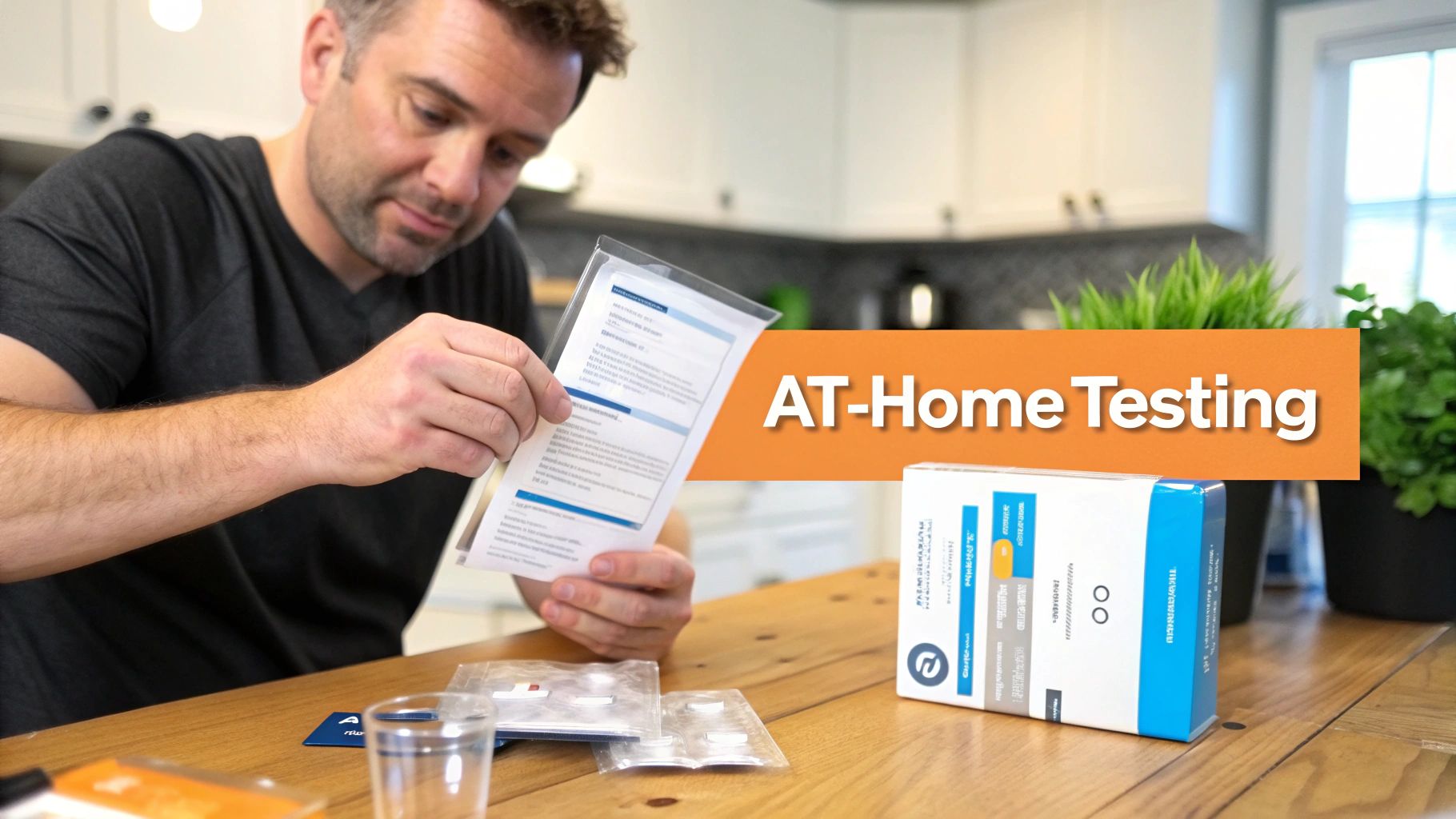
The world of personal health management is definitely changing. Not too long ago, looking into a possible hormone imbalance meant booking a doctor's appointment, getting a lab referral, and then waiting days for the results. Today, men are increasingly taking a more direct path, arming themselves with vital information right from home.
This trend is really being pushed by a few key things. First, there's a much greater awareness of how testosterone actually impacts daily life. Symptoms that were once brushed off as just "getting older"—like nagging fatigue, mood swings, or a dip in physical performance—are now being seen for what they often are: potential signs of low testosterone.
Taking Proactive Control of Your Health
Men aren't just waiting around for their annual physical to bring up concerns anymore. They're actively digging for answers, driven by a desire to feel their best. Ordering a testosterone test online fits perfectly with this proactive approach. It’s a private and incredibly convenient way to get some baseline data before you even talk to a doctor.
This proactive mindset lets you:
- Get Preliminary Insights: Understand your current hormone levels without the headache of scheduling multiple appointments.
- Spot Potential Issues Early: Catching a hormonal imbalance early can make it much simpler to address.
- Walk Into Your Doctor's Visit Prepared: You can have a more productive, informed conversation about your health when you show up with data already in hand.
The numbers absolutely back this up. The global market for testosterone test kits was valued at USD 1.37 billion in 2024 and is expected to nearly double to USD 2.65 billion by 2034. This kind of growth points to a clear demand for accessible, at-home health tools. You can learn more about this market expansion from expert research into testosterone testing.
Why Privacy and Convenience Matter
Let's be real—talking about topics like low libido or flagging energy can be uncomfortable. The ability to start this journey from the privacy of your own home removes a huge barrier for a lot of guys. No sitting in a waiting room or feeling rushed during a quick appointment.
The real power of at-home testing lies in its ability to put you in the driver’s seat. It transforms you from a passive patient into an active participant in your own wellness journey, giving you the confidence and information to seek the right medical guidance.
This convenience goes beyond just privacy. For anyone with a demanding schedule, carving out time for a lab visit can be a logistical nightmare. An online test completely removes that hurdle, letting you collect your sample when it works for you—usually first thing in the morning, right when testosterone levels are at their peak.
In the end, this modern approach isn’t about replacing doctors; it's about making the patient-doctor relationship better. By arming you with fundamental knowledge about your own body, an online testosterone test serves as the perfect launchpad for optimizing your health.
Choosing The Right Online Testosterone Test
Trying to pick an online testosterone test can feel a bit like ordering from a menu in a foreign language. You’re hit with terms like “total,” “free,” and a bunch of different collection methods, making it easy to feel lost. Let’s cut through the jargon and break down these choices so you can confidently pick the test that actually fits your health goals.
The first big decision is figuring out what, exactly, you need to measure. The two main players you’ll see are total testosterone and free testosterone.
Think of total testosterone as every bit of testosterone floating around in your bloodstream. The catch is that most of it is latched onto proteins, like albumin and sex hormone-binding globulin (SHBG), which keeps it inactive.
Free testosterone, on the other hand, is the small, unbound portion—usually just 1-4% of the total—that’s readily available for your body to use. This is the stuff that gets to work influencing muscle mass, sex drive, and energy levels. A total testosterone test gives you a good bird's-eye view, but a free testosterone measurement offers a much clearer picture of what your body can actually put to use.
Deciding Between Basic and Comprehensive Panels
Many at-home test companies offer a basic panel that only measures your total testosterone. This is a perfectly fine starting point if you're just curious about your levels or want a more budget-friendly option. It will definitely flag a major deficiency.
But for a more complete story, a comprehensive panel is the way to go. These more advanced tests usually include:
- Total Testosterone: Your overall level.
- Free Testosterone: The active, usable portion.
- SHBG (Sex Hormone-Binding Globulin): The main protein that binds to testosterone. High SHBG can mean less free T is available, even if your total numbers look good.
- Albumin: Another protein that binds to testosterone, but not as tightly as SHBG.
A comprehensive panel gives you and your doctor the full context. For example, it’s not uncommon for a man to have a “normal” total testosterone level but still feel all the symptoms of low T. A deeper look often reveals his SHBG is sky-high, leaving very little free testosterone for his body to access.
Understanding Sample Collection Methods
Once you’ve decided which markers to test, the next choice is how you'll collect your sample. This decision impacts everything from convenience and cost to the type of data you’ll get back. Your main options are a finger-prick blood test, a full serum blood draw, or a saliva test.
The most crucial factor here is matching the test’s accuracy and convenience with what you’re comfortable with. A test you can’t or won’t complete correctly is useless, no matter how advanced it is.
The medical community overwhelmingly views blood-based testing as the gold standard for accuracy. This isn't just a professional opinion; market trends back it up. The testosterone blood testing market was valued at USD 2,188.8 million in 2024 and is on track to hit USD 3,601.4 million by 2030. This kind of growth shows that both patients and doctors trust blood samples for reliable hormone data. You can find more statistics on the blood testing market from Grand View Research.
A full serum draw at a partner lab will give you the most accurate and complete data—it's the exact same procedure your doctor would order. A finger-prick test is a super convenient at-home alternative that uses just a few drops of blood. When done right, these tests are highly reliable for measuring key hormones. Saliva tests are the least invasive, but they’re generally only used for free testosterone and are more prone to collection errors.
Comparing At-Home Testosterone Test Collection Methods
To help you decide, here’s a quick side-by-side look at the three main sample collection methods for at-home testosterone tests. Each has its pros and cons, so the "best" one really depends on your personal needs.
| Method | How It Works | Accuracy Level | Best For |
|---|---|---|---|
| Finger-Prick (Blood Spot) | You prick your finger at home and collect small drops of blood on a special card. | High | At-home convenience with reliable results for a broad panel of hormones. |
| Serum (Lab Draw) | You order a test online and visit a local partner lab for a traditional blood draw. | Very High | The "gold standard" for accuracy and for individuals who prefer a professional collection. |
| Saliva | You collect a saliva sample in a tube at home. | Moderate | Non-invasive testing for free testosterone, but can have more variability. |
Ultimately, the right testosterone test online comes down to your goals. If you just want a preliminary check-in, a simple total testosterone finger-prick test might be all you need. But if you’re trying to get to the bottom of specific symptoms, a comprehensive blood panel is a much more powerful diagnostic tool.
If your results come back and raise any concerns, the next step is talking to a professional. You can easily schedule an online doctor consultation for personalized medical advice to figure out what to do next.
How an Online Testosterone Test Actually Works
Jumping into the world of at-home health testing can feel a little intimidating at first, but ordering a testosterone test online is a surprisingly simple and private process. It’s designed to put you in control, giving you direct access to key health data. Let’s walk through what you can really expect, from the moment you click "order" to when you ship your sample back to the lab.
The first move you’ll make is picking a reputable online provider. You’ll want to look for companies that are completely transparent about their lab certifications. The big ones to look for are CLIA (Clinical Laboratory Improvement Amendments) and CAP (College of American Pathologists) accreditation. Think of these as non-negotiable seals of quality—they guarantee the lab meets strict federal standards for accuracy and reliability.
Placing Your Order and Getting Ready
Once you’ve found a provider you trust, ordering the kit is as easy as buying anything else online. You’ll choose the test you need—whether it’s a basic total testosterone screening or a more detailed panel—and the kit will be shipped discreetly right to your door. The packaging is almost always unbranded, so your privacy is protected.
This flowchart shows the typical thought process for choosing a test, starting with a foundational marker and building up to a complete hormonal picture.
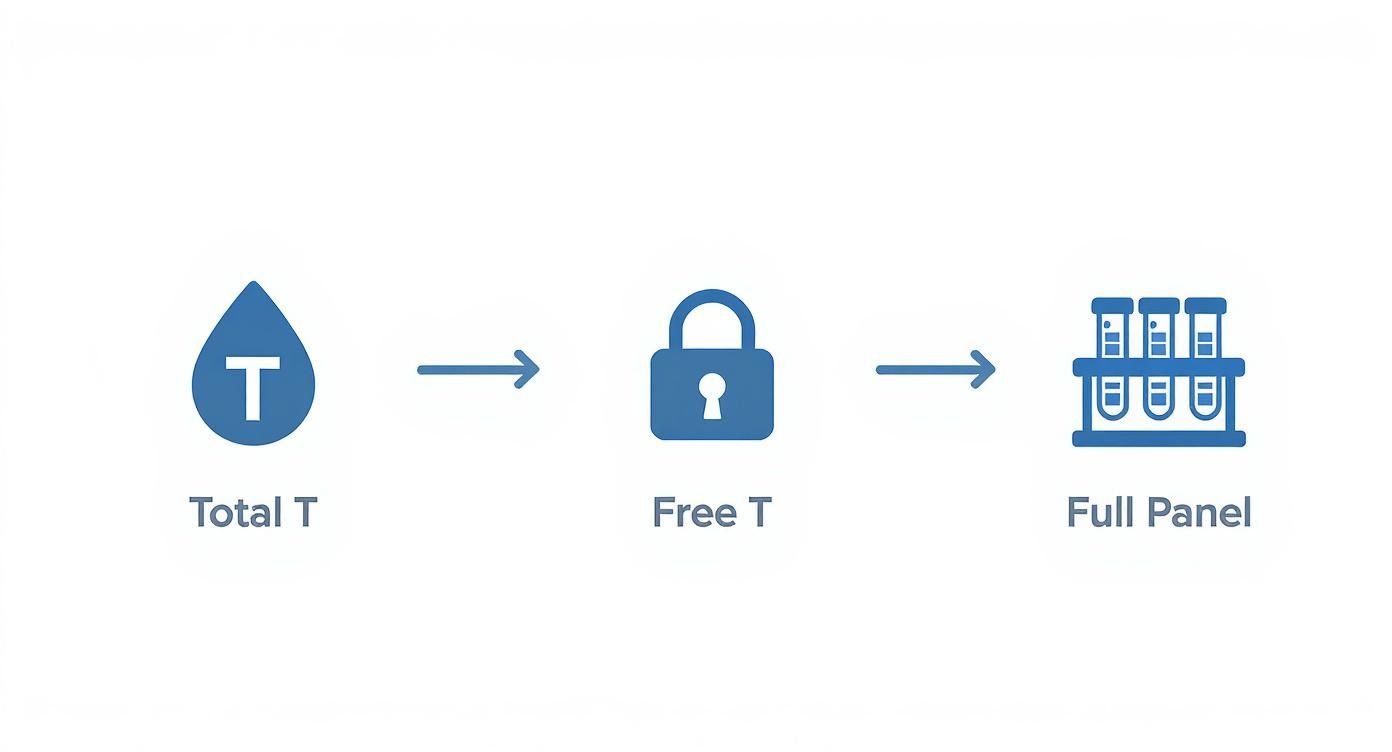
As you can see, you can begin with a simple Total T test and then add more specific markers like Free T or a full panel if you need a more granular analysis.
When the kit arrives, don't just tear it open and start right away. Timing is everything. Your testosterone levels are at their natural peak in the morning, so you need to collect your sample within 30-60 minutes of waking up for the most accurate reading.
Here are a few essential prep steps:
- Fast Beforehand: Don’t eat, drink anything but water, or exercise before the test. It's best to collect your sample after at least an eight-hour overnight fast.
- Hydrate: Drink a glass of water about 20 minutes before you collect. This helps a lot with finger-prick tests by improving blood flow.
- Do a Kit Check: Open the box and lay everything out. You should see lancets, a collection device (card or tube), alcohol wipes, bandages, and a biohazard bag for the return trip.
Collecting Your Sample Like a Pro
Now for the main event—the sample collection. Whether you're doing a finger-prick or a saliva test, following the instructions to the letter is critical. You want to avoid contaminating the sample or not collecting enough, which could lead to an invalid result.
For a finger-prick blood test, here's the drill:
- Wash Your Hands: Use warm water and soap. This not only cleans the area but also gets the blood flowing to your fingertips.
- Pick the Right Spot: Use the side of your ring or middle finger. The tip has more nerve endings, so it’ll hurt more.
- Use the Lancet: Wipe the spot with an alcohol pad and let it air-dry completely. Press the lancet firmly against your finger until you hear a click.
- Get the Drops: Gently massage your finger from the base toward the tip to form a nice, round drop of blood. Let it fall directly onto the designated spots on the card. Whatever you do, don’t squeeze or "milk" your finger—this can damage the red blood cells and skew your results.
If you’re doing a saliva test, it’s even easier. You’ll just spit into a collection tube until you hit the fill line. The golden rule here is no eating, drinking, smoking, or brushing your teeth for at least 30 minutes beforehand. You need a pure sample. You can learn more about the specifics in our guide on how to check hormone levels at home.
Packing It Up and Sending It Off
Once your sample is collected, you're almost done. For a blood spot card, you’ll need to let it air dry completely for a few hours before you pack it up. This is a crucial step; it prevents mold and keeps the sample stable on its journey to the lab.
After it’s dry, place the collection card or saliva tube into the biohazard bag that came with your kit. Pop that bag into the prepaid return mailer. Most companies use major carriers, so you can just drop the package in a mailbox or a designated dropbox.
Then, you just wait. Turnaround time for results is typically 3 to 7 business days after the lab gets your sample. You'll get an email notification as soon as your results are ready to view on the company's secure online portal, keeping your health information confidential and accessible only to you.
Making Sense of Your Test Results

So, your online testosterone test results are in. You open the file and… it looks like a complex code. You're hit with a wall of numbers, acronyms, and units of measurement that don't mean much on their own. The first thing to remember is that this report isn't a diagnosis—it's the start of a conversation.
Every lab report will show your numbers next to a "reference range." This is simply the spectrum of values the lab considers normal for a healthy population. It's your first checkpoint to see where you stand.
Understanding Total vs. Free Testosterone Levels
The two most critical numbers you'll see are total testosterone and free testosterone. Think of total testosterone as all the testosterone in your system, but most of it is bound to proteins and isn't actively working for you. A widely accepted normal range for men here is roughly 300 to 1,000 nanograms per deciliter (ng/dL).
But that number only tells part of the story. The real workhorse is free testosterone. This is the tiny, unbound fraction that’s biologically active and available for your body to use. Because there's so little of it, the measurements are much smaller, usually in picograms per milliliter (pg/mL). A typical range might be 5 to 21 pg/mL, though this can vary.
Here's a common scenario: a man might have a "normal" total testosterone level but still feel awful. Why? Often, his free testosterone is in the gutter because a protein called Sex Hormone-Binding Globulin (SHBG) is locking it all up. A good, comprehensive test gives you the full picture.
Why Your "Normal" Might Be Different
Reference ranges are a great guide, but they are not one-size-fits-all. Simply falling "within range" doesn't always line up with how you feel, because what's healthy for you depends on several personal factors.
Here are the key variables that can shift the goalposts:
- Age: It’s a fact of life. Testosterone levels naturally drop by about 1-2% a year after you hit 30. What's normal for a 65-year-old would be considered low for a guy in his mid-20s.
- Lab Differences: Every lab sets its own reference ranges based on its equipment and the population it tests. This is why you must always compare your results to the range provided on your specific report.
- Time of Day: Your testosterone is at its peak in the morning. This is why at-home tests need to be done right after you wake up. A sample taken at 4 PM could give you a falsely low reading.
Your lab results are a snapshot of your hormonal health at one specific moment. They’re incredibly valuable data points, but their real meaning only comes to light when interpreted in the context of your age, health history, and the symptoms you're actually experiencing.
What the Numbers Mean for You
When you look at your report, you’ll see your number next to the lab's range. For instance, your total testosterone might be 450 ng/dL within a range of 300-1,000 ng/dL. While technically "normal," that's on the lower end of the spectrum and could absolutely be the reason you're not feeling your best.
- Low Levels: If your numbers are below the reference range, it’s a clear signal to talk to a doctor, especially if you have classic symptoms like fatigue, low sex drive, or mood swings.
- Normal Levels: Being in range is great, but don't ignore your symptoms if you still feel off. This is where a conversation with a healthcare professional is crucial to connect the dots.
- High Levels: This is less common, but levels above the reference range can also point to underlying health issues and need a medical follow-up.
Learning to read these reports is a skill. Our detailed guide on how to read lab results can give you a deeper understanding of the terms and what to look for. Ultimately, getting a testosterone test online is about arming yourself with information. Use that data to have a productive, informed conversation with a medical expert who can help you figure out what's really going on and map out the right next steps.
So, Your Testosterone Test Results Are In. Now What?
Getting your results back is a big moment, but it’s really just the starting line. Whether the numbers are where you want them, borderline, or officially low, the next move is always the same—and it’s the most important one you’ll make: talk it over with a doctor who knows what they’re doing. A set of numbers on a lab report doesn't have the one thing you need most: context.
That report is a critical piece of the puzzle, but it can't put itself together. A doctor who specializes in men's health or endocrinology is the one who can connect those numbers to your actual symptoms, your age, and your overall health. They can help you figure out if a "low-normal" number is the real reason you’re feeling wiped out, or if something else is going on.
Finding the Right Expert for You
You've got a few solid options here. You can always book an appointment with your primary care doctor. They can give you some initial feedback and, if needed, refer you to a specialist like a urologist or an endocrinologist who lives and breathes hormonal health.
Or, you can stick with the convenience that led you to an online testosterone test in the first place and look into telehealth. Many platforms now connect you directly with doctors who specialize in hormone optimization. This path has some clear advantages:
- Specialized Know-How: Telehealth doctors in this niche are often deeply focused on the latest treatment strategies for hormone imbalances.
- Total Convenience: You can have an in-depth consultation right from your home, skipping the travel and waiting room shuffle.
- A Direct Path: These services are built from the ground up to diagnose and treat hormonal issues, so the process is incredibly focused.
What to Expect From Your Consultation
When you meet with the doctor, they’re going to do a lot more than just glance at your lab sheet. Be ready for a deep dive into your symptoms, lifestyle, diet, workout habits, and stress levels. Honesty is everything here—the more detail you give, the clearer the picture gets for them.
Remember, the point of this conversation isn’t just to chase a number on a lab report. It’s about figuring out why you feel the way you do and getting you back to a higher quality of life. The lab results are just a tool to build a plan that’s right for you.
After this comprehensive review, your doctor will likely lay out a few potential paths forward, all tailored to your specific situation.
Potential Follow-Up Actions and Discussions
If your results and symptoms both point to a hormone issue, don't be surprised if the first recommendation isn't a prescription. Your doctor might suggest several strategies that can make a real difference on their own.
Possible next steps often include:
- Lifestyle Adjustments: The first line of defense is often making changes to your diet, exercise, and sleep. Simple things like adding strength training, locking in 7-9 hours of quality sleep per night, and getting a handle on stress can give your natural testosterone production a serious boost.
- More In-Depth Testing: Your initial test might be the signal for a more detailed look. The doctor may order more blood work to check other key hormones like estrogen, prolactin, or thyroid levels to make sure nothing else is contributing to your symptoms.
- A Conversation About Treatment: If lifestyle tweaks don't move the needle and your levels are clinically low, the conversation may turn to medical options like Testosterone Replacement Therapy (TRT). This is a major decision that should only be made with close medical supervision. Your doctor will walk you through the different delivery methods—injections, gels, pellets—and be upfront about the benefits and potential risks, so you can make a fully informed choice.
Your Top Questions About Online Testosterone Testing
Deciding to check your testosterone levels from home is a big step, and it's natural to have a few questions. You want to know if the results are legit, what it's going to cost, and who gets to see your private health info. Getting clear, straight answers is the only way to feel confident you're making the right move.
Let's break down the biggest concerns so you know exactly what you’re getting into.
Are At-Home Testosterone Tests Actually Accurate?
This is the big one, and the short answer is yes—but with a major catch. The accuracy of your test comes down to two things: the quality of the company you choose and the lab they partner with.
Top-tier at-home testing services don't run these tests in a back room. They work with the same professional labs your doctor uses—labs that are CLIA-certified and CAP-accredited. These aren't just fancy titles; they're strict federal standards ensuring the lab's equipment and methods are held to the highest medical-grade benchmarks.
Blood tests are the gold standard here, whether it’s a full vial from a lab or a finger-prick sample you collect at home. While you might see saliva tests out there, they're generally less reliable for hormones like testosterone because they can be easily skewed by collection mistakes.
The bottom line for an accurate result is simple: pick a company that uses a certified lab and follow the collection instructions to the letter. Timing your sample—first thing in the morning when testosterone is at its peak—is non-negotiable for getting a true picture of your levels.
What’s the Real Cost of an Online Testosterone Test?
The price tag can swing quite a bit, usually falling somewhere between $50 and over $200. What you end up paying really depends on how deep you want to go.
- The Basics: A simple test measuring only your total testosterone will land on the lower end of that scale. It’s a good starting point, but it doesn't give you the full story.
- Comprehensive Panels: For a complete picture, you'll want a panel that includes free testosterone, SHBG, albumin, and other key biomarkers. These are more expensive, but the data you get is far more actionable.
Most at-home tests won't be covered by your regular health insurance, but many companies do accept payments from a Health Savings Account (HSA) or Flexible Spending Account (FSA). Before you buy, always double-check what the price includes—things like shipping, the kit itself, and whether a doctor reviews your results should all be part of the deal.
How Safe Is My Personal Health Information?
Completely. Your privacy is protected by the same federal laws that cover your doctor’s office. Any legitimate company offering medical testing is legally bound by the Health Insurance Portability and Accountability Act (HIPAA).
This means they have to use strict security measures to keep your personal and medical data confidential. Before ordering, take a quick look for a clear privacy policy on their website. A trustworthy provider will use a secure, encrypted platform to deliver your results and communicate with you, ensuring your sensitive information is locked down every step of the way. Your results are your business and no one else's.
Ready to take the next step in understanding your hormonal health? At Elite Bioscience, we provide confidential, lab-certified at-home testing solutions and expert guidance to help you optimize your well-being. Start your journey with Elite Bioscience.