



When is the best time to take L-carnitine? The simple answer is, it all comes down to your goal. For fat loss and performance, 30-60 minutes before a workout is your sweet spot. For recovery, a post-workout dose might be a better move.
Your Quick Guide to L-Carnitine Timing
To get the most out of any supplement, you first have to understand why you’re taking it. L-carnitine is no different.
Think of it as a specialized delivery service inside your body. Its main job is to shuttle fatty acids into your cells’ powerhouses—the mitochondria—so they can be torched for energy. If this delivery service isn't running efficiently, your body can't tap into fat for fuel nearly as well.
This is exactly why timing is so crucial. By lining up your dose with your body's demands, you’re ensuring this "delivery service" is fully staffed and ready to go right when you need it most.
Matching Your Timing to Your Goal
The timing that works best for someone looking to shed a few pounds will likely be different from an athlete focused on pushing their endurance. Here’s a quick breakdown to help you figure out your strategy:
- For Fat Loss: Taking L-carnitine before your workout primes your body to dig into its fat stores for energy during exercise.
- For Performance: A pre-training dose can help spare muscle glycogen and buffer lactic acid, letting you train harder and longer before hitting a wall.
- For Recovery: Using L-carnitine after a tough session can help dial down muscle soreness and oxidative stress, speeding up your bounce-back time.
The flowchart below gives you a clear visual guide, showing how your primary goal should dictate when you supplement.
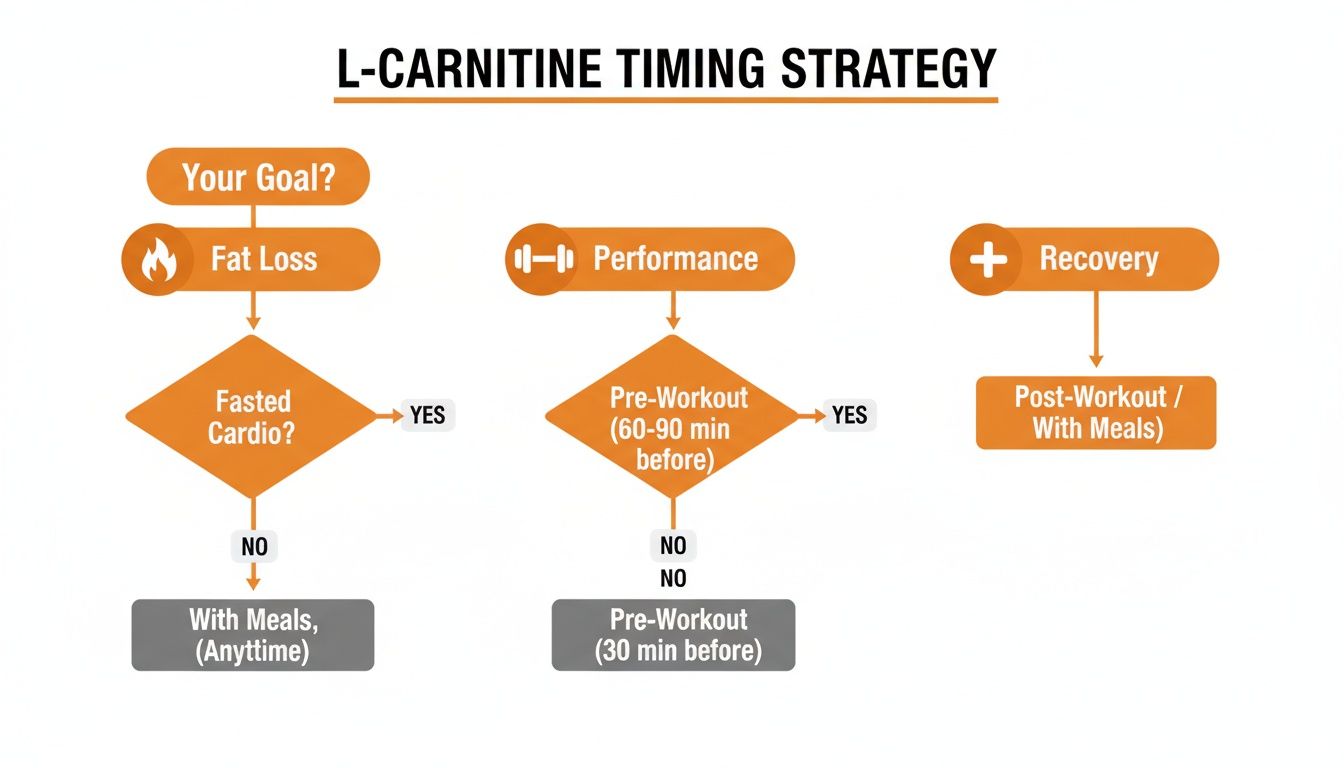
As you can see, aligning your dose with your specific objective is the most effective approach. This quick reference table breaks it down even further to help you choose the best timing strategy for your needs.
Optimal L-Carnitine Timing Based on Your Health Goal
A quick reference guide to help you decide the best time to take L-Carnitine according to your specific fitness or health objectives.
| Your Goal | Best Time to Take | Primary Benefit |
|---|---|---|
| Fat Loss | 30-60 minutes pre-workout | Maximizes fat oxidation during exercise |
| Performance | 30-60 minutes pre-workout | Enhances endurance and energy production |
| Recovery | Immediately post-workout | Reduces muscle soreness and oxidative stress |
| General Health | With a carb-containing meal | Improves insulin sensitivity and nutrient uptake |
While these general guidelines are a fantastic starting point, you can dive deeper into the many injectable L-carnitine benefits to further customize your plan. In the next sections, we'll get into the science behind each of these recommendations, helping you build a perfect strategy.
How L-Carnitine Actually Fuels Your Body
To really get a handle on when is the best time to take l-carnitine, you first need to see how it works inside your body. Forget the dense biochemistry—the concept is surprisingly simple. It all comes down to how your body burns fat for fuel.
Imagine your cells are filled with tiny, powerful engines called mitochondria. These little powerhouses are responsible for generating almost all of your body's energy. Fatty acids—the building blocks of fat—are an incredibly potent source of fuel for these engines, but there's a catch: they can't get inside on their own.
This is where L-carnitine steps in. Think of it as a specialized taxi service. Its main job is to pick up long-chain fatty acids, drive them across the mitochondrial membrane, and drop them off inside the engine where they can be burned for energy.
Without enough of these L-carnitine "taxis," fatty acids are left stranded outside the cellular engine. This means your body can't efficiently tap into its fat stores for fuel, forcing it to rely more heavily on other sources like carbs.
The Different Forms and Their Functions
Not all L-carnitine is the same. Different forms have slightly different jobs, which makes them better suited for specific goals. Knowing the difference helps make it clear why choosing the right type—and timing it correctly—is so important for getting the results you want.
- L-Carnitine L-Tartrate: This is the form you’ll see most often in studies on physical performance. It absorbs quickly, making it a great choice for a pre-workout supplement to help speed up recovery and cut down on muscle soreness.
- Acetyl-L-Carnitine (ALCAR): This form is special because it has an "all-access pass" to the brain, easily crossing the blood-brain barrier. Because of this, it's primarily used to support cognitive function, sharpen focus, and protect the brain from oxidative stress.
- Propionyl-L-Carnitine (GPLC): Often found paired with glycine, this form is known for improving blood flow and circulation. It works by boosting nitric oxide production, which can benefit everything from cardiovascular health to your pump in the gym.
Once you see L-carnitine as a fat transporter, the importance of timing becomes obvious. To maximize fat loss, you want that taxi service running at full capacity during your workout. For brain benefits, you need a form that can actually get to your brain. This basic understanding is the key to unlocking the strategic timing recommendations we’ll cover next. Having enough L-carnitine available at just the right moment ensures your cellular engines are always running on premium fuel.
Timing L-Carnitine to Maximize Fat Loss

If shedding body fat is your main objective, the question of when is the best time to take l-carnitine isn't just a minor detail—it's a critical part of your strategy. You want to time your dose to create a perfect storm, where your body's demand for energy lines up perfectly with L-carnitine’s ability to serve up fat for fuel. The sweet spot? 30 to 60 minutes before your workout.
This pre-workout window is purely strategic. It gives the L-carnitine enough time to be absorbed so that its levels in your bloodstream are peaking right as you start to exercise. Think of it as calling in your fleet of fat-transporting "delivery trucks" just before the morning rush. They show up ready to move fatty acids into your cellular power plants the moment your body starts screaming for more energy.
When you nail this timing, you’re encouraging your body to prioritize burning stored fat instead of just leaning on its easier-to-access carbohydrate stores (glycogen). This simple shift can make a real difference in how your body fuels itself during a tough cardio or resistance training session.
The Carb Synergy Strategy
Ready to take it up a notch? Try pairing your L-carnitine with a small amount of fast-acting carbs. I know, it sounds a little backward for fat loss, but there’s a powerful biological reason this works. Taking in carbs triggers a small, controlled insulin spike.
Insulin acts like a key that unlocks the doors to your muscle cells. When insulin levels rise just a bit, it dramatically improves the uptake of L-carnitine into the muscle tissue where you need it most. This synergy basically supercharges the fat-shuttling process, making your muscles far more efficient at burning fat.
You don't need much; just something light and easy to digest:
- A small banana or a handful of berries.
- A small amount of a sports drink.
- A slice of toast with a thin layer of jam.
This small carb hit ensures the L-carnitine doesn't just hang out in your blood but gets delivered directly into the muscle cells, primed and ready for action.
This strategic timing isn't just theory; a growing body of evidence backs it up. Studies suggest that taking L-Carnitine 30-60 minutes pre-workout can boost fat oxidation by up to 55% in athletes. In North America, where a huge portion of adults are actively working on their weight, this simple timing hack is a powerful tool for optimizing energy metabolism. You can explore more data on the global L-carnitine market and its applications.
Practical Application for Maximum Impact
For the best results, make your pre-workout L-carnitine dose an unbreakable part of your routine. It's the consistency that allows carnitine levels to build up inside your muscle tissue over time, leading to deeper and more lasting effects on your body's fat-burning engine.
Aim for a dose between 1-3 grams, taken with about 20-30 grams of fast-acting carbohydrates around 30 minutes before you start training. This straightforward, science-backed approach helps turn your body into a more efficient fat-burning machine, helping you get more out of every single workout.
Fueling Performance and Accelerating Recovery
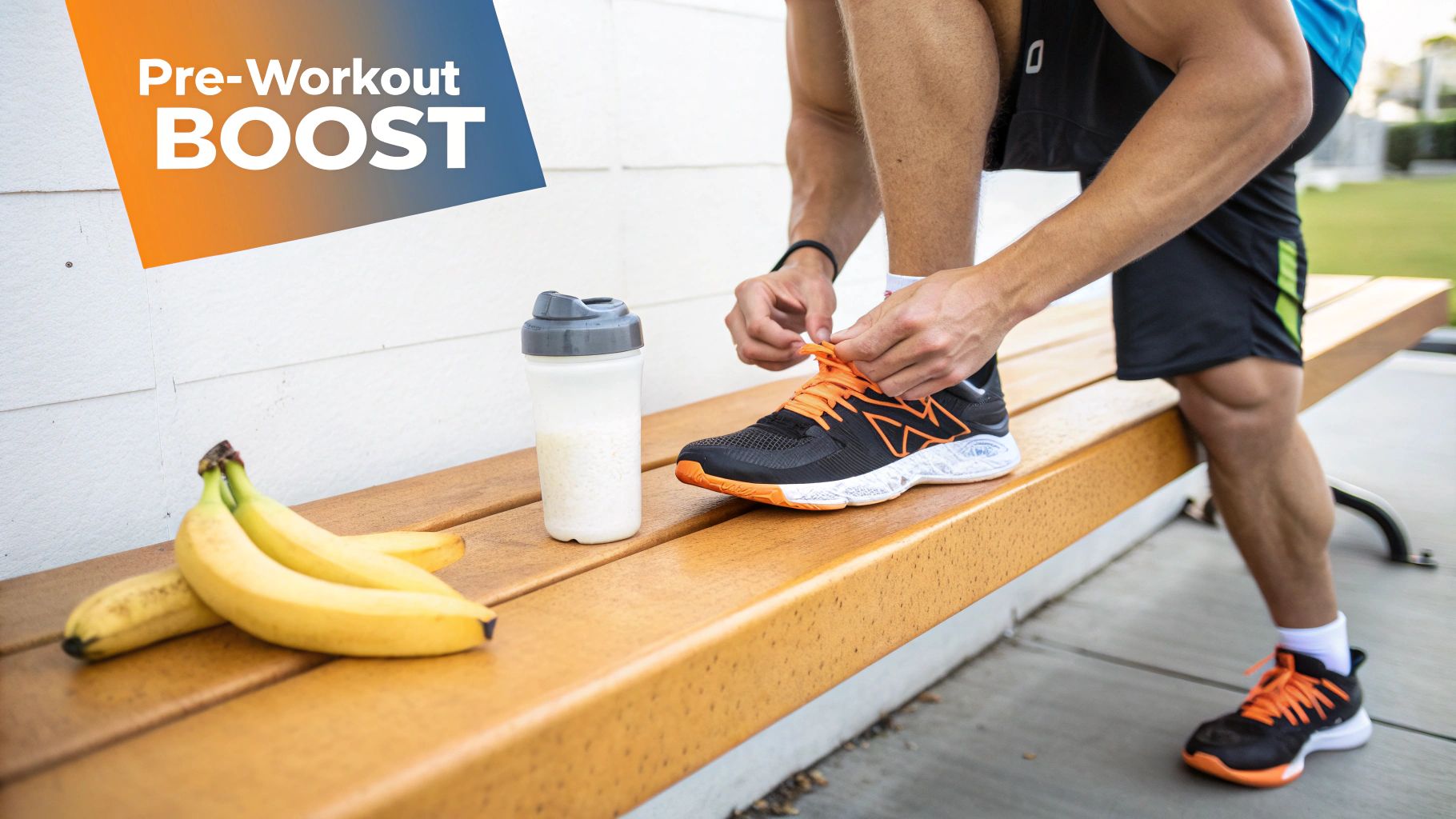
For anyone serious about fitness, L-carnitine is much more than just a fat-loss supplement. It’s a powerful ally for pushing your physical limits. By getting your timing right, you can unlock a dual benefit that impacts both your performance during a workout and how quickly you bounce back afterward.
The secret is in how L-carnitine works when your body is under stress. When you train hard, your body tears through its main fuel source, muscle glycogen. L-carnitine steps in to spare this precious fuel by making your body better at burning fat for energy. Think of it as giving you more gas in the tank for longer, more intense sessions.
This process also helps buffer the buildup of lactic acid, the compound that creates that familiar burning sensation in your muscles. By keeping lactate in check, you can push back fatigue and perform at a higher level for longer.
Pre-Workout for Peak Endurance
Taking L-carnitine 30-60 minutes before your workout is the sweet spot for boosting performance. This timing ensures the L-carnitine "taxis" are fully up and running, ready to shuttle fatty acids right when your muscles start screaming for more fuel. The result is a noticeable improvement in your endurance and overall work capacity.
Let’s break it down:
- Without L-carnitine: Your body burns through its glycogen stores fast, and fatigue sets in early.
- With pre-workout L-carnitine: Your body efficiently taps into fat for energy, saving that glycogen for when you need it most—like during that final, all-out set.
This simple timing tweak can be the difference between hitting a new personal best and falling just short. It's a strategic move to get the most out of every rep.
Post-Workout for Faster Recovery
The benefits don't stop when you rack the weights. Taking a dose immediately after training can seriously speed up your recovery. Intense exercise creates microscopic tears in your muscle fibers and generates oxidative stress, which is what leaves you feeling sore and drained.
L-carnitine helps dial down this damage by reducing markers of muscle breakdown and fighting off exercise-induced inflammation. In simple terms, this means less soreness, faster tissue repair, and a quicker return to peak strength for your next workout.
This post-workout strategy is catching on globally. The demand for these supplements has jumped 15% year-over-year, with a huge portion coming from North America and Asia-Pacific. Data shows that intense training can drain carnitine levels by 20-30%, and a post-gym dose is perfect for topping those stores back up. Some studies have even found this can slash recovery time by as much as 27% in endurance athletes. If you want to dive deeper, you can read the L-carnitine market analysis on Straits Research.
For a complete blueprint on bouncing back faster, our guide explains in detail how to improve muscle recovery using a variety of proven methods. By combining a pre- and post-workout L-carnitine strategy, you create a complete support system that fuels your performance and rebuilds your body more efficiently than ever.
Dosage Safety and Combining with Other Therapies

Knowing when is the best time to take l-carnitine is a great start, but it's only one piece of the puzzle. To really get the results you're after without unwanted side effects, you have to nail your dosage and understand how to use it safely.
Most clinical studies and real-world applications stick to a dosage range of 1 to 3 grams per day. If you're just starting out, the smart move is to begin at the lower end of that spectrum—think 500 mg to 1 gram daily—just to see how your body responds.
This "start low and go slow" approach lets your system adapt. From there, you can gradually increase your dose based on what you're trying to achieve, whether that's better performance, faster recovery, or changes in body composition.
Managing Potential Side Effects
The good news is that L-carnitine is generally very well-tolerated. However, some people might run into mild digestive issues like nausea or stomach cramps, especially when they start taking higher doses. Luckily, these problems are usually easy to fix.
One of the simplest and most effective solutions is to take your L-carnitine with a meal. Having some food in your stomach acts as a buffer and can dramatically reduce the chances of any discomfort. This strategy also works perfectly with the tip about taking it with carbs to boost muscle uptake.
Key Takeaway: Start with a low dose to see how your body reacts. If you notice any digestive upset, try taking your L-carnitine with food instead of on an empty stomach.
This small tweak often solves the issue entirely. It’s a similar principle to other supplements, where timing makes all the difference in both absorption and comfort, just like understanding the best time to take vitamins.
Important Medical Considerations
Before you add any new supplement to your daily routine, it's absolutely essential to have a conversation with your healthcare provider. This step is non-negotiable, especially if you have any pre-existing health conditions or are taking certain medications.
Make sure to get medical advice if any of these apply to you:
- Thyroid Conditions: L-carnitine might interfere with how thyroid hormones work in the body.
- Blood Thinners: It could potentially increase the effects of anticoagulant drugs like warfarin.
- Seizure Disorders: In very rare instances, L-carnitine has been linked to a higher frequency of seizures in people who already have a history of them.
L-Carnitine and Other Therapies
For many of our clients at Elite Bioscience, L-carnitine is a powerful addition to their existing protocols. It works incredibly well alongside treatments like Hormone Replacement Therapy (HRT) or various peptide therapies.
By helping your body get better at using fat for fuel and cutting down on oxidative stress, L-carnitine creates a healthier internal environment where these other therapies can really shine.
For instance, it can support the body composition goals that often come with TRT or boost the metabolic benefits of certain peptides. Its role in powering up your cells makes it a valuable player in any well-rounded health plan, helping you get the most out of your efforts, safely.
Frequently Asked Questions About L-Carnitine
Even with the best plan, questions always come up as you dial in your routine. Here are some clear, straightforward answers to the most common questions we hear about L-carnitine, so you can use it confidently and get the results you're after.
Should I Take L-Carnitine On Rest Days?
Absolutely. Consistency is what makes L-carnitine effective. Taking a maintenance dose on your off days keeps your muscle carnitine levels fully saturated, making sure it’s ready to work for your next training session.
Think of it as keeping the fuel tanks of your "cellular taxis" topped off. This way, they're ready to transport fatty acids the moment you need them, which supports both ongoing recovery and your overall metabolic efficiency.
Can I Take L-Carnitine Before Bed?
It’s generally not the best time, particularly if you're sensitive to supplements. Some forms, especially Acetyl-L-Carnitine (ALCAR), have a mild stimulating effect on the brain that could mess with your sleep quality.
If your goals are fat loss and performance, pre-workout timing is far more effective. If you have no other option but to take it at night, stick to a non-stimulatory form like L-Carnitine L-Tartrate and pay close attention to how it affects your ability to wind down.
Expert Tip: To get the most out of L-carnitine, stick to the timing that aligns with your main goal. For almost everyone, that means taking it earlier in the day—either before a workout or with a meal—to avoid any chance of it impacting your sleep.
How Long Until I See Results From L-Carnitine?
Patience is key with L-carnitine. While you might notice a little extra energy during a workout soon after taking it, the real, game-changing benefits aren't immediate.
It takes consistent, daily use over several weeks to effectively build up carnitine concentrations inside your muscle tissue. See it as a long-term investment in your metabolic health and performance, not a quick-fix stimulant. The real magic happens with sustained use.
Is It Better On an Empty Stomach or With Food?
The answer really depends on your goal and how your body reacts. Neither approach is wrong, but each offers a unique advantage.
- For Fastest Absorption (Pre-Workout): Taking L-carnitine on an empty stomach allows it to get into your system more quickly. This is your best bet if you're taking it about 30 minutes before hitting the gym.
- For Best Muscle Uptake (General Use): Taking it with a meal that contains carbohydrates is the superior method for getting it deep into your muscle cells. The insulin spike from the carbs acts like a key, unlocking your muscles to pull in and store L-carnitine much more effectively.
For most people focused on long-term muscle saturation and overall benefits, taking it with a meal is the way to go. This method also helps minimize any potential for an upset stomach. Ultimately, figuring out when is the best time to take l-carnitine for you comes down to matching the method to your specific objective.
Ready to optimize your body's energy production and accelerate your results? Elite Bioscience offers high-quality, third-party tested injectable therapies designed to support your metabolic health and performance goals. Explore our solutions and take the next step in your health journey today. Visit us at https://elitebioscience.co.