



Keeping the muscle you’ve worked hard to build comes down to a simple but powerful trio: consistent resistance training, adequate protein intake, and prioritizing recovery.
This combination sends a constant signal to your body to preserve and repair muscle tissue, even when you’re in a calorie deficit or just getting older. Think of it as an ongoing conversation with your body, reminding it that your muscles are essential and need to stick around.
Why You Need to Maintain Your Muscle Mass
When people hear about maintaining muscle, they often picture bodybuilders. But the reality is far more fundamental. Preserving muscle isn't just about looking good; it's a cornerstone of long-term health, vitality, and being able to live life on your own terms.
Strong muscles are your body’s metabolic engine. They directly influence how you burn calories and manage your weight.
Your muscle tissue is incredibly active, burning far more calories at rest than fat does. By holding onto more muscle, you naturally support a higher metabolism, which makes maintaining a healthy body composition much easier. This becomes especially critical as we age and our metabolic rate tends to slow down.
Beyond the Biceps: Muscle and Longevity
The benefits of maintaining muscle mass run deep into your physiological well-being. It’s not just about lifting heavy things; it’s about building a more resilient body that can handle the stresses of life and aging.
Here’s why it’s so critical:
- Disease Prevention: Healthy muscle mass improves your insulin sensitivity, which significantly lowers the risk of developing type 2 diabetes.
- Bone Health: The stress from resistance training stimulates bone density. This is your best natural defense against osteoporosis.
- Functional Independence: Strong muscles in your legs, core, and back are what allow you to perform daily activities—from carrying groceries to playing with your grandkids—safely and without pain.
This link between muscle and longevity isn’t just a theory. Research has shown a direct connection between muscle mass and survival rates in older adults. In one study of adults in their 90s and beyond, women with low muscle mass had a 1.54 times higher risk of mortality over four years compared to those with normal levels.
Your muscles are like a retirement account for your physical health. The more you invest in them now, the more functional freedom and resilience you'll have to draw upon later in life.
Before we dive into the specific strategies, here’s a quick overview of the core pillars we’ll be covering. Think of this as your roadmap to building a resilient, muscular physique that lasts.
Your Muscle Maintenance Blueprint at a Glance
| Pillar | Core Principle | Primary Goal |
|---|---|---|
| Nutrition | Provide the building blocks for repair and preservation. | Prevent muscle protein breakdown and fuel recovery. |
| Training | Stimulate muscle tissue to signal its necessity. | Maintain strength and muscle fiber integrity. |
| Recovery | Allow the body to repair and adapt. | Minimize muscle soreness and support hormonal balance. |
| Hormones | Create an anabolic environment for muscle preservation. | Optimize key hormones like testosterone for muscle synthesis. |
| Supplements | Fill nutritional gaps and enhance recovery. | Provide targeted support where diet falls short. |
This table lays out the essential framework. Now, let’s get into the actionable details for each pillar, starting with what you put on your plate.
Hormonal Health and Muscle Preservation
Hormones also play a huge role in this process. Key players like testosterone are crucial for signaling muscle protein synthesis—the process of building and repairing muscle.
As we get older, these hormone levels can naturally decline, making muscle preservation more of a challenge but also more important than ever. You can learn more about how testosterone levels change over time with this age chart to understand its impact on muscle and overall vitality.
By focusing on smart training, nutrition, and recovery, you create a supportive environment for your body to hold onto its valuable muscle tissue for years to come.
Fueling Your Muscles The Right Way
Training provides the stimulus, but nutrition is what gives your body the raw materials to rebuild and hold onto that hard-earned muscle. What you eat is every bit as important as how you train when you’re figuring out how to maintain muscle mass. It’s about more than just cramming in protein; it’s about strategic fueling.
Think of your body as being in a constant state of turnover, breaking down old proteins and building new ones. To keep the muscle you have, you need to make sure the rate of muscle protein synthesis (MPS) is at least equal to the rate of muscle protein breakdown. Nutrition is your number one tool for tipping that balance in your favor.
The whole process really boils down to three interconnected pillars.
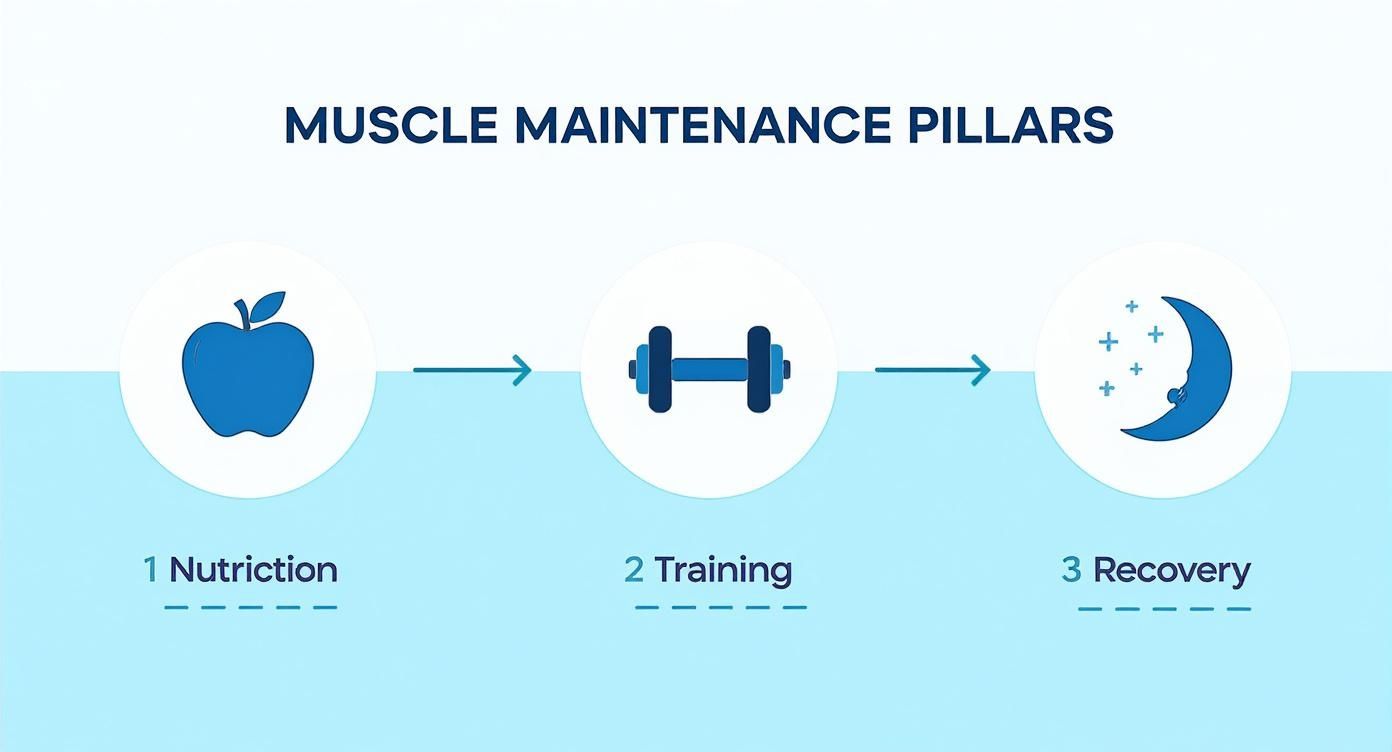
As you can see, strategic nutrition provides the fuel, targeted training sends the signal to preserve muscle, and proper recovery is when the actual repair and adaptation happen.
Mastering Your Protein Intake
Protein is the absolute non-negotiable for muscle tissue. Without enough of it, your body simply can’t repair and maintain muscle fibers, especially when it’s under stress from intense training or a calorie deficit.
For muscle maintenance, a solid guideline is to consume between 0.7 to 1.0 grams of protein per pound of body weight (that’s 1.6 to 2.2 grams per kilogram) every day. If you're cutting fat while trying to preserve every ounce of muscle, definitely aim for the higher end of that range.
But here’s the real game-changer: spread that protein intake out. Don’t just have one or two massive, protein-heavy meals. Aim for several smaller, protein-rich feedings throughout the day.
Consuming 20-40 grams of high-quality protein every 3-4 hours provides a consistent stream of amino acids to your muscles. This keeps muscle protein synthesis elevated all day long and stops your body from dipping into a catabolic (muscle-breakdown) state.
This steady supply is far more effective for muscle preservation than eating the same total amount of protein in fewer, larger meals.
Choosing High-Quality Protein Sources
Where your protein comes from really matters. Different foods have different profiles of amino acids—the individual components that make up a complete protein. You want to focus on complete proteins, which contain all nine essential amino acids your body can't make on its own.
Here are some of the best choices out there:
- Lean Meats: Chicken breast, turkey, and lean cuts of beef are powerhouses of complete protein and other essentials like iron and B vitamins.
- Fish: Salmon, tuna, and cod are not only great protein sources but also deliver anti-inflammatory omega-3 fatty acids that help with recovery.
- Dairy and Eggs: You can't go wrong with Greek yogurt, cottage cheese, and whole eggs. Whey and casein, the two proteins in dairy, are legendary for their muscle-building and preserving abilities.
- Plant-Based Options: If you’re plant-based, great options include soy products (tofu, tempeh), seitan, lentils, and quinoa. You can also create a complete amino acid profile by combining sources, like classic rice and beans.
While whole foods should always be the foundation of your diet, hitting your protein targets can be tough with a busy schedule. This is where smart supplementation can fill the gaps. For a deeper look at what works, you can explore various supplements for muscle growth that support a well-rounded diet.
The Crucial Role Of Carbs And Fats
Protein gets all the glory, but carbohydrates and fats are the unsung heroes of muscle maintenance. You absolutely cannot afford to ignore them.
Carbohydrates are your body’s go-to energy source. Getting enough carbs means your protein can be used for muscle repair instead of being burned for fuel. They also replenish muscle glycogen, the fuel stored in your muscles, which is critical for powering your workouts and keeping fatigue at bay.
Healthy fats are vital for producing hormones like testosterone, a major player in muscle preservation. Sources like avocados, nuts, seeds, and olive oil also help reduce inflammation and keep your joints healthy, so you’re always ready for the next training session.
Practical Meal Timing for a Busy Schedule
You don’t need the rigid schedule of a pro bodybuilder to apply these principles. It’s all about making smart choices that fit your real life.
Here’s a look at what a typical day could look like for someone focused on maintaining muscle:
| Time | Meal/Snack | Protein Source Example | Purpose |
|---|---|---|---|
| 7:00 AM | Breakfast | Scrambled eggs or a tofu scramble | Start the day with a protein hit to stop overnight muscle breakdown. |
| 10:30 AM | Mid-Morning Snack | Greek yogurt with berries | Bridge the gap to lunch with a slow-digesting protein. |
| 1:00 PM | Lunch | Grilled chicken salad or lentil soup | Refuel midday with protein, carbs, and micronutrients. |
| 4:00 PM | Pre-Workout Snack | A banana with a scoop of whey protein | Provide quick energy for the workout and prime muscles for recovery. |
| 7:00 PM | Dinner | Baked salmon with quinoa and broccoli | Replenish glycogen and provide nutrients for overnight repair. |
This kind of structure ensures you’re consistently fueling your body, keeping muscle protein synthesis elevated, and giving yourself the energy you need for life and training. It's a flexible template that proves you don’t have to live in the kitchen to keep your muscles properly fueled.
Your Smart Muscle Maintenance Workout Plan
Keeping the muscle you’ve worked so hard to build doesn’t mean you have to live in the gym. It's really about working smarter, not harder. The whole game is providing a consistent, challenging stimulus that tells your body, "Hey, we need this muscle, don't get rid of it." This becomes especially true if you're cutting calories or life just gets in the way of your normal routine.
Your goal shifts from all-out growth to intelligent preservation. You're sending a powerful signal that your muscle tissue is essential. Without that signal, your body, looking to be efficient, might see that metabolically "expensive" muscle as expendable.

The Ideal Training Frequency for Maintenance
Here’s something that might surprise you: holding onto muscle requires a lot less total work than building it in the first place. For most people, 2-3 full-body resistance training sessions per week is the sweet spot. This frequency is more than enough to hit all your major muscle groups without leading to burnout.
This isn't just gym wisdom; health organizations worldwide back this up. For instance, many recommend muscle-strengthening activities at least twice a week, though this is often underreported in national health stats. This kind of regular training is absolutely crucial for keeping muscle mass as we age. For a deeper dive, you can check out what health experts say about the importance of muscle-strengthening surveillance.
A well-structured plan gives your muscles plenty of time to recover between sessions, which is when the real magic of adaptation happens. Spacing your workouts out—think Monday, Wednesday, and Friday—gives you that perfect balance of stimulus and rest.
Prioritize Compound Movements
When your goal is efficient muscle maintenance, compound exercises are your absolute best friends. These are the big lifts that recruit multiple muscle groups and joints at the same time, giving you the most bang for your buck.
Instead of spending tons of time isolating tiny muscles, you're creating a large metabolic and hormonal response that supports overall muscle preservation. Make these lifts the core of your workouts.
Top Compound Exercises for Muscle Maintenance
- Squats: The undisputed king of lower-body exercises. They hammer your quads, hamstrings, glutes, and core. Don't sleep on variations like goblet squats or front squats, either.
- Deadlifts: A true full-body powerhouse. This movement strengthens your entire posterior chain—from your back down to your glutes and hamstrings. Romanian Deadlifts (RDLs) are a fantastic, less taxing alternative.
- Bench Press: The classic upper-body push, targeting the chest, shoulders, and triceps. Dumbbell presses or even high-resistance push-ups work just as well.
- Overhead Press: Essential for building and keeping strong, stable shoulders. You can do this with a barbell, dumbbells, or even kettlebells.
- Rows: The perfect pulling counterpart to all your pressing work. Rows build a thick, strong back and biceps. Bent-over rows, single-arm dumbbell rows, and cable rows are all great choices.
By building your routine around these five core movement patterns (squat, hinge, push, press, pull), you guarantee a balanced and incredibly effective stimulus for your entire body. Smart training is a cornerstone of a better physique; you can learn more about how to improve body composition here.
Volume and Intensity: The Maintenance Levers
To keep the muscle you have, you need to lift with enough intensity. Now, this doesn't mean you have to go for a new one-rep max every session. It simply means lifting a weight that challenges you to complete your target reps with good form, usually leaving just 1-2 reps in the tank.
Maintaining strength is the best indicator of maintaining muscle. If your numbers in the gym are staying consistent, you can be confident you’re preserving your lean mass.
Here’s a simple framework to guide your sets and reps for maintenance:
- Sets: Stick to 2-3 hard-working sets per exercise.
- Reps: A range of 6-12 reps per set is perfect for muscle preservation.
This approach gives you enough intensity and volume to signal muscle retention without pushing you into overtraining, which can be a real risk when you aren't in a calorie surplus. You're just doing enough to remind your muscles they're needed.
Sample Maintenance Routine
So, what does this look like in practice? Here’s a sample full-body split. Just remember to warm up properly before you jump into the working sets.
Workout A (e.g., Monday)
- Goblet Squats: 3 sets of 8-10 reps
- Dumbbell Bench Press: 3 sets of 8-10 reps
- Bent-Over Dumbbell Rows: 3 sets of 10-12 reps
- Lateral Raises: 2 sets of 12-15 reps
- Plank: 3 sets, hold for 45-60 seconds
Workout B (e.g., Friday)
- Romanian Deadlifts: 3 sets of 8-10 reps
- Overhead Press: 3 sets of 8-10 reps
- Lat Pulldowns (or Pull-Ups): 3 sets of 8-12 reps
- Leg Press: 2 sets of 10-15 reps
- Face Pulls: 2 sets of 15-20 reps
With a schedule like this, you’re hitting every major muscle group twice a week with enough of a challenge to maintain mass, all without having to spend hours upon hours in the gym.
No Gym? No Problem
You don't need a fancy gym membership to hold onto your muscle. Bodyweight exercises and a good set of resistance bands can provide an incredible stimulus. The key is to apply the principle of progressive overload, just like you would with weights.
For example, you can progress from a standard push-up to an incline push-up (feet elevated) to make it harder. With bands, you can move to a thicker band or perform more reps to increase the challenge. As long as you're creating tension and pushing yourself, you're sending your muscles the signal to stick around.
The Overlooked Secrets of Muscle Recovery
Your muscles aren't built in the gym; they're built while you rest. It’s a hard truth, but many people hammer away at training and nutrition only to completely drop the ball on recovery, unknowingly sabotaging their own efforts. The hours you spend outside the gym are when the real magic happens—when your body repairs tissue, balances hormones, and solidifies your hard work.
Ignoring recovery is like building a house but never letting the foundation settle. Sooner or later, cracks are going to show. Let’s shine a light on the non-negotiables that too many people skip, starting with the most critical one of all.

Prioritize Quality Sleep
Sleep is the single most powerful recovery tool you have, and it’s completely free. This is primetime for your body to release crucial hormones like growth hormone, which is absolutely essential for repairing the muscle fibers you challenged during your workout. Skimping on sleep is a direct invitation for muscle breakdown.
When you're sleep-deprived, your body ramps up the production of cortisol, a stress hormone that is catabolic by nature. In simple terms, it actively breaks down muscle tissue for energy. Consistently poor sleep creates a hormonal environment where holding onto lean mass becomes an uphill battle, no matter how perfect your diet and training are.
Aim for 7-9 hours of quality sleep per night. This isn't a luxury; it's a biological necessity for anyone serious about maintaining muscle mass. If you're struggling, a simple pre-sleep routine can make a world of difference.
Here are a few actionable things you can do to improve your sleep quality tonight:
- Create a Cool, Dark Environment: Your bedroom should feel like a cave. Blackout curtains and a lower thermostat are your best friends.
- Limit Blue Light Exposure: Turn off screens—phones, TVs, tablets—at least an hour before bed. That blue light messes with your natural melatonin production.
- Establish a Consistent Schedule: Try to go to bed and wake up around the same time every day, even on weekends. It helps regulate your body's internal clock.
Manage Your Stress Levels
Chronic stress is another silent killer of muscle. Just like poor sleep, high levels of daily stress flood your body with cortisol. Your body doesn’t care if the stress is coming from work, your personal life, or even overtraining—it just responds by shifting into a state of breakdown.
This makes stress management an essential part of your muscle maintenance plan. You need to foster a hormonal environment that’s conducive to preservation, not catabolism. Luckily, you don’t need to go on a month-long retreat to see an impact.
Simple, consistent practices can significantly lower cortisol and shift your body into a more anabolic (muscle-building) state. Try weaving one of these into your daily routine:
- Meditation: Even 10 minutes of mindfulness or a guided meditation app can lower stress markers.
- Light Activity: A short walk, especially in nature, has been proven to reduce cortisol levels.
- Deep Breathing: Practicing box breathing (inhale for 4 seconds, hold for 4, exhale for 4, hold for 4) can calm your nervous system almost instantly.
Hydration: The Unsung Hero
Finally, let's talk about something incredibly basic but so often overlooked: hydration. Water is fundamental to nearly every bodily process, including muscle function and repair. Your muscle tissue itself is about 75% water, and even slight dehydration can tank your performance and recovery.
Proper hydration is critical for transporting essential nutrients, like amino acids and glucose, to your muscle cells. Without enough water, this entire delivery system slows to a crawl, hindering your body's ability to repair itself after a workout. Dehydration also increases protein breakdown, directly working against your muscle maintenance goals.
Don’t just drink when you’re thirsty; by then, you’re already behind. Make a habit of sipping water consistently throughout the day. A good starting point is to aim for around half your body weight in ounces daily. It’s a simple change that supports the entire 24/7 ecosystem of muscle health.
How to Beat Age-Related Muscle Loss
Sarcopenia, or age-related muscle loss, sounds like some unavoidable sentence that comes with getting older. But the truth is, you have a remarkable amount of control over how this plays out. It's not a cliff you suddenly fall off; it’s more like a gentle slope you can choose to flatten out.
The idea that muscle just melts away with the years is mostly a myth driven by inactivity, not biology. Your muscles are incredibly adaptable and are always ready to respond to the right signals, whether you're 25 or 75. A proactive approach can help you keep your strength, mobility, and independence for decades to come.
This isn’t about chasing the body you had in your twenties. It’s about preserving the functional strength that lets you live a full, vibrant life on your own terms.
The Truth About Muscle and Aging
It's easy to think that muscle loss just goes into overdrive after a certain age. While some natural decline is part of the process, it’s really our daily habits that dictate the outcome.
Research shows that inactive adults can lose around 1% of their muscle mass every year after age 30. But here’s the hopeful part: that same research confirms our muscle is in a constant state of renewal, turning over at a rate of 1-2% per day. This means our bodies are primed to rebuild tissue, even in later years, as long as we give them the right stimulus. You can read more about these findings on muscle mass decline from Maastricht University.
This capacity for renewal is your greatest asset. It means you can actively fight back against sarcopenia and maintain a strong, resilient body.
Resistance Training Is Your Best Defense
If there’s one "magic bullet" for fighting age-related muscle loss, this is it. Resistance training—lifting weights, using bands, or even doing challenging bodyweight exercises—sends a powerful signal to your body: keep this muscle.
This is not the time to slow down; it’s the time to train smarter. Your muscles don't know your age. All they know is stress and adaptation. Applying a consistent challenge is the key to telling your body that your muscle is essential and needs to stick around.
For older adults, the focus should shift to compound movements that directly support everyday function.
- Chair Squats: This directly builds the strength you need to stand up from a chair, a critical part of maintaining independence.
- Farmer's Walks: Just carrying weights (dumbbells or even grocery bags) is a fantastic way to strengthen your grip, core, and posture.
- Glute Bridges: These are perfect for firing up the glutes and lower back, which provide the power for walking and climbing stairs.
The goal isn't necessarily to lift heavier and heavier. It's about maintaining strength with impeccable form. Consistency with moderate loads is far more valuable than occasional, high-risk efforts that could lead to an injury.
Listening to your body becomes more important than ever. Make sure you get enough recovery time between sessions and never push through sharp pain.
Nutrition and Lifestyle Adjustments
As we get older, our bodies can become less efficient at using the protein we eat. This is a real phenomenon known as anabolic resistance. It just means you might need a bit more protein than a younger person to get the same muscle-building response.
A great strategy is to aim for 25-40 grams of high-quality protein with each meal. This keeps a steady supply of amino acids available to fight muscle breakdown all day long.
Vitamin D also becomes a crucial ally. It plays a vital role in both muscle function and bone health, and many older adults are running low. It’s worth getting your levels checked and supplementing if needed, as it directly supports the strength you’re working so hard to maintain.
Finally, don’t forget balance and mobility work. Simple exercises like standing on one leg or practicing yoga can drastically reduce your risk of a fall, protecting both your bones and your confidence.
To help put all of this into practice, I've created an actionable checklist. Think of it as your daily and weekly game plan for staying strong.
Sarcopenia Prevention Checklist
| Action Item | Frequency | Why It Matters |
|---|---|---|
| Resistance Training | 2-3 times per week | Directly stimulates muscle fibers to prevent atrophy and maintain strength. |
| Protein with Each Meal | Daily | Overcomes anabolic resistance and provides building blocks for muscle repair. |
| Vitamin D Check | Annually | Supports muscle function, bone density, and overall health. |
| Balance & Mobility Work | 3-5 times per week | Improves stability and coordination, significantly reducing the risk of falls. |
By adopting these habits, you're not just maintaining muscle—you are actively investing in your long-term health and functional freedom. Age is just a number, but your strength is a choice you can make every single day.
Common Questions About Maintaining Muscle
Even with the best plan, real life throws curveballs. Vacations, unexpected illnesses, or just a crazy week at work can make you wonder if all your hard work is about to vanish. It's totally normal to have questions about what's happening to your body when your routine gets disrupted.
Let's tackle some of the most common concerns I hear all the time. Think of this as your go-to guide for navigating the practical challenges of keeping the muscle you've built.
How Much Muscle Can I Lose and How Quickly?
This is the big one. Everyone worries that a week off will send them back to square one. The good news? Muscle is a lot more stubborn than you think. You absolutely will not lose your gains overnight.
True muscle loss, a process called atrophy, doesn't really kick in until after a few weeks of doing nothing at all. If you take a week or two off, you might notice a "softer" or smaller look. That's almost entirely due to a drop in stored muscle glycogen and water, not a loss of actual muscle fiber.
It’s only after about three weeks of complete inactivity that your body might start breaking down muscle tissue in a meaningful way. The key is to get back to it as soon as you can, even with some light activity. That sends the signal your body needs to hang onto that hard-earned muscle.
Do I Still Need as Much Protein on Rest Days?
Yes, one hundred percent. Your muscles don't just stop repairing themselves on the days you skip the gym. In fact, your rest days are when most of the real growth and recovery happens. Think of your protein intake as a 24/7 insurance policy against muscle breakdown.
Keeping your protein intake high and consistent every single day gives your muscles a constant supply of the amino acids they need for repair. If you let your protein drop on your off days, you can create a deficit that slows down recovery and might even tell your body it's okay to start tapping into muscle for energy.
Your daily protein target should be the same whether you're training or resting. Consistency is what creates a pro-muscle environment in your body.
Can I Maintain Muscle in a Calorie Deficit?
You definitely can, but it demands a smarter, more deliberate approach. When you're in a calorie deficit to shed body fat, your body is hunting for energy—and your muscle tissue can become a prime target. Learning how to maintain muscle mass is most critical in this scenario.
To protect your muscle while you're dieting down, you have to be relentless about two things:
- A High Protein Intake: This is non-negotiable. Aim for the higher end of the scale, around 1.0 gram of protein per pound of your body weight. This feeds your muscles and makes them a much less appealing energy source for your body.
- Consistent Resistance Training: Lifting weights is the most powerful signal you can send to your body to preserve muscle. It screams, "Hey! I need this muscle, it's essential! Don't you dare burn it for fuel."
It also helps to aim for a slow and steady rate of weight loss, somewhere around 0.5-1% of your body weight per week. Crash dieting is the fastest way to lose muscle. It's a balancing act, for sure, but it’s completely doable with the right strategy.
At Elite Bioscience, we provide the tools to support your health and fitness goals. Our therapies are designed to help you optimize your body's potential, from maintaining strength to enhancing vitality. Explore our customized treatment options and take control of your wellness journey at https://elitebioscience.co.