




When you're trying to find the best online hormone replacement therapy, you'll quickly run into big names like Hims and Roman, along with more specialized telehealth clinics. They all promise convenient, medically guided treatment plans, but the real difference is in their focus. Some are built for testosterone replacement therapy (TRT), while others offer a wider range of services for women's health. The trick is finding a provider that's not just safe but is also the right fit for your specific health goals.
How to Navigate Online Hormone Replacement Therapy

Telehealth has completely reshaped how we get medical care, and HRT is no exception. This shift lets you manage your entire treatment from the comfort and privacy of your home. Gone are the days of juggling multiple, time-consuming appointments at a physical clinic.
This convenience is a huge reason the market is booming. The global HRT market is projected to hit a value somewhere between USD 20.94 billion and USD 39.64 billion by 2025. This explosive growth is driven by a combination of greater awareness around hormonal health and the sheer accessibility that telemedicine provides. You can find more insights on this growth from market analyses like those on Future Market Insights.
The Digital Clinic Experience
The online model streamlines what used to be a fragmented process. Instead of booking separate appointments with your primary doctor, a specialist, and a lab, a good telehealth platform coordinates everything for you.
Here’s what that process usually looks like:
- Initial Online Assessment: You'll start by filling out an in-depth health questionnaire covering your medical history, symptoms, and what you hope to achieve.
- Lab Work Coordination: The provider sets up your blood tests. They might send a phlebotomist to your home or direct you to a partner lab in your area.
- Telehealth Consultation: You’ll have a video or phone call with a licensed medical professional to go over your lab results and map out a personalized treatment plan.
- Discreet Medication Delivery: If a prescription is right for you, your medication is shipped directly to your door in plain, discreet packaging.
The real value of a legitimate online HRT provider isn't just convenience; it's about delivering structured, data-driven medical care supervised by licensed professionals. If a service tries to skip any of these steps, it's a massive red flag.
Traditional vs. Online HRT
The main differences between traditional and online HRT boil down to accessibility, speed, and the overall patient experience. While both paths should deliver the same standard of care, the way it's delivered is worlds apart. Our detailed guide on hormone replacement therapy online breaks down the process even further.
| Feature | Traditional In-Person HRT | Online Telehealth HRT |
|---|---|---|
| Consultation | In-office appointments, often with long waits to see a specialist. | Virtual consultations via video or phone, scheduled quickly. |
| Lab Testing | Requires a separate trip to a lab after getting a referral. | Often coordinated with at-home testing or local lab partners. |
| Convenience | Demands multiple appointments and travel time. | Can be managed entirely from home with minimal disruption to your day. |
| Privacy | Discussions and visits happen in a public clinic setting. | Highly discreet, with at-home consultations and direct-to-door shipping. |
The Essential Checklist for Vetting Online HRT Providers
Choosing an online HRT provider isn't like picking a new streaming service—it's a critical medical decision. Your health, safety, and results hinge entirely on the legitimacy and quality of the clinic you trust. To help you tell the difference between a top-tier medical practice and a risky, sales-focused operation, I've put together a practical checklist.
Think of each point below as a non-negotiable standard for safe and effective care. Arm yourself with these questions, and you'll be able to confidently partner with a clinic that puts your well-being first.
Medical Licensing and Physician Access
This is the absolute bedrock of a legitimate clinic. An online practice is still a medical practice, and it must play by the same rules as a brick-and-mortar office. That means being run by qualified, licensed medical professionals.
Never, ever move forward with a provider that can't easily verify its credentials. Telehealth laws are strict, and physicians must be licensed to practice in your specific state. This should be easy for you to confirm.
Ask these questions directly:
- Are your physicians licensed to practice in my state?
- Can I see the credentials of the doctor who will be managing my care?
- Will I have a direct, one-on-one consultation with a licensed MD, DO, or Nurse Practitioner?
Comprehensive Lab Testing Protocols
Hormone therapy without comprehensive blood work isn't just negligent—it's dangerous. Baseline labs are the only way to accurately diagnose a hormonal imbalance, and follow-up tests are crucial for monitoring your body’s response and adjusting your dosages safely.
A reputable provider will never prescribe hormones based on a simple questionnaire. They will always require a recent and thorough blood panel before you even speak with a clinician.
A provider that downplays or skips lab work is cutting corners on your health. This is one of the biggest red flags you can find, signaling a focus on sales over patient safety. Your treatment plan must be built on objective, clinical data.
Medication Sourcing and Pharmacy Legitimacy
You absolutely need to know where your medication is coming from. Legitimate online HRT clinics will only work with state-licensed compounding pharmacies or FDA-approved pharmaceutical manufacturers located in the United States. These facilities are held to incredibly strict quality and safety standards.
Avoid any service that gets its medications from overseas or from unlicensed pharmacies. These products can be counterfeit, contaminated, or improperly dosed, posing a massive health risk. Always ask about their pharmacy partners and take a moment to confirm they are licensed and located in the U.S.
To give you a clear, at-a-glance summary of what to look for, here is a simple checklist you can use when evaluating any online provider.
Online HRT Provider Evaluation Checklist
| Evaluation Criterion | What to Look For (Green Flags) | What to Avoid (Red Flags) |
|---|---|---|
| Medical Oversight | Licensed MDs, DOs, or NPs supervising care in your state. Direct telehealth consultation with a real clinician. | Vague credentials, no direct access to a doctor, or using unlicensed "health coaches" for medical advice. |
| Lab Testing | Mandatory, comprehensive blood work (baseline and follow-up) to guide diagnosis and dosage adjustments. | Prescriptions based solely on online quizzes or symptoms. Downplaying the need for regular lab monitoring. |
| Medication Quality | Sourced exclusively from U.S.-based, state-licensed compounding pharmacies or FDA-approved manufacturers. | Sourcing from overseas pharmacies, "research chemical" sites, or inability to name their pharmacy partners. |
| Pricing Transparency | Clear, upfront breakdown of all costs: consultations, labs, medication, and shipping. No hidden fees. | Unusually low "teaser" rates, vague subscription models, or high-pressure sales tactics. |
| Legal & Privacy | Full HIPAA compliance for data security. Discreet packaging and secure patient communication portals. | No clear privacy policy, non-secure communication (like social media DMs), or flashy, indiscreet packaging. |
This table covers the make-or-break factors. A legitimate clinic will easily meet all the "Green Flag" criteria, while any "Red Flag" should be an immediate deal-breaker.
Pricing Transparency and Hidden Fees
Financial clarity is a strong sign of a trustworthy operation. The best online hormone replacement therapy providers are completely upfront about all potential costs, including consultations, lab work, medication, and shipping. There should be no surprises.
Be wary of unbelievably low prices or confusing subscription models that make it hard to know what you're really paying for. Always ask for a complete cost breakdown before you commit to anything. This not only prevents surprise charges but also helps you make an honest, apples-to-apples comparison between different providers.
Discretion and HIPAA Compliance
Your medical information is protected by federal law under the Health Insurance Portability and Accountability Act (HIPAA). Any telehealth provider worth your time must be fully HIPAA-compliant, which ensures your personal health information is kept secure and confidential from start to finish.
Beyond digital security, a good provider respects your privacy in their logistics. This means discreet packaging for all shipments and secure, private channels for your consultations. You can learn more about how legitimate clinics handle these details in our guide on how to get prescriptions delivered safely. Your privacy should be a top priority, from that first call to every delivery that arrives at your door.
Comparing the Three Main Online HRT Service Models
When you start looking into online HRT, you're not just choosing a treatment—you're choosing a business model. How a provider structures its service will completely shape your experience, from how predictable your costs are to how often you'll actually interact with a medical professional. The best online hormone replacement therapy for you often comes down to which of these models fits your life and your needs.
Most providers fall into one of three camps: the all-inclusive subscription, the pay-as-you-go fee-for-service, or the direct-to-consumer pharmacy. Each one has its own logic and its own trade-offs. Let's break down how they work in the real world so you can see past the marketing spin and find the right fit.
The All-Inclusive Subscription Model
The subscription model is easily the most common in telehealth, and for good reason. It bundles everything—consultations, medication, ongoing support, and sometimes even your lab work—into one flat monthly or quarterly fee. Simple and predictable.
Think of it like a gym membership for your health optimization. You pay a set price, and you get access to everything included in the package. This is perfect if you value a predictable budget and can't stand the thought of getting nickel-and-dimed for every little thing. It takes the financial guesswork right out of the equation.
But that convenience can have a catch. You might end up paying for services you don't really use. Or, if your medical needs are complex and change often, the plan might not be flexible enough without forcing you into a pricier tier.
The Fee-for-Service Model
The fee-for-service approach is the polar opposite of a subscription—it’s completely à la carte. You pay for every single part of your care separately as you go. That means you’ll see separate bills for your initial consult, each follow-up, your lab panels, and every medication refill.
This model gives you total flexibility and ensures you’re only ever paying for what you actually use. If your treatment plan is straightforward and doesn't need frequent tweaking, this could easily be the most cost-effective route. It’s also incredibly transparent, as every single charge is itemized, showing you exactly where your money is going.
The biggest risk here? Unpredictable costs. While individual prices might look low at first, the total can add up fast, especially if you need frequent labs or several consultations to get your protocol dialed in just right. You also have to watch out for hidden fees for things like shipping or "administrative support," so always ask for a complete cost breakdown upfront.
Key Insight: Your choice between a subscription and fee-for-service often boils down to your tolerance for financial surprises. Subscriptions offer the peace of mind of a fixed cost, while fee-for-service gives you more control but demands you manage your budget more closely.
The Direct-to-Consumer Pharmacy Model
The third model is the direct-to-consumer (DTC) or "self-service" pharmacy. These platforms act more like online storefronts than legitimate medical clinics. They often sell hormones and related compounds with little to no real medical oversight, sometimes using a quick questionnaire to have a remote, unseen doctor sign off on a prescription.
While this approach offers maximum convenience and rock-bottom prices, it comes with significant health risks. Proper hormone therapy requires a real diagnostic process, starting with comprehensive blood work and a live consultation with a licensed clinician who understands your health history. Skipping these crucial steps can lead to dangerous side effects from improper dosing or, even worse, missing an underlying health condition that needed to be diagnosed.
This infographic lays out a clear path for vetting any provider, helping you spot the difference between safe, legitimate care and a risky shortcut.
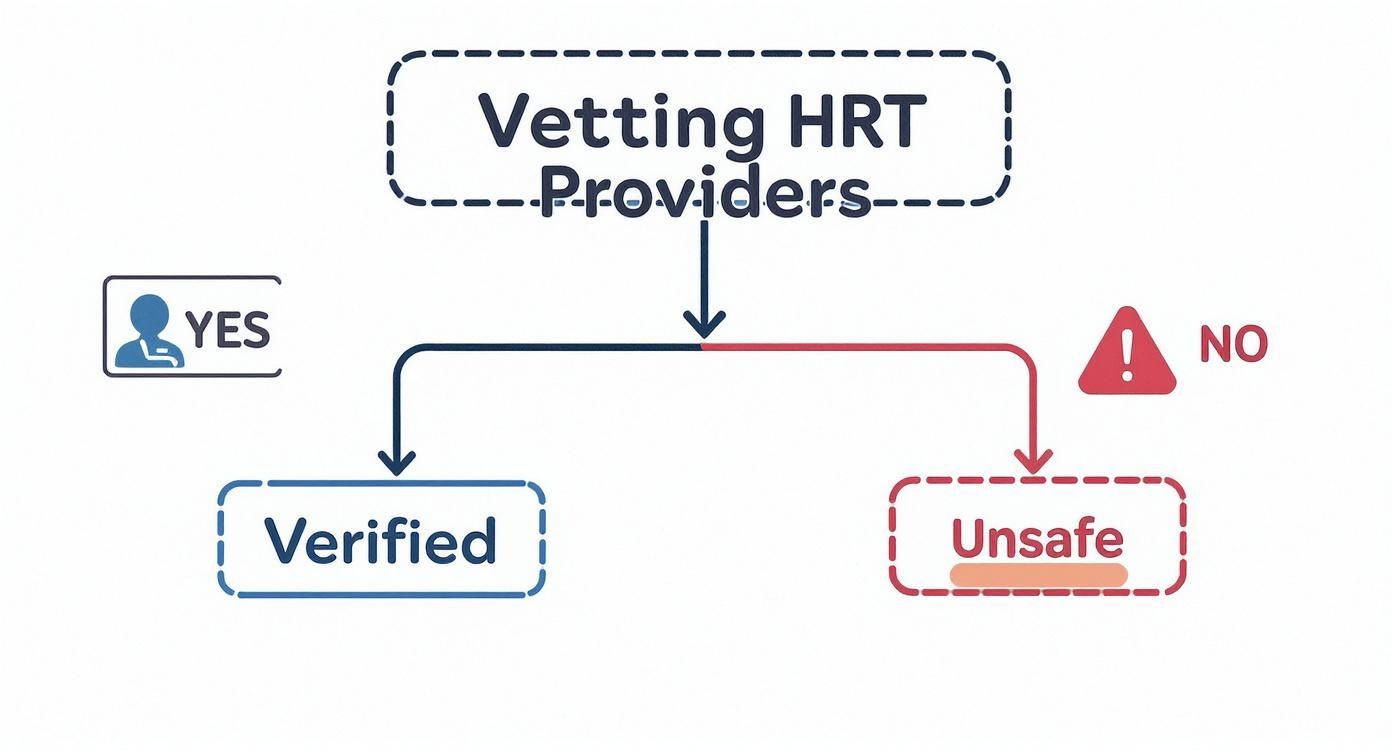
As the visual makes clear, the absolute first step is confirming a provider's medical legitimacy. Without that, nothing else matters—the service is fundamentally unsafe.
For these reasons, the DTC model is not a recommended path for anyone serious about safe and effective hormone therapy. The appeal of speed and low cost is a terrible trade-off for the basics of responsible medical care. True health optimization has to be built on a foundation of professional medical guidance, not just easy access to a product.
Finding the Right HRT Provider for Your Specific Needs

There’s no such thing as the single “best online hormone replacement therapy” for everyone. The right choice is deeply personal and hinges entirely on your specific health profile, symptoms, and what you’re trying to achieve. A service that’s perfect for a man looking to optimize testosterone might be completely wrong for a woman navigating menopause.
This is where you need to move past generic reviews and start matching your goals to a provider's specialized expertise. The key is to pinpoint your primary objective and then find a clinic built to help you get there safely and effectively.
For Men Seeking Testosterone Replacement Therapy (TRT)
If you’re a man dealing with symptoms of low testosterone—fatigue, a lagging libido, or trouble building muscle—you need a provider with deep expertise in male endocrinology. The best TRT clinics are laser-focused on testosterone management and its total impact on men’s health.
Look for services that offer:
- Comprehensive Male Hormone Panels: They should go beyond just total testosterone. A full picture requires testing for free testosterone, estradiol (E2), and Sex Hormone Binding Globulin (SHBG).
- Multiple Treatment Options: A good clinic will offer different delivery methods, like injections or creams, and help you find what fits your lifestyle.
- Proactive E2 Management: Controlling estrogen is a make-or-break part of successful TRT. An expert provider will have clear protocols for monitoring and managing E2 levels.
The goal of TRT isn't just to boost a number on a lab report; it's about resolving your symptoms and improving your quality of life. A provider who prioritizes how you feel over just prescribing a standard dose is a sign of a patient-first practice.
For Women Navigating Menopause
For women in perimenopause or menopause, the game changes. The goal is to relieve symptoms like hot flashes and night sweats while also protecting long-term bone and cardiovascular health. The best online HRT providers for women take a more holistic approach that goes beyond just estrogen.
Many women get the best results from clinics specializing in bioidentical hormone replacement therapy (BHRT), which uses hormones structurally identical to those your body makes naturally. It's crucial to find a provider who truly understands the nuanced application of these treatments. You can learn more about how bioidentical hormone replacement therapy differs from synthetic options and why it could be a better fit for you.
Key features to look for include:
- Expertise in BHRT: Find clinicians experienced in prescribing plant-based estradiol and micronized progesterone.
- Combination Therapy: Providers must understand that women with a uterus need progesterone alongside estrogen to protect the endometrial lining.
- Wellness Support: Top-tier clinics often provide resources for nutrition, fitness, and stress management that work alongside your hormone therapy.
For Athletes and Fitness Enthusiasts
Athletes and serious fitness buffs often look to hormone optimization to boost performance, accelerate recovery, and fine-tune body composition. This group needs a provider who gets the delicate balance between optimization and safety, operating squarely within established medical guidelines.
A good clinic for athletes won’t make wild promises. Instead, they’ll focus on bringing your hormone levels to an optimal—but healthy—range for your age and activity level. They should have a solid grasp of sports medicine and be able to design a protocol that supports your training without risking your long-term health.
For Busy Professionals and High-Performers
For busy professionals, convenience is king. Efficiency, discretion, and a seamless user experience are the deciding factors. You need a service that respects your time and fits into your packed schedule without a hitch.
Look for a provider with a slick digital platform for managing appointments and prescriptions. At-home lab testing or mobile phlebotomy services are a massive bonus, saving you trips to a clinic. Finally, discreet packaging and responsive customer support are non-negotiable—they make the whole process smooth and private.
To help you connect your personal needs with the right service model, this table breaks down the best approach for different patient profiles.
Recommended HRT Model by Patient Profile
| Patient Profile | Primary Goal | Recommended Service Model | Key Features to Prioritize |
|---|---|---|---|
| Men (35+) with Low-T Symptoms | Testosterone optimization and symptom relief | TRT-Specialist Clinic | Comprehensive labs, E2 management, multiple delivery options |
| Women in Perimenopause/Menopause | Symptom relief and long-term health | BHRT-Focused Wellness Clinic | Bioidentical hormone expertise, combination therapy, holistic support |
| Athletes and Fitness Enthusiasts | Performance, recovery, and body composition | Performance Medicine or Optimization Clinic | Medically supervised protocols, advanced biomarker tracking, sports medicine knowledge |
| Busy Professionals | Convenience, efficiency, and privacy | Subscription-Based Telehealth Platform | At-home testing, seamless digital experience, responsive support, discreet shipping |
Ultimately, the best provider is the one whose specialty aligns perfectly with what you need to achieve. By using your goals as a filter, you can cut through the noise and find a partner who can truly help you optimize your health.
The Big Picture: How Global Growth in Hormone Therapy Affects You
The rising demand for hormone therapy isn't just a local trend—it's a global movement that gives us a peek into the future of HRT. The sheer convenience of online platforms has put this growth into overdrive, creating a fiercely competitive international market. This dynamic directly shapes the quality, cost, and options available to you, so understanding the bigger picture is key to making a smart choice.
While North America has long been the dominant player in the hormone therapy space, other parts of the world are catching up fast. This boom is driven by a mix of factors: people are more aware of their hormonal health, the global population is aging, and many countries are making huge investments in their healthcare systems. As more and more people look for answers to hormonal imbalances, the demand for accessible, effective treatments keeps climbing.
The Asia Pacific Surge
The most dramatic shift is happening in the Asia Pacific. The region has exploded onto the scene as the fastest-growing market for hormone therapy, with a projected growth rate of a staggering 23.5% in 2025. This rocket-like expansion is fueled by a perfect storm of increased healthcare spending, a growing awareness of hormone-related conditions, and a digitally savvy population that makes telemedicine a natural fit. You can dig into more of the data on these market dynamics from Coherent Market Insights.
For patients, this global competition is a huge win. It forces providers to step up their game, improve service quality, and offer more competitive pricing to keep you as a client.
What This All Means for Your Online HRT Choice
This global movement isn't just some abstract economic trend; it has real, tangible consequences for anyone looking for the best online hormone replacement therapy. The rapid growth and intense competition are pushing providers to deliver a much higher standard of care.
As the market gets bigger, the bar for quality gets higher. Providers can no longer compete on price alone. Now, they have to prove themselves with a sophisticated platform, top-tier medical staff, and an outstanding patient experience. Ultimately, this competition works in your favor.
Here’s a look at how these global dynamics are directly improving the services you can get:
- Better Technology: Providers are pouring money into more secure and user-friendly telehealth platforms, which makes your consultations and follow-ups smoother and more reliable.
- Deeper Specialization: To stand out from the crowd, clinics are carving out specific niches, like TRT for men or bioidentical hormones for women. This leads to more focused, expert-driven care.
- More Transparent Pricing: The competition is forcing providers to be upfront about their costs. We're seeing a move away from confusing, hidden fees and toward clear, all-inclusive pricing models.
At the end of the day, this worldwide growth is a sign that online HRT is graduating from a niche service to a mainstream healthcare solution. For you, the patient, that means more choices, higher standards, and better access to the specialized care you need to hit your health goals.
Your Questions About Online HRT, Answered
Diving into online HRT can bring up a lot of questions, and that's perfectly normal. This section is designed to give you straightforward, direct answers to the most common concerns, so you can move forward with confidence.
Is Online Hormone Replacement Therapy Safe and Legal?
Yes—as long as it’s done right. When you go through a reputable provider that follows strict medical and legal standards, online HRT is both safe and legal. The key is finding a service that refuses to cut corners on your health.
Any legitimate clinic will always require a comprehensive medical evaluation, including recent blood work, before a licensed medical provider in your state writes a prescription. This is a non-negotiable step for safe, effective treatment.
They also must be fully HIPAA-compliant to protect your personal health data. Be wary of any operation that sells hormones without a prescription, skips essential blood tests, or uses unlicensed "health coaches" for medical consultations. Always double-check the credentials of the medical staff and confirm they use a licensed U.S. pharmacy to fill all prescriptions.
A provider’s willingness to bypass medical essentials like blood work and a real consultation is the biggest red flag. The best online hormone replacement therapy services prioritize your health and operate with the same standards as a physical clinic.
How Much Does Online HRT Usually Cost?
The cost of online HRT can vary quite a bit, depending on the provider’s business model and the specific hormones in your treatment plan. Knowing the different pricing structures is the best way to avoid surprise expenses.
Many clinics use an all-inclusive subscription model, which typically runs from $100 to $300 per month. This fee usually bundles everything—your consultations, the medication itself, and ongoing support from the clinical team.
On the other hand, some providers use a fee-for-service model, which can be less predictable. Initial consultations might cost anywhere from $150 to $500, with lab work adding another $50 to $400. On top of that, your monthly medication could be $50 to $250 or more.
Before you commit, always ask for a complete, itemized breakdown of all potential fees. This kind of transparency lets you budget accurately and compare your options fairly.
What Is the Process for Starting with an Online HRT Clinic?
A legitimate online clinic will guide you through a clear, structured medical process to ensure your treatment is both safe and effective. While the platforms might look different, the core steps are consistent across all high-quality providers.
The journey usually unfolds in four main stages:
- Initial Health Assessment: You’ll start by filling out a detailed online intake form. This is where you’ll share your medical history, describe your current symptoms, and outline your health goals.
- Comprehensive Lab Work: Next, you'll need to get comprehensive blood work done. The clinic coordinates this for you, either by sending a mobile phlebotomist to your home or directing you to a partner lab nearby.
- Telehealth Consultation: Once your lab results are back, you’ll have a video call with a licensed medical provider. They'll go over your results, discuss your symptoms, and work with you to create a personalized treatment plan.
- Medication and Monitoring: If a prescription is right for you, your medication will be shipped directly to your door from a licensed pharmacy. Your treatment will always include ongoing monitoring with follow-up labs and consultations to make sure your protocol stays effective and safe.
Can I Use My Insurance for Online HRT Services?
Whether you can use insurance for online HRT really depends on the provider and your specific plan. This is a common point of confusion for a lot of people just starting out.
Most specialized online HRT clinics operate on a direct-pay or "cash-pay" basis. They choose not to work with insurance companies directly, which helps them streamline their services, cut down on administrative costs, and offer more transparent, upfront pricing.
However, that doesn't always mean you're paying for everything out of pocket. Some clinics can give you a superbill—an itemized receipt of the services you received. You can then submit this superbill to your insurance company for potential out-of-network reimbursement.
It’s also worth noting that lab work is often a coverable expense. Even if the clinic’s consultation and medication fees aren't covered, your insurance may pay for the required blood tests.
Before choosing a provider, there are two things you should do:
- Ask the clinic directly if they offer superbills or any other documentation for insurance claims.
- Call your insurance provider and ask about their policy on out-of-network reimbursement for telehealth services and HRT medications.
Taking these steps upfront will give you a clear picture of your potential costs and reimbursement options before you begin treatment.
Ready to take the next step in optimizing your health with expert guidance? At Elite Bioscience, we provide medically supervised hormone, peptide, and vitamin therapies with a focus on safety, transparency, and results. Explore our personalized treatment plans and discover how we can help you achieve your wellness goals.
Learn more and get started at https://elitebioscience.co.