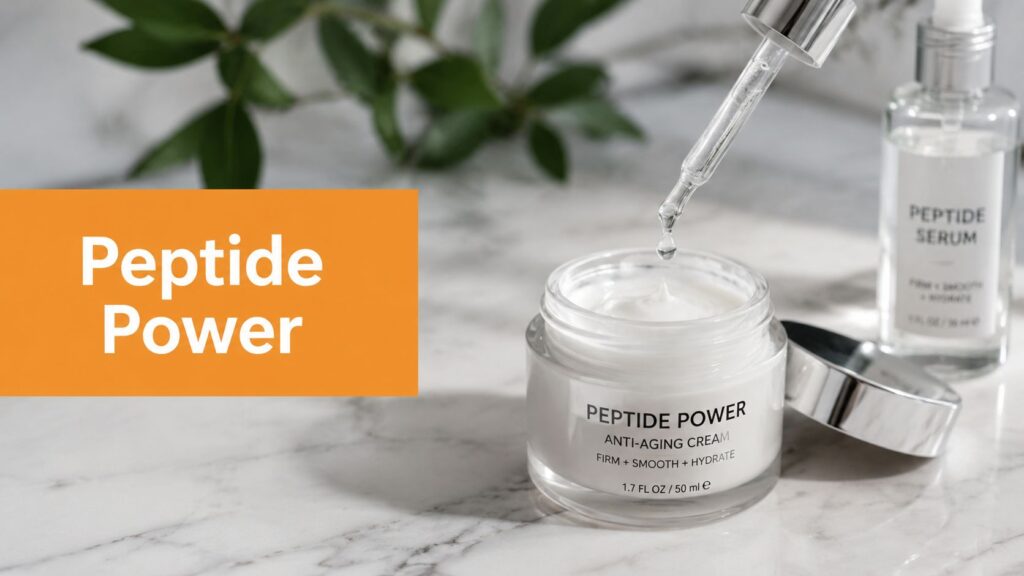
If you've been told that any cream with “peptides” on the label is automatically a smart anti-aging buy, that advice is too loose to be useful. Peptides are real skincare actives, but the word gets used so broadly in marketing that shoppers often end up paying for the idea of peptide science rather than a formula that matches their actual skin goals.
That distinction matters because an anti aging peptides cream can be worth using, just not for every person and not for every job. Peptides can support firmer-looking skin, soften the look of fine lines, and help a stressed barrier feel more resilient. They are not a substitute for sunscreen, and they won't outperform a well-chosen retinoid if your main goal is deeper photoaging correction.
A better way to judge peptide skincare is simple. Ask what visible problem the product is trying to improve in the mirror. Is it expression lines, early crepiness, dryness, a rough texture, or loss of bounce? Once you think that way, peptide science becomes much easier to understand.
Why Every Anti-Aging Cream Contains Peptides
Walk through any skincare aisle and you'll see peptides in moisturizers, serums, eye creams, and “firming” creams. That doesn't mean every formula works equally well. It means peptides have become one of the most established non-retinoid anti-aging ingredient categories in modern skincare.
CeraVe describes peptides as short chains of amino acids and notes that peptide-containing formulations can help improve the appearance of aging skin, minimize the look of fine lines and wrinkles, and promote firmer, smoother-looking skin with consistent use, which is one reason peptides now show up across mainstream skincare categories rather than niche products in CeraVe's peptide ingredient overview.
Why brands keep using them
There are two practical reasons.
- They fit many formulas. Brands can place peptides into creams, serums, and eye products without making the whole routine feel harsh.
- They target visible aging pathways. Peptides are commonly positioned around collagen, elastin, barrier support, and smoother-looking skin.
- They appeal to cautious users. Many people want anti-aging help without jumping straight into stronger actives.
That last point is important. Plenty of patients want results, but they also want a product they'll keep using. A cream that feels comfortable every night often beats a stronger product that sits untouched after a week of irritation.
Not all peptide creams are nonsense. Not all peptide creams are impressive either.
The real reason peptides matter
Peptides matter because they've moved beyond vague “anti-aging” language. In everyday skincare, they now occupy a middle ground between a basic moisturizer and a stronger corrective active. That makes them especially appealing for people who want steadier, lower-irritation support.
The mistake is assuming the ingredient name alone tells you what the product will do. It doesn't. One peptide cream may be aimed at expression lines. Another may focus on firmness and recovery. Another may mainly support hydration and barrier comfort.
So when you see peptides everywhere, don't ask, “Do peptides work?” Ask, “Which visible problem is this peptide cream trying to solve?”
How Peptides Signal Your Skin to Act Younger
The easiest way to understand peptides is to stop thinking of them as magic collagen and start thinking of them as messages.
Your skin runs on communication. Cells need signals that tell them when to repair, when to build supportive material, and when to calm down. As skin ages and faces daily stress, that communication becomes less efficient. Topical peptides are used because they can act like small, targeted reminders.

From amino acids to a visible skin effect
Amino acids are the small building blocks your body uses to make proteins. When a few amino acids link together, they form a peptide. Proteins such as collagen and elastin are much larger structures built from these smaller components.
That's where people often get confused. Applying a peptide cream doesn't mean you are smearing whole collagen fibers onto the skin and replacing what's been lost. Instead, the peptide acts more like an instruction. It interacts with the skin in a way that can encourage certain processes, such as support for collagen-related activity, skin-cell turnover, or a calmer inflammatory environment.
Think of peptides as text messages
A moisturizer mostly helps by reducing water loss and making skin feel smoother. A peptide does something different. It aims to signal.
A simple analogy works well here:
| Skin component | What it does |
|---|---|
| Amino acids | Individual letters |
| Peptides | Short messages |
| Proteins like collagen | Full long-form structures built from many parts |
Some peptides “tell” skin to support firmness. Some help the skin act less inflamed. Some are used because they may soften the look of movement-related lines. If you want a deeper explanation of this signaling role, this guide on peptides for collagen production gives useful background on why these molecules are discussed so often in skin-support conversations.
Practical rule: A peptide cream doesn't replace your skin's structure directly. It tries to nudge the skin toward better behavior.
Why that matters in the bathroom mirror
This mechanism helps explain why peptide products rarely deliver overnight drama. They are not like makeup, and they are not procedures. They depend on repeated use because they are trying to influence gradual biological processes rather than create an instant surface trick.
That's also why the benefits tend to show up in specific ways:
- Fine lines may look softer
- Skin can feel smoother and less papery
- Early loss of firmness may look less obvious
- Dry, fatigued skin may appear more rested
A good anti aging peptides cream is really about improving the conditions that make skin look older, not faking youth in a single application.
The Key Peptide Players in Anti-Aging Creams
When consumers read “peptide complex” on a jar, they often assume more peptides automatically means better results. That's not how formulation works. What matters more is which type of peptide is included and what that type is meant to do.

Signal peptides for firmness and texture
If your main complaint is that your skin looks less springy or your fine lines seem more etched in, signal peptides are usually the category to notice first. These are the peptides most often associated with telling skin to support collagen- and elastin-related functions.
A common example is Palmitoyl Pentapeptide-4, often recognized by the Matrixyl name. In plain English, this category is usually chosen for people who look in the mirror and say, “My skin doesn't look as dense or as smooth as it used to.”
Visible goal: firmer-looking skin and softer fine lines
What shoppers often miss is that signal peptides are less about one dramatic wrinkle disappearing and more about an overall shift in surface quality. Skin may look a little more even, a little more resilient, and less tired.
Carrier peptides for repair support
Carrier peptides are easier to understand if you think of them as delivery helpers. They are used to carry trace elements to the skin, especially in formulas designed around recovery and visible skin quality.
The best-known example is copper peptides, often listed as GHK-Cu. These are popular in conversations about post-stress skin, visible healing support, and overall skin vitality.
Visible goal: better-looking recovery, smoother texture, and a healthier feel
This type often appeals to people whose skin looks fragile, dull, or “worn down.” If your face doesn't just have lines but also looks less firm overall, a carrier peptide may make more sense than a product aimed only at movement lines.
For readers interested in peptide categories linked to firmness-focused goals, this article on the best peptides for skin tightening is a useful label-reading companion.
Neurotransmitter-blocking peptides for expression lines
This category gets the most attention because it sounds like a topical shortcut to smoother forehead or crow's-feet lines. These peptides are used in products marketed toward dynamic wrinkles, meaning lines linked to repeated facial movement.
The best-known example is Acetyl Hexapeptide-8, often called Argireline.
Visible goal: smoothing the look of expression lines
Expectations require adjustment. A topical product is not the same as an injectable procedure. A cream in this category may help the skin look smoother in areas where repeated movement contributes to visible lines, but the effect is typically subtler and depends heavily on the full formula.
Enzyme-inhibitor peptides for preserving structure
Some peptides are discussed in terms of helping limit processes that break down skin's support system. These are often described as enzyme-inhibitor peptides.
In practical terms, the visible goal here is not “instant tightening.” It is more about helping skin hold onto its structure by reducing some of the wear-and-tear patterns associated with aging skin.
Visible goal: helping maintain firmness over time
This category is the hardest to understand from marketing copy because brands often overstate it. The mirror-level translation is simple: these peptides are aimed at slowing some of what makes skin look looser and more lined.
A label-reading shortcut that actually helps
If you don't want to memorize ingredient chemistry, use this simpler framework:
- Concern is forehead or smile lines: look for products positioned around Argireline or other movement-line peptides.
- Concern is softness, crepiness, or loss of bounce: lean toward signal peptides such as Matrixyl-type ingredients.
- Concern is fragile, stressed, dull skin: consider copper peptide formulas.
- Concern is vague “aging” with no clear goal: skip broad claims and find a product that names the visible target.
A peptide name is only useful when you can connect it to a skin concern you actually have.
That bridge between the ingredient list and the bathroom mirror is what makes peptide shopping less confusing. You're not buying a peptide. You're buying a proposed visible outcome.
Clinical Efficacy What Science Says About Results
The fairest question about any anti aging peptides cream is blunt. Do topical peptides do anything you can see? The answer is yes, but the scale of improvement depends on the peptide, the concentration, the rest of the formula, and your starting skin condition.
A recent peer-reviewed review from 2024 reported that cosmetic peptides are supported by a growing body of clinical and review literature across wrinkle reduction, collagen support, and skin-barrier repair. The review notes that peptides can improve collagen synthesis, enhance skin-cell proliferation, and reduce inflammation, with visible wrinkle reduction reported in some studies at 2% in one formulation and 4% in another, and it also cites a study of 45 subjects in which Tripeptide-3 improved forehead fine lines by up to 52% in the 2024 review on cosmetic peptides.

What those results mean in real life
Those numbers are encouraging, but they need context. A measurable change in a study does not mean everyone using a peptide cream will look dramatically younger in casual bathroom lighting. It means some formulations can produce visible improvements that are large enough to be tracked in controlled settings.
That's still meaningful. In skincare, a product doesn't need to behave like a procedure to be useful. For many people, a softer forehead line, a smoother skin surface, or less “crinkly” texture around the eyes is exactly the kind of gain they want.
Why one peptide cream works better than another
Not all peptide formulas perform the same way, even when the front label looks similar. A few reasons matter a lot:
- Concentration matters. Some studies in the review reported visible wrinkle change at specific concentrations, not just from the presence of a peptide name.
- Delivery matters. A peptide has to be formulated in a way that gives it a fair chance to interact with the skin.
- The whole formula matters. A peptide cream paired with supportive hydrating and barrier ingredients often makes more practical sense than a peptide added to a weak base.
Measurable does not mean miraculous. It means the product has a plausible chance of creating visible improvement when used correctly and consistently.
What to expect without fooling yourself
Reasonable expectations for peptide creams look like this:
| Likely outcome | Less likely outcome |
|---|---|
| Softer-looking fine lines | Immediate dramatic wrinkle removal |
| Smoother texture | A result that rivals procedures |
| Better-looking skin comfort and bounce | Reversal of deeper long-term photoaging |
| Gradual improvement with regular use | Overnight change |
If you approach peptides as gradual corrective support, the science looks solid enough to justify interest. If you expect them to replace procedures or stronger cornerstone actives, you'll probably be disappointed.
Integrating Peptides Into Your Skincare Routine
Peptides are often a good fit for people who want an anti-aging active that feels cooperative rather than combative. In practical use, peptide creams are generally positioned as lower-irritation options that may suit sensitive, dry, and acne-prone skin, and they're commonly recommended once or twice daily as leave-on products, often paired with ingredients such as hyaluronic acid, niacinamide, or antioxidants in No7's guide to using peptides for skin.

Where a peptide cream goes
A simple routine usually works best.
- Cleanse first. Start with clean skin.
- Apply your peptide product as a leave-on step. If it's a cream, use it after cleansing or after a light hydrating layer.
- Add moisturizer if needed. Some peptide creams are rich enough to serve as the moisturizer. Others are more treatment-like.
- Finish with sunscreen in the morning. This matters more than any peptide.
The routine doesn't need to be complicated. Consistency matters more than creating an elaborate lineup you won't maintain.
Here's a visual walkthrough of layering order and application flow:
What peptides pair well with
Peptides are generally easy team players. Good companions include:
- Hyaluronic acid for hydration and a plumper look
- Niacinamide for barrier support and overall skin comfort
- Antioxidants for added environmental support
These combinations make sense because they don't ask one ingredient to do everything. The peptide handles signaling support. The others help with water balance, barrier function, and daily skin stress.
A routine example that keeps expectations realistic
If your skin is sensitive or dry, a morning routine could be cleanser, peptide cream, then sunscreen. At night, you might cleanse and use the same peptide cream again, with a moisturizer layered on top if you need more comfort.
If you already use stronger actives, keep the routine calm enough that you can stay consistent. Peptides tend to be easier to tolerate than many exfoliating or retinoid-based products, so they're often useful as a supportive layer rather than the star of an aggressive routine.
Topical Creams vs Injectable Peptides
This is one of the biggest sources of confusion. A peptide in a face cream and a peptide used in a medical setting are not the same tool, even if the word “peptide” appears in both conversations.
Topical cosmetic peptides are designed to work locally on the skin. Their job is appearance-focused. They're used to support smoother texture, firmer-looking skin, or less visible fine lines.
Injectable peptides belong to a very different category. They are discussed in relation to broader physiological goals such as signaling within the body, therapeutic protocols, or clinician-guided wellness and recovery uses. That is not the same as putting a peptide moisturizer on your face before bed.
Side-by-side difference
| Feature | Topical peptide cream | Injectable peptide |
|---|---|---|
| Primary goal | Cosmetic skin appearance | Systemic or therapeutic effect |
| Target | Skin surface and nearby skin layers | Body-wide biological pathways |
| Result style | Gradual visible skin improvement | Non-cosmetic goals may be involved |
| Access context | Cosmetic skincare purchase | Medical or clinic-guided context |
| Use case | Fine lines, firmness, barrier support | Depends on the specific peptide and protocol |
Why the distinction matters
People sometimes assume that because injectable peptides can have more powerful-sounding effects, a cream with peptides must be a weaker version of the same thing. That's the wrong model.
A topical peptide cream is not a home version of an injectable protocol. It's a different category with a different route, different purpose, and different expectation level. The cream is trying to improve how skin looks. An injectable peptide protocol may be aimed at entirely separate goals.
If your question is cosmetic, start by deciding whether you want a skincare product or a medical treatment. Don't blur them together.
Don't borrow dosing logic across categories
Another common mistake is trying to apply medical-style peptide thinking to over-the-counter skincare. Concentration in a cream, frequency of facial application, and systemic dosing are different issues.
If you're researching therapeutic peptide categories rather than cosmetic skincare, resources like this overview of GHK-Cu dosage belong in that separate conversation. It's useful educational material, but it shouldn't be treated as instructions for choosing a face cream at the drugstore.
That separation protects you from bad assumptions. It also helps you spend money more intelligently. Buy a peptide cream for visible skin support. Explore injectable peptides only in the proper medical context and for the right reasons.
How to Choose a Peptide Cream That Actually Works
A smart peptide purchase starts by lowering the hype and sharpening the question. Don't ask whether peptides are “good.” Ask whether this product fits the problem you want to improve, and whether that problem would be better addressed by a simpler staple.
Cleveland Clinic's guidance frames peptides as helpful adjuncts rather than the cornerstone of a routine, noting they may support inflammation control and skin support while basics like cleanser, moisturizer, sunscreen, and retinoids or bakuchiol often deserve priority in Cleveland Clinic's overview of peptides for skin.
A buying checklist that saves money
Use this when you shop:
- Match the product to the mirror problem. If your concern is expression lines, look for a peptide cream marketed for that purpose. If your issue is dryness and loss of bounce, choose one oriented toward firmness and barrier support.
- Prefer named peptides over vague “peptide complex” language. Specific names give you a clearer sense of intended function.
- Judge the whole formula. A peptide in a well-built moisturizing base often makes more sense than a flashy label attached to a mediocre cream.
- Think of peptides as support, not replacement. They may help with fine lines, hydration, and skin comfort. They probably won't replace sunscreen or stronger corrective staples.
- Buy based on tolerance and consistency. The best anti aging peptides cream for you is the one you'll use steadily for months.
When a peptide cream is worth it
A peptide cream is often worth trying if you want a lower-irritation anti-aging step, your skin dislikes stronger actives, or you want to support a routine built around hydration and gradual smoothing.
It may not be the first place to spend money if you still skip sunscreen, don't use a reliable moisturizer, or haven't considered a retinoid or bakuchiol product when appropriate. Those basics usually do more heavy lifting.
One practical option in the broader peptide space is Elite Bioscience, which operates as an online medical clinic focused on hormone, peptide, and vitamin therapies. That's a separate category from cosmetic peptide creams, but it may be relevant for readers comparing skincare peptides with medically guided peptide services.
The bottom line is simple. Peptides are useful, but they work best when you know what you're asking them to do.
If you're sorting out the difference between cosmetic peptide creams and medically guided peptide options, Elite Bioscience offers educational resources and telehealth-based access to peptide-related therapies in the USA, Canada, and Australia. Start there if your questions go beyond skincare labels and into clinical peptide use.