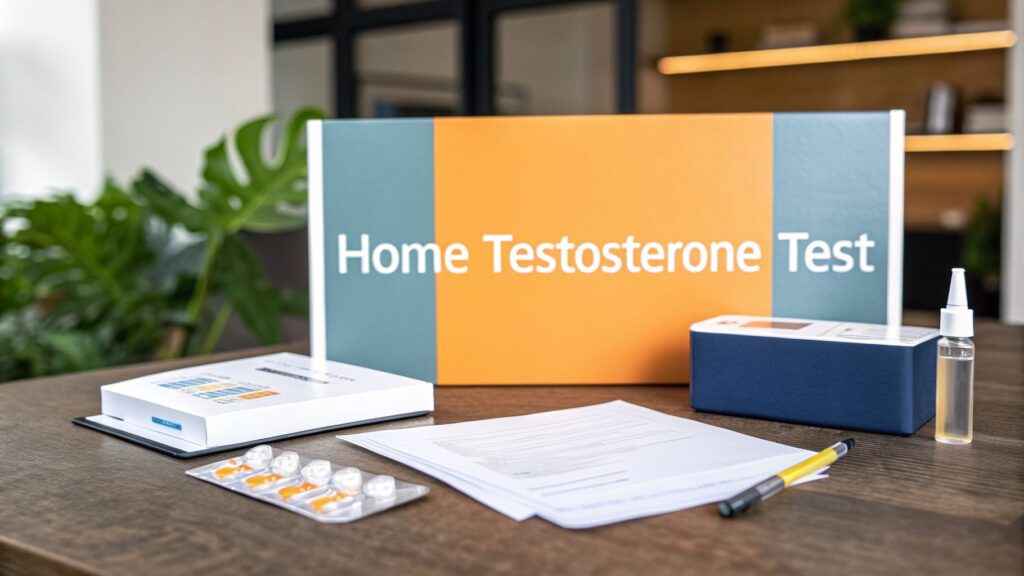
An at-home testosterone test is a straightforward, private way to get a handle on your hormone levels right from your own home. Think of it as your first step—a baseline measurement that gives you a starting point for a real conversation about your health, all without the hassle of a clinic visit.
Why Test Your Testosterone at Home?
Ever feel off, drained, or just not quite yourself? For a lot of guys, the answer might be tied to their testosterone levels. But the thought of booking a doctor's visit, then a separate lab appointment, can be enough to make you put it off indefinitely. This is where an at-home testosterone test completely changes the game.
It’s less of a medical procedure and more of a simple, proactive health check-in. These kits give you the power to collect critical information about your hormonal health on your own schedule. Instead of carving out time for a clinic, you can collect a sample first thing in the morning when testosterone is typically at its peak. It's about removing the barriers and putting you in the driver's seat.
The New Standard in Personal Health
This move toward home-based health testing isn't just a fleeting trend; it’s a genuine shift in how we manage our own wellness. People want direct, accessible ways to keep tabs on their health, and hormone testing is a perfect example of this.
The demand for convenience and privacy is reshaping the entire market. In 2025, the global testosterone test market was valued at USD 114.3 million, and it's expected to nearly double to USD 222.7 million by 2035. What’s really telling is that home care settings make up 40.2% of that market. This explosive growth is fueled by how easy these tests are and the ability to get health insights without needing to book an appointment. You can read more about these market trends and what they mean for the future of personal health management.
The big idea here is moving from passively wondering about your health to actively collecting the data you need to have a meaningful conversation with a healthcare professional.
At Home Testosterone Testing At a Glance
So, what exactly makes at-home testing such a compelling option? It comes down to a few key advantages that directly solve the pain points of the old way of doing things. This guide is designed to be your roadmap, taking you from curiosity to clear, actionable insights—especially if you're considering next steps with a telehealth provider like Elite Bioscience.
Let's break down the main benefits.
| Feature | At-Home Test Benefit | Why It Matters For You |
|---|---|---|
| Convenience | Test from anywhere, anytime without appointments. | Fits into your busy schedule, eliminating travel and wait times. |
| Privacy | Collect your sample in the comfort of your home. | Discuss sensitive health topics discreetly and on your own terms. |
| Accessibility | No need for a doctor's referral to order a test. | Gives you direct access to your own health data, fast. |
| Empowerment | Provides a clear starting point for health discussions. | Transforms vague symptoms into concrete data you can act on. |
Ultimately, these tests give you a powerful, private, and incredibly convenient tool to start understanding and taking control of your hormonal health.
Choosing the Right At-Home Testosterone Test for You
So, you're ready to check your testosterone levels from home. Great. But as soon as you start looking, you'll see a few different options: finger-prick blood tests, saliva swabs, and even urine collection kits. Each one gives you a slightly different angle on your hormonal health, so picking the right one comes down to what you really want to know.
Think of it like getting a report on your car's engine. A saliva test is like a quick diagnostic that checks one specific, important part—your free testosterone, the stuff your body can use right now. A dried blood spot test, on the other hand, is more like a full workup from a mechanic, measuring your total testosterone and often other key markers that show the bigger picture.
This isn't about one being "good" and the others "bad." It's about matching the tool to the job. If you're not sure which job you need done, this quick guide should help.

As you can see, whether you're just curious about your baseline T-levels or you're trying to get to the bottom of some nagging symptoms, an at-home test is a smart, private, and convenient first step.
To help you decide, let's break down the common test types you'll find.
Comparing At-Home Testosterone Test Types
This table gives a clear, side-by-side look at the three main at-home testing methods. Use it to quickly compare what each test measures, its key benefits and drawbacks, and who it's best suited for.
| Test Type | What It Measures | Pros | Cons | Best For |
|---|---|---|---|---|
| Blood Spot | Total Testosterone, Free Testosterone (calculated), SHBG, Estradiol, LH | Clinically relevant data, comprehensive panel, considered the "gold standard" for at-home screening. | Requires a finger prick, which can be uncomfortable for some. | Men who want a detailed, actionable overview of their hormonal health for initial screening or monitoring. |
| Saliva | Free Testosterone only | Completely painless, non-invasive, and very easy to collect the sample. | Doesn't measure total testosterone, which is the primary marker for clinical diagnosis. | Quick, simple checks of active testosterone levels or for those who are needle-averse. |
| Urine | Hormone metabolites (breakdown products) | Can show hormone production and use over a 24-hour period. | Results are complex to interpret and don't directly map to the serum levels doctors use for diagnosis. | Specialized cases or tracking daily hormonal rhythms, but not ideal for a straightforward T-level check. |
Each method has its place, but for most men starting this journey, one type clearly provides the most useful and reliable information.
Blood Spot Tests: The All-Rounder
The most common and, frankly, most comprehensive option you'll find is the dried blood spot (DBS) test. You've probably seen these—it’s a simple kit with a tiny, spring-loaded lancet. You just prick your fingertip and squeeze a few drops of blood onto a collection card. It’s over in a minute.
The real power of a blood spot test is that it measures total testosterone. This is the metric that matters most to doctors and is the cornerstone for diagnosing low T. It gives you the complete picture by accounting for both the "free" testosterone ready for action and the testosterone that's bound to proteins in your blood.
Plus, a good blood spot test doesn't stop there. The best kits use that same sample to check other critical biomarkers, including:
- Sex Hormone-Binding Globulin (SHBG): This protein locks onto testosterone. Knowing your SHBG level helps explain how much of your total T is actually available for your body to use.
- Luteinizing Hormone (LH): Think of this as the "go" signal from your brain to your testes. Low LH can point to a different root cause of low T than if your testes just aren't responding.
- Estradiol: Yes, men need estrogen too. But it has to be in the right balance with testosterone. High estradiol can cause its own set of problems.
This is why the blood spot test is the go-to for a serious initial screening. It gives you a rich, multi-layered view of your entire endocrine system.
Saliva Tests: The Convenience Option
There’s no denying the appeal of a saliva test. It's completely painless—you just spit into a tube. If you're anxious about needles or even a quick finger prick, this is the easiest way to get some data.
The catch? Saliva tests typically only measure free testosterone. While that number is important (it’s the hormone that does the heavy lifting), it's only one piece of the puzzle. Most medical guidelines and doctors rely on total testosterone to make a diagnosis, something a saliva test can't give you.
A saliva test can be a decent entry point if you're just curious and want the simplest possible experience. But for a truly complete hormonal profile or a result you can take to a doctor, you'll almost always need a blood test to follow up.
Urine Tests: A Look at Metabolites
Urine testing is the least common method for a simple testosterone check, and for good reason. It doesn't measure the hormones directly, but rather their metabolites—what's left over after your body has used them. This can sometimes paint a picture of how your body processes hormones over a full day.
While this data can be useful in very specific, complex cases, it's not what you need for a straightforward answer about your T-levels. The results are harder to interpret and don't line up neatly with the blood serum levels that are the standard in clinical practice.
For a clear, reliable, and clinically relevant starting point, the dried blood spot test delivers the most robust data. If you're interested in learning more about the process, check out our guide on how to check hormone levels at home.
How Accurate Are These Tests Really?
This is the million-dollar question, isn't it? And thankfully, the answer is pretty straightforward. When you're using a quality at home testosterone test from a company that knows what it's doing, the results are absolutely reliable enough for screening.
The real key is understanding what we mean by "accurate" and realizing the critical role you play in getting a good reading.
Think of it like this: the high-tech lab equipment doesn't care where the blood came from. Whether a phlebotomist takes it from your arm in a clinic or you provide a few drops from a finger prick at your kitchen table, the sample ends up in the same kind of sophisticated laboratory. The science behind the analysis is identical; the only thing that changes is how the sample was collected.
The Gold Standard Versus At-Home Convenience
In a clinical setting, the "gold standard" is venipuncture—a blood draw straight from a vein. This gives technicians a large, pristine sample to work with, which is why it's the benchmark for official medical diagnoses. An at-home finger-prick test, on the other hand, collects capillary blood from the tiny vessels just under your skin.
So, are they the same? Not exactly, but for our purposes, they are extremely close. Study after study has shown that dried blood spot tests deliver results that are clinically comparable to traditional venous draws for major hormones like testosterone.
The whole point of an at-home test is to be a powerful first-line screening tool. It’s designed to tell you if your levels are in a healthy range or if something is off that warrants a closer look. For that job, they are more than accurate enough.
The biggest variable in this whole equation isn't the test itself. It's you.
Why Lab Certification Is a Non-Negotiable
Before we even get into collection technique, let's talk about the lab. This is a deal-breaker. You absolutely must ensure the laboratory processing your sample is the real deal, and that's where CLIA certification comes in.
CLIA stands for the Clinical Laboratory Improvement Amendments. These are strict federal standards that labs must meet to prove the accuracy, reliability, and timeliness of their results. A CLIA-certified lab is your guarantee that your sample is being handled by professionals who meet the highest industry standards.
Opting for a test kit that isn't processed by a CLIA-certified lab is a waste of your time and money. It's like asking an amateur to interpret your MRI scan—you just can't trust the results. Reputable telehealth providers like Elite Bioscience only partner with these top-tier, certified labs.
Common Mistakes That Can Skew Your Results
Here’s the thing: the biggest threat to getting an accurate result from an at home testosterone test isn’t a faulty kit. It’s the small, completely avoidable mistakes people make during the collection process. If your results come back looking strange, it's almost always due to one of these slip-ups:
- Testing at the Wrong Time: Your testosterone levels are highest in the morning, usually peaking around 8 a.m. If you test in the afternoon, your levels could be up to 25% lower, giving you a false low reading.
- Contamination: It sounds obvious, but not washing your hands thoroughly before the finger prick can introduce oils and dirt into your sample. Likewise, touching the collection card with anything besides your blood droplet can easily compromise the test.
- "Milking" Your Finger: Squeezing your finger like you're trying to get the last drop of toothpaste out is a huge mistake. This forces interstitial fluid (tissue fluid) into the blood sample, diluting it and causing an artificially low reading. The right way is to warm your hands up first to get the blood flowing naturally.
- Not Enough Blood: The lab needs a sufficient sample to run its analysis. One of the most common reasons for a test to be rejected is because the collection circles on the card weren't filled completely.
Nailing these simple steps is the single most important thing you can do to ensure the number you get back truly reflects what's going on in your body. An accurate reading is the first step to taking control of your health, especially if you're experiencing the symptoms of low free testosterone.
The bottom line is clear: a quality at-home test, used correctly and processed by a certified lab, provides reliable and actionable data. It's an excellent starting point for anyone looking to get a handle on their hormonal health.
How to Nail Your At-Home Sample Collection

Getting a trustworthy result from your at home testosterone test all comes down to collecting a good sample. Think of it like a pre-flight checklist. The steps are simple, but getting them right is non-negotiable for an accurate snapshot of your hormone levels. This guide will walk you through the process, helping you sidestep the common mistakes that can skew your results.
First, let's talk about timing. It's everything. Testosterone levels are highest in the morning, typically between 7 a.m. and 10 a.m. If you test in the afternoon, your reading could be up to 25% lower than your morning peak. That's a huge difference that could point you in the wrong direction. The golden rule? Always collect your sample within the first hour of waking up.
Also, what you do before the test matters. For a true baseline reading, you'll want to collect your sample before you eat or drink anything (except water) and definitely before you hit the gym. A tough workout can cause temporary hormone fluctuations, so get your sample squared away first.
Getting Ready for a Smooth Collection
A few minutes of prep work can make the entire process a breeze. Don't just tear open the kit and go for it. Setting the stage ensures you get a clean, usable sample that the lab can work with.
Here are a few pro tips to get you started:
- Hydrate: Drink a glass of water 20 to 30 minutes before you plan to collect the sample. Good hydration means better blood flow.
- Warm Your Hands: This is the secret to an easy collection. Run your hands under warm water for a minute or swing your arms around like a windmill. Getting blood to your fingertips is key.
- Pick the Right Finger: Go for the middle or ring finger on the hand you don't write with. They're usually less calloused, so the prick will be less noticeable.
The goal is a steady, natural flow of blood. If you have to squeeze or "milk" your finger aggressively, you risk contaminating the sample with tissue fluid. This will dilute the blood and can lead to an artificially low reading.
The Finger-Prick Process, Step by Step
Okay, your kit is laid out and your hands are warm. You're ready. The blood spot test is designed to be quick and almost painless. Just follow these steps carefully.
- Clean the Site: Wash your hands well with soap and warm water. Grab the alcohol wipe from your kit, clean the tip of your chosen finger, and let it air dry completely.
- Use the Lancet: Press the lancet firmly against the side of your fingertip and click the button. You'll feel a quick, sharp prick.
- Wipe the First Drop: Use the sterile gauze to wipe away the very first bead of blood. It can contain fluids from the skin that we don't want.
- Fill the Dots: Now, gently massage your finger from the base toward the tip to form a large, hanging drop. Let that drop fall right into the center of a circle on the collection card. Don't smear it—let it drop.
- Complete the Card: Keep going until you've completely filled every circle on the card. The lab needs enough blood to run all the necessary tests.
- Package It Up: Pop a bandage on your finger. Let the collection card air dry for at least 60 minutes before you put it in the return mailer. Then just seal it and send it off.
This simple process is part of a major shift in how we manage our health. In fact, the global market for blood-based testosterone testing hit USD 2,188.8 million in 2024 and is on track to reach USD 3,601.4 million by 2030, largely because of the convenience of at-home kits. It’s a powerful way to get crucial data about your body without waiting for a doctor's appointment. You can discover more insights about the growth of testosterone testing and see how it's shaping modern healthcare.
Understanding Your Results and Planning Next Steps

Getting a lab report full of medical jargon and numbers can feel like you’re trying to crack a code. But those numbers from your at-home testosterone test are exactly what you need to understand what’s going on inside your body. Let's walk through how to translate that data into real insights and, more importantly, how to build an effective plan from there.
The numbers themselves are just the starting point. They give you a critical snapshot of your hormonal health, but their true power is in the informed conversation they enable you to have with a healthcare professional. Think of your test result not as a final verdict, but as the perfect jumping-off point for taking back control of your health.
Decoding Your Hormone Report
When you open your results, a few key biomarkers will stand out. The two most important ones are Total Testosterone and Free Testosterone. Getting the difference between them is the key to seeing the whole picture.
- Total Testosterone: This is the big, all-encompassing number. It measures every bit of testosterone in your blood—both the portion that's bound to proteins and the small amount that’s “free” and ready to be used by your body.
- Free Testosterone: This is the stuff that really matters for how you feel. It’s the active, usable hormone that isn't attached to proteins. This tiny fraction, usually just 2-3% of the total, is what can actually enter your cells and get to work.
Your report will show your levels next to a “reference range,” which is basically the typical range for healthy individuals. If your numbers are dipping below that range, it’s a clear signal that it’s time to dig a little deeper. For a more detailed look at lab values, check out our guide on how to read lab results.
Your test result is more than just a number; it's a piece of evidence. It transforms vague symptoms like fatigue or low libido into a concrete data point that can guide your next steps with precision.
From Information to Action: The Next Step
A number on a page is just information. The real power comes from what you do with it. Your at-home test result is the catalyst for a productive conversation with a qualified medical provider who can interpret the findings in the context of your symptoms, medical history, and goals.
This is where a specialized telehealth clinic like Elite Bioscience becomes an essential partner. Our medical team is trained to look beyond the numbers and connect your lab results to how you actually feel. That evaluation is the bridge between identifying a potential issue and creating a personalized plan to fix it.
This isn't guesswork. It's a structured, medically supervised pathway designed to help you get your vitality back.
Considering Testosterone Replacement Therapy (TRT)
If your lab results and symptoms point toward clinically low testosterone (hypogonadism), one of the most effective treatments your provider may discuss is Testosterone Replacement Therapy (TRT). TRT is a medical treatment designed to restore your hormone levels to an optimal, healthy range, directly tackling the root cause of your symptoms.
This isn't some fringe treatment; it's established medical science. In fact, testosterone replacement therapy is a major pharmaceutical market, projected to hit USD 2.57 billion by 2031. The main reason? Hypogonadism, which accounts for 52.8% of all cases. These figures show that TRT is a professionally regulated, multibillion-dollar industry with serious clinical backing and physician oversight. When you work with a clinic like Elite Bioscience, you're engaging with a legitimate and highly effective medical protocol.
Based on a comprehensive evaluation, your provider might determine that a tailored TRT plan is the right path forward for you.
Your Personalized Path with Elite Bioscience
The journey with Elite Bioscience is designed to be clear and supportive from day one. It all starts with your at-home testosterone test results and moves through a structured process to ensure you get the right care.
- Review and Consultation: You'll have a private telehealth consultation with a licensed physician to review your labs, discuss your symptoms in detail, and go over your medical history.
- Personalized Plan: If TRT is the right fit, your provider will design a personalized treatment plan with a specific protocol and dosage created just for you.
- Ongoing Monitoring: Your progress is carefully monitored with follow-up testing and consultations. This makes sure your hormone levels are optimized and your treatment is both safe and effective for the long haul.
This structured approach ensures your initial test results are translated into a safe, effective, and professionally managed health plan, putting you firmly in control of your well-being.
A Few More Questions You Might Have
Even after digging into the details, a few practical questions usually pop up. Let's tackle the most common ones we hear so you can move forward with total confidence.
How Long Does It Take to Get Results?
Waiting for health insights is never easy, but the turnaround is quicker than you might think. Once the lab gets your sample, you can typically expect your results back online within 5-7 business days.
Keep in mind, the whole process involves you collecting the sample at home, popping it in the pre-paid mailer, and shipping it back. As soon as the lab finishes its analysis, you’ll get an email prompting you to view your report on a secure online portal. From the time you mail it, you're usually just about a week away from having concrete answers.
Can I Get a TRT Prescription from an At Home Test?
This is a fantastic starting point. An at-home test gives you the hard data you need to see if a hormone imbalance is at play and to have a productive conversation with a doctor.
But the test result itself isn't a prescription. A licensed physician will need to sit down with you for a telehealth consultation to go over your numbers, talk through your symptoms, and review your overall medical history. For clinics like Elite Bioscience, these at-home results are a critical first step, often followed by a confirmatory lab test to lock in a precise diagnosis before creating a safe and effective treatment plan.
Think of the at-home test as your ticket to entry. It opens the door to a professional medical evaluation, and you walk in already holding the data needed to find the right solution.
Are At Home Testosterone Tests Covered by Insurance?
In most cases, no. These direct-to-consumer health tests are typically an out-of-pocket expense. Frankly, that’s part of what makes them so accessible—it sidesteps the hassle of dealing with insurance claims and waiting for pre-authorizations.
The price you see usually covers everything: the kit, the lab work, and access to your digital results. It’s a straightforward approach that puts your privacy and convenience first, letting you take the reins of your health on your own terms.
Ready to stop guessing and start knowing? An at-home test is the first real step toward understanding what’s going on inside your body. Elite Bioscience provides not just the test, but the expert guidance to help you make sense of your results and explore effective solutions like TRT.
Take Control of Your Hormonal Health with an At-Home Test from Elite Bioscience