When you start looking into the best vitamins for aging skin, four names pop up again and again: Vitamin C, Vitamin A (often in the form of Retinoids), Vitamin E, and Vitamin B3 (you’ll probably know it as Niacinamide). These are your skin’s true allies, the foundational support crew in the battle against fine lines, dullness, and environmental wear and tear. They work to rebuild and protect your complexion from both the inside out and the outside in.
Why Vitamins Are Your First Line of Defense Against Skin Aging
As our skin matures, its natural support systems start to wind down. The production of collagen and elastin—the proteins that give skin its firmness and bounce—slows down quite a bit. Think of these proteins as the scaffolding holding up your skin; as that scaffolding weakens, the structure becomes less stable, leading to the visible signs of aging like wrinkles and sagging.
At the same time, years of exposure to environmental stressors like UV radiation and pollution unleash "free radicals." These are unstable molecules that act like tiny wrecking balls, damaging skin cells and speeding up the breakdown of that all-important scaffolding. This is exactly where a smart, targeted vitamin strategy becomes essential.
The Core Four Vitamins For Youthful Skin
The most effective vitamins for aging skin aren't just passive ingredients; they're active workers that help repair, protect, and rejuvenate skin at a cellular level. Each one plays a distinct, vital role in pushing back against those aging processes.
-
Vitamin C (Ascorbic Acid): This is the master builder. It’s absolutely essential for synthesizing new collagen, which helps rebuild your skin’s firm foundation and smooth out fine lines. As a bonus, it’s also a powerful antioxidant, neutralizing free radicals before they can do their dirty work.
-
Vitamin A (Retinoids): Think of this as the great accelerator. Vitamin A speeds up skin cell turnover, a process that sheds dull, old cells and brings fresh, new ones to the surface. This refines skin texture and dramatically reduces the appearance of wrinkles, though it can take three to six months of consistent use to see the full effect.
-
Vitamin E (Tocopherol): This is the ultimate protector. It works to fortify your skin's natural barrier, locking in moisture and defending against environmental assault. It’s a great team player, too, often partnering with Vitamin C to boost its protective power.
-
Vitamin B3 (Niacinamide): The versatile multitasker of the group. Niacinamide helps improve skin elasticity, calms redness and inflammation, and diminishes the appearance of pores and discoloration.
Understanding the specific job of each vitamin is what lets you build a smarter, more effective skincare routine. Instead of just guessing, you can strategically pick products that address your unique concerns, whether that's a loss of firmness or an uneven skin tone.
To make things even clearer, we’ve put together a quick-reference table summarizing how these key nutrients support your skin.
Quick Overview of Top Anti-Aging Vitamins
Here's a simple breakdown of the most effective vitamins for aging skin, their main benefits, and the best way to use them.
| Vitamin | Primary Benefit for Aging Skin | Best Delivery Method (Oral/Topical) |
|---|---|---|
| Vitamin C | Boosts collagen production and provides antioxidant protection. | Topical for direct skin benefits; Oral for overall health. |
| Vitamin A | Accelerates cell renewal to reduce wrinkles and smooth texture. | Topical is most effective for targeted anti-aging. |
| Vitamin E | Protects the skin barrier and provides antioxidant defense. | Both Topical and Oral are beneficial. |
| Vitamin B3 | Improves elasticity, calms inflammation, and evens skin tone. | Topical provides the most direct skin benefits. |
This table helps you quickly see which vitamin does what, allowing you to tailor your approach—whether through your diet, supplements, or skincare—to get the best possible results.
How Skin Ages—And Where Vitamins Fit In
To get a real handle on which vitamins actually work for aging skin, we first need to look at what’s happening beneath the surface. Think of your skin in its prime like a new, high-quality mattress—it's firm, bouncy, and supportive. That structure comes from a dense, orderly network of collagen and elastin fibers. These proteins are the "springs" keeping everything tight and resilient.
But over time, two things start to work against that perfect mattress. First, our body's natural factory for making new collagen and elastin slows way down. At the same time, things like sun exposure, pollution, and even our own lifestyle choices unleash tiny troublemakers called "free radicals."
Free Radicals: The Cellular Wrecking Crew
So, what are free radicals? Imagine them as microscopic, out-of-control wrecking balls bouncing around inside your skin. They are unstable molecules, and to calm themselves down, they steal parts from healthy cells. This theft kicks off a destructive chain reaction known as oxidative stress, which is one of the main culprits behind premature aging.
This relentless assault directly degrades the proteins that give your skin its structure. The collagen and elastin "springs" in your mattress get weak, tangled, and broken. The result? That once-firm surface starts to look worn out, showing up as fine lines, wrinkles, and a general loss of bounce.
This is exactly where vitamins step in. They don't just sit on the surface; they get involved at a cellular level, acting like your skin's dedicated defense and repair crew.
Vitamins as Your Skin's Repair Team
Vitamins aren't a magic bullet. Instead, they're essential tools your body uses to fight back against daily damage and support its own natural repair processes. Different vitamins play distinct, powerful roles in protecting and rebuilding your skin's framework.
-
The Builders: Some vitamins, especially Vitamin C, are absolutely critical for creating new collagen. They act like the factory foreman, helping your body manufacture fresh, strong "springs" to reinforce the skin's structure from the inside out.
-
The Protectors: Others, like Vitamin E, are potent antioxidants. They’re like bodyguards, stepping in to neutralize free radicals by giving them the electron they're trying to steal. This stops the destructive chain reaction before it can harm healthy cells.
-
The Accelerators: Certain vitamins, particularly Vitamin A and its derivatives, work by speeding up cell turnover. They help sweep away old, damaged cells from the surface and encourage fresh, healthy ones to take their place, which helps refine your skin's texture and tone.
Vitamin C is one of the most well-researched defenders against environmental aging. Sun exposure, in particular, is known to drain Vitamin C levels in the skin, leaving it far more vulnerable to damage. One clinical trial found that applying a 5% ascorbic acid cream every day for six months led to a significant reduction in deep wrinkles and a visible improvement in skin texture compared to a placebo. You can dive into the specifics of these powerful findings in the full clinical trial on topical vitamin C.
Once you grasp this constant battle—damage versus repair—it becomes obvious why a steady supply of the right vitamins is non-negotiable for keeping skin looking youthful. They give your body the resources to both fend off daily attacks and rebuild what's been lost. This targeted intervention is the foundation of any smart anti-aging strategy.
A Deep Dive Into the Top Anti-Aging Vitamins
Now that we've covered the battle between skin damage and repair, let's meet the key players who fight on your side. Think of this as getting to know your elite skincare team, where each member has a unique set of skills that contribute to a winning strategy. We're moving beyond the buzzwords to see what Vitamin C, Vitamin A, Vitamin E, and Niacinamide actually do for your skin.
This visual shows exactly how environmental factors create the problem that these vitamins are so perfectly equipped to solve.
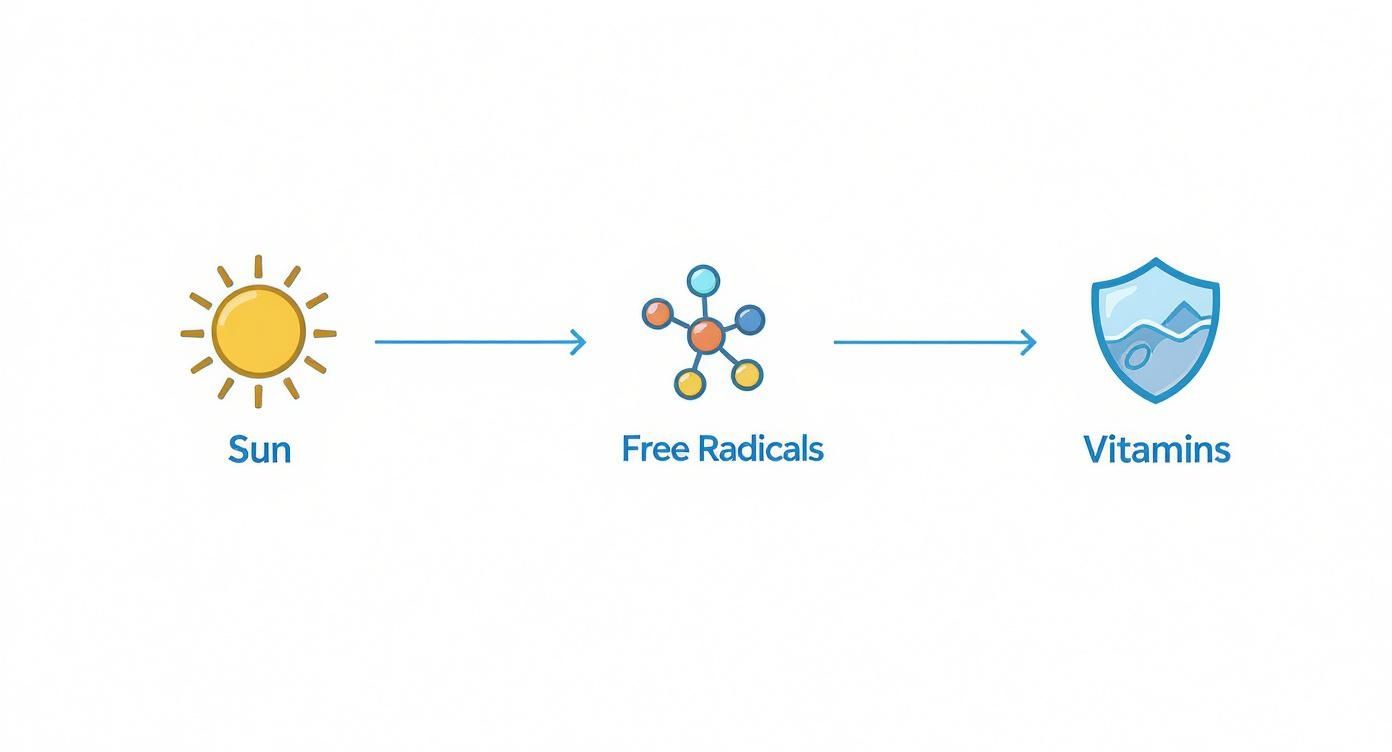
As you can see, sun exposure is a major source of free radicals that accelerate skin aging. Vitamins are your front-line defense, acting as a protective shield against this constant assault.
Vitamin C: The Master Builder and Protector
Vitamin C, or ascorbic acid, is one of the most celebrated ingredients in skincare, and for very good reason. Its main job is to act as a critical cofactor in collagen synthesis. Without enough Vitamin C, your body simply can't produce the strong, healthy collagen needed to keep skin firm and resilient.
But it’s not just a builder; it's also a formidable antioxidant. Vitamin C actively seeks out and neutralizes free radicals from UV light and pollution before they can wreak havoc on your skin cells. This dual-action power—building new structures while protecting existing ones—makes it an absolute cornerstone of any effective anti-aging routine.
A systematic review of multiple clinical trials confirmed that topical Vitamin C is highly effective in treating signs of photoaging. The research showed serums with concentrations between 10% and 20% led to smoother, less wrinkled skin. In studies with 139 participants, objective skin assessments showed significant improvements in texture and pigmentation. You can dive into the research findings on Vitamin C's efficacy for a deeper look.
Vitamin A: The Great Accelerator
When we talk about Vitamin A in skincare, we're usually talking about a class of compounds called retinoids. This group includes everything from gentle, over-the-counter retinol to potent, prescription-strength tretinoin. Their primary function is to kick skin cell turnover into high gear.
As we age, the process of shedding old, dull skin cells and replacing them with fresh ones slows way down. Retinoids essentially hit the fast-forward button on this cycle. By encouraging rapid exfoliation, they help to:
- Smooth Fine Lines: By revealing newer, plumper cells underneath.
- Unclog Pores: Reducing breakouts and making pores appear smaller.
- Even Out Skin Tone: Fading the look of dark spots and sun damage.
It's important to know that retinoids are a long-term commitment. While you might see some initial changes, the most significant results in wrinkle reduction often take three to six months of consistent nightly use to become apparent. The very best results can take up to a year.
Vitamin E: The Barrier Guardian
Vitamin E, often listed as tocopherol, is a fat-soluble antioxidant that’s a master at protecting your skin's outermost layer—the lipid barrier. Think of this barrier like a brick-and-mortar wall: the skin cells are the bricks, and the lipids (oils) are the mortar holding it all together. A strong barrier is everything when it comes to keeping moisture in and irritants out.
Vitamin E strengthens this "mortar," preventing water loss and shielding delicate cell membranes from oxidative stress. It’s also particularly good at absorbing energy from UV light, making it a natural, albeit mild, form of sun protection.
It’s also a true team player, often found in formulations alongside Vitamin C. They work synergistically: Vitamin E helps protect Vitamin C from breaking down, while Vitamin C helps regenerate Vitamin E after it has neutralized a free radical. This makes the pair far more powerful together than either is alone.
Niacinamide: The Versatile Soother
Niacinamide, a form of Vitamin B3, is the ultimate multitasker and is exceptionally well-tolerated by almost all skin types. It tackles multiple signs of aging through several different pathways, making it one of the most versatile ingredients you can add to your routine.
Here’s a look at its wide-ranging benefits:
- Improves Elasticity: It boosts the production of ceramides, which are key components of the skin barrier, helping skin stay supple.
- Reduces Redness: Its anti-inflammatory properties are fantastic for calming irritated skin and reducing blotchiness.
- Minimizes Pore Appearance: While you can't actually shrink pores, niacinamide helps reduce their visibility by keeping them clear.
- Evens Skin Tone: It works to inhibit the transfer of pigment within skin cells, which helps lighten dark spots.
Because it's so gentle, niacinamide fits easily into almost any skincare regimen. It plays well with other active ingredients, including retinoids and Vitamin C, by supporting the skin barrier and reducing potential irritation from more powerful treatments.
To pull all this information together, the table below offers a side-by-side comparison of these anti-aging powerhouses, helping you understand their specific roles and how they work.
Vitamin Deep Dive Comparison of Benefits and Use
| Vitamin | How It Works (Mechanism) | Proven Benefits (Human Studies) | Effective Topical Concentration |
|---|---|---|---|
| Vitamin C | Acts as a cofactor for collagen synthesis and a potent antioxidant that neutralizes free radicals from UV exposure. | Reduces wrinkles, brightens skin tone, improves firmness, and fades hyperpigmentation. | 10% – 20% |
| Vitamin A (Retinoids) | Accelerates skin cell turnover, stimulates collagen production, and inhibits collagen breakdown. | Smooths fine lines and deep wrinkles, reduces breakouts, and evens out skin tone and texture. | 0.025% (Tretinoin) to 1.0% (Retinol) |
| Vitamin E | A fat-soluble antioxidant that protects cell membranes and the skin's lipid barrier from oxidative damage. | Moisturizes, strengthens the skin barrier, reduces UV damage, and has anti-inflammatory properties. | 1% – 5% (often combined with Vitamin C) |
| Niacinamide (B3) | Improves epidermal barrier function, reduces inflammation, and inhibits pigment transfer to skin cells. | Reduces redness, minimizes pore appearance, improves elasticity, and lightens dark spots. | 2% – 10% |
This comparison highlights how each vitamin brings something unique to the table. While Vitamin C focuses on building and protecting collagen, retinoids are all about renewal and regeneration. Meanwhile, Vitamin E guards the barrier, and Niacinamide calms, strengthens, and brightens. Building a routine that leverages these different strengths is the key to comprehensive skin health as you age.
Unsung Heroes: The Supporting Nutrients Your Skin Craves
While the big names like Vitamin C and E get all the attention, a truly effective strategy for healthy, youthful skin relies on a strong supporting cast. Think of it like a championship sports team; the star players are crucial, but the game is often won by the depth and skill of the entire roster. Nutrients like Vitamin K, Zinc, and Selenium are these unsung heroes, working quietly behind the scenes to tackle specific issues and boost the power of your overall routine.
These supporting players offer specialized benefits that the primary vitamins might not cover. They help you fine-tune your approach, targeting everything from stubborn dark circles to slow healing and ensuring your skin has every last thing it needs to function at its peak.
Beyond the Basics: Key Minerals and Vitamins
Getting to know these lesser-known players can take your skin health to a whole new level. They don't just work on their own; they work in harmony with the vitamins we've already covered, creating a powerful, interconnected network of support.
-
Vitamin K: This vitamin is famous for its role in blood clotting, which is exactly why it’s so helpful for dark under-eye circles. Those shadows are often caused by blood pooling in the tiny, delicate capillaries under your eyes. By promoting healthy circulation and strengthening vessel walls, Vitamin K can help minimize their appearance.
-
Zinc: As an essential mineral for skin, Zinc is a master of repair and regulation. It plays a critical role in wound healing and has impressive anti-inflammatory properties, making it fantastic for calming down irritated or blemish-prone skin. On top of that, Zinc helps regulate oil production, which can lead to a much more balanced complexion.
-
Selenium: This trace mineral is a potent antioxidant in its own right, but its real superpower is its role as a "co-antioxidant." Selenium is a vital component of an enzyme called glutathione peroxidase, which is one of the body’s most important antioxidant defense systems. It essentially helps protect and recycle other antioxidants, like Vitamin E, making them more effective.
No single nutrient works in a vacuum. Healthy skin is the result of a complex interplay between dozens of vitamins, minerals, and antioxidants. A holistic approach that values this synergy will always outperform one that focuses on just a single ingredient.
This idea of synergy is absolutely crucial. These nutrients don't just add their individual benefits—they amplify the effects of others. For instance, Vitamin E is known to help regenerate Vitamin C after it has neutralized a free radical, essentially "recharging" it to fight again. This kind of teamwork is what makes a well-rounded diet and skincare routine so incredibly powerful.
The Power of Synergy in Skin Health
This synergistic relationship is especially clear when we look at collagen, the protein that gives skin its firm, plump structure. While Vitamin C is the undisputed star player here, its effectiveness is central to the entire process of keeping skin youthful. Collagen synthesis is the foundation of healthy skin, and Vitamin C is biochemically essential for both producing new collagen and protecting your existing stores from breaking down.
After age 20, our natural collagen production drops by about 1% every year, and that decline is accelerated by free radical damage from sun exposure and pollution. This is why supporting your body's own production is so important. For those wanting to go a step further, there are many natural ways to boost collagen that perfectly complement a vitamin-rich regimen. Ultimately, a well-formulated routine provides both the building blocks and the protective shields your skin needs for long-term resilience.
Topical Serums vs Oral Supplements Explained
It's one of the biggest questions in skincare: should you be swallowing your vitamins or slathering them on your face? The truth is, it’s not an either/or situation. These two approaches work in completely different ways, and understanding that difference is the key to building an anti-aging strategy that actually works.
Think of it like tending a garden. Oral supplements are like watering the soil. When you take a vitamin, it enters your bloodstream and gets distributed systemically, nourishing every organ in your body—including your skin—from the ground up. This is foundational, whole-body support.
Topical serums, on the other hand, are like giving a specific, struggling plant a targeted nutrient spray directly on its leaves. They deliver a powerful, concentrated dose of active ingredients right where you need it most: your skin cells.
Why Concentration and Delivery Matter
The main difference here boils down to bioavailability and concentration. When you pop a vitamin pill, it has to survive the long journey through your digestive system, get absorbed into your blood, and then finally get delivered to your skin. By the end of that trip, only a tiny fraction of the original dose actually makes it to your dermal and epidermal cells.
Topical application completely bypasses that entire process. A well-formulated serum delivers vitamins like C and A directly into the skin, achieving a concentration at the cellular level that would be impossible to reach through your diet or supplements alone. This direct-delivery method is precisely why topicals are often the best vitamins for aging skin when you're trying to tackle specific surface issues like wrinkles or dark spots.
The most effective anti-aging plans don’t treat oral and topical vitamins as competitors; they see them as partners. One builds health from the inside out, while the other provides targeted, high-impact treatment from the outside in.
For example, studies have shown that applying Vitamin C topically can give a significant boost to collagen production and help fend off UV damage. Ingesting that same vitamin is fantastic for providing antioxidant support to your entire body, but it won't produce the same dramatic, localized effects you’d see on your face.
Building Your Inside-Out Strategy
So, which vitamins belong in your cabinet and which belong on your bathroom counter? A smart strategy uses both, playing to the unique strengths of each delivery method for comprehensive results.
-
Topical Powerhouses (Serums): Vitamins C, A (retinoids), and B3 (niacinamide) are the heavy hitters when applied directly. Their benefits—like stimulating collagen synthesis, speeding up cell turnover, and strengthening the skin barrier—are most impactful right at the skin's surface.
-
Oral Essentials (Supplements): Vitamins D and E, along with minerals like Zinc and Selenium, are perfect for oral supplementation. They provide systemic support for things like inflammation control and antioxidant defense that benefit your skin from a foundational level.
Ultimately, combining a nutrient-rich diet with targeted oral supplements ensures your body has all the raw materials it needs for repair and protection. You can get more out of your regimen by understanding the best time to take vitamins to maximize their absorption. Adding potent topical serums on top of that foundation allows you to directly attack the visible signs of aging with a powerful, concentrated approach. This dual strategy is the most effective way to support your skin’s long-term health and vitality.
How to Choose Products That Actually Work
Walking down the skincare and supplement aisles can feel like navigating a maze. Countless products, all wrapped in beautiful packaging, promise miraculous results. But how do you separate the marketing hype from what actually works?
This section is your practical guide to cutting through the noise. We'll give you a simple checklist to help you move from a hopeful buyer to a savvy consumer who knows exactly what to look for.
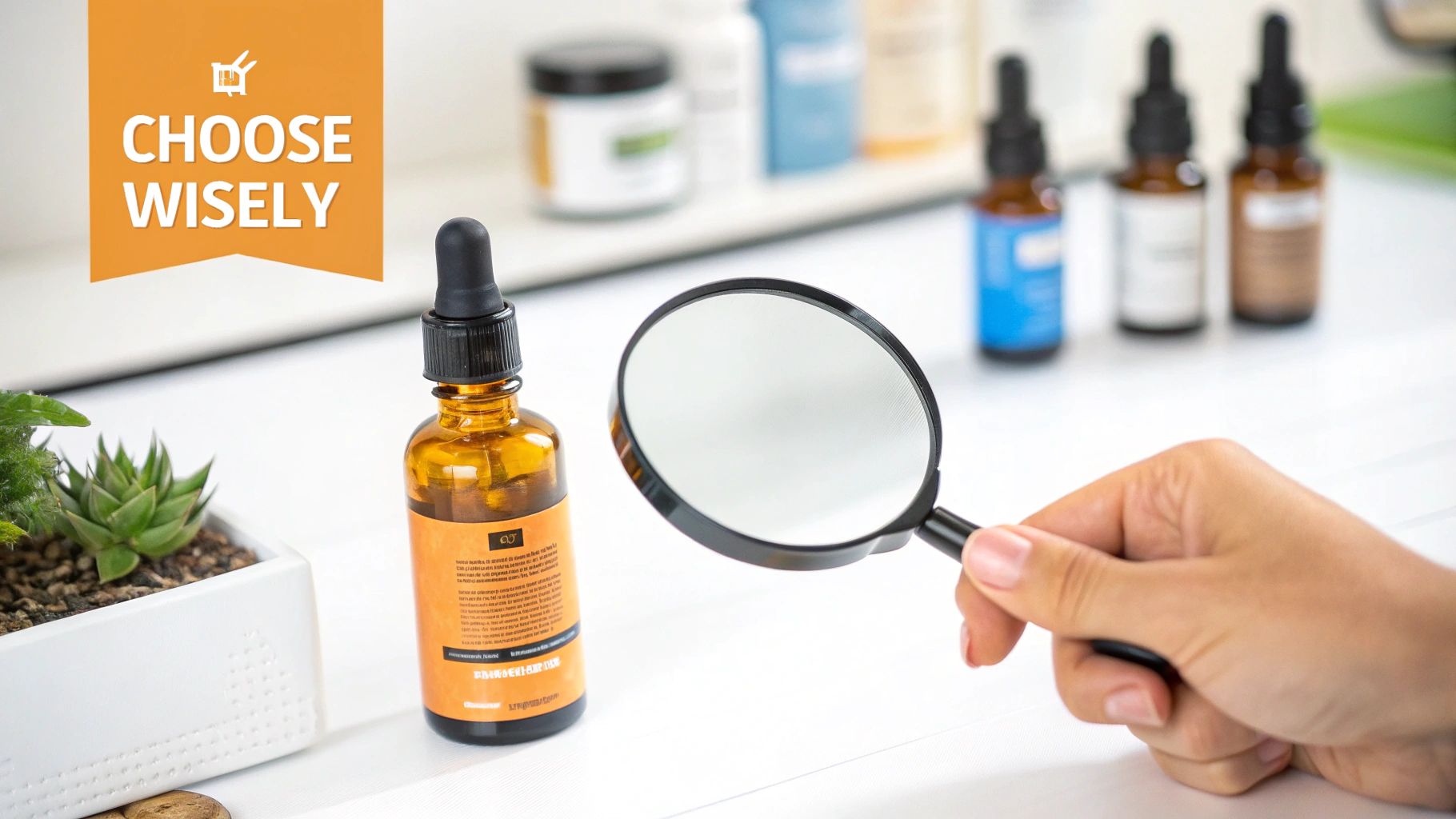
A product’s true power isn't just about its star ingredient. It’s about stability, delivery, and purity. An expensive Vitamin C serum is essentially worthless if the vitamin itself breaks down before it ever touches your skin cells.
Decoding Topical Serums
When it comes to topical treatments, the formula and packaging are non-negotiable clues to quality. Unstable vitamins, especially L-ascorbic acid (Vitamin C) and retinoids, degrade incredibly fast when exposed to light and air.
-
Check the Packaging: Always, always choose products in opaque, airless pump bottles or dark glass droppers. If you see a sensitive active in a clear jar, it’s a huge red flag. That exposure to light is rendering the product useless.
-
Look at the Concentration: For Vitamin C, the science points to an effective range of 10% to 20%. For over-the-counter retinol, you'll want to see concentrations between 0.25% and 1.0%. Anything less is unlikely to deliver any noticeable changes.
-
Mind the Formulation: Smart formulas include supporting ingredients that boost stability and performance. For example, Vitamin C works even better when it's paired with Vitamin E and ferulic acid—a combination proven to dramatically increase its antioxidant power.
A product's packaging tells you a lot about the manufacturer's grasp of cosmetic science. A company that puts a fragile active ingredient in a clear jar is either cutting corners or just doesn't understand formulation chemistry. Either way, it's a clear sign to put that product back on the shelf.
Selecting Oral Supplements
With oral supplements, the game is all about bioavailability and verification. You need to be sure that what’s on the label is actually in the bottle, and that your body can absorb it effectively. This means looking past the flashy claims on the front of the box.
-
Identify Bioavailable Forms: Not all vitamin forms are created equal. Your body has preferences. Look for methylcobalamin instead of cyanocobalamin for B12, or tocopherols for Vitamin E. These are the forms your body can actually use right away.
-
Seek Third-Party Certification: This is the most important step. Look for seals from independent organizations like USP (United States Pharmacopeia) or NSF International. These certifications are your proof that the product contains what it says it does, in the correct amounts, without any harmful contaminants.
-
Avoid Unnecessary Fillers: Take a second to scan the "other ingredients" list. While some binders are needed, a long list of artificial colors, flavors, and junk fillers is usually a sign of a lower-quality product.
Equipped with this knowledge, you can make smarter choices for both your skin and your overall health. For those looking to explore more advanced therapies, understanding the science behind different compounds is crucial. Diving into options like peptides for skin can open up new avenues for supporting skin structure and vitality from a different angle.
By focusing on stability, bioavailability, and third-party verification, you can finally feel confident that you're choosing products that will truly deliver.
Common Questions About Vitamins for Skin
Jumping into the world of vitamins for your skin can bring up a lot of questions. To help you feel more confident about the choices you're making, here are some straightforward answers to the queries we hear most often.
Can I Get All My Skin Vitamins from Diet Alone?
A nutrient-rich diet is the absolute foundation for healthy skin, but getting the high concentrations needed for significant anti-aging effects from food alone is nearly impossible. Think of it this way: your body sends dietary vitamins everywhere they're needed, not just to your face.
Topical serums, on the other hand, are like a direct delivery service, bringing potent doses of vitamins like C and A straight to your skin cells. The smartest strategy combines a balanced diet for overall health with targeted topicals for that powerful, inside-and-out support.
How Long Until I See Results from Using These Vitamins?
Patience and consistency are everything here. Improving your skin is a gradual marathon, not a sprint. With topical products like a good Vitamin C serum or a retinoid, you might start to see a brighter complexion and smoother texture within 4 to 8 weeks.
But the bigger changes—like a visible reduction in fine lines and better firmness—can take 3 to 6 months of consistent, daily use to really show. Oral supplements work more systemically, so their effects often take several months to become noticeable.
Are There Any Vitamins I Should Avoid Mixing?
Yes, some powerful combinations need to be applied thoughtfully to avoid irritation. For instance, using a high-strength Vitamin C and a potent retinoid at the exact same time can be too much for many skin types, especially if you're on the sensitive side.
A great way to handle this is to apply your Vitamin C serum in the morning—it gives you antioxidant protection against the day's environmental stress. Then, use your retinoid at night, since it can make your skin more sensitive to the sun. It’s also critical to follow dosage guidelines for any oral supplements, as high levels of fat-soluble vitamins (A, D, E, and K) can build up in the body. Always talk to a healthcare professional before starting a new supplement routine to make sure it’s the right move for you.
At Elite Bioscience, we provide third-party lab-tested vitamin therapies to help you achieve your skin health goals with confidence. Explore our targeted solutions to support your anti-aging journey.
Discover Your Personalized Vitamin Therapy at elitebioscience.co