When you hear people talk about the most effective stacks for recovery and tissue repair, the combination of BPC-157 and TB-500 almost always comes up. It's for good reason. These two peptides work in tandem, providing both targeted healing right where you need it and a systemic boost to your entire body. The result is a synergistic effect that’s far more powerful than what either compound could manage on its own.
Introducing the Ultimate Recovery Stack
So, what exactly are peptides? In simple terms, they're short chains of amino acids, the very building blocks of proteins. The best way to think of them is as biological messengers—tiny, smart molecules that deliver specific instructions to your cells. They can tell a cell to dial down inflammation, get to work building new tissue, or even form new blood vessels to fast-track healing.
Within the world of regenerative medicine, two peptides consistently rise to the top for their incredible and complementary healing powers: BPC-157 and TB-500. While both share the goal of repairing the body, they have very different game plans.
The Local Repair Crew and the System-Wide Coordinator
Let's use an analogy. Imagine your injury is a big pothole on a busy road.
BPC-157 is like the local repair crew that gets dispatched directly to that pothole. It works on-site—patching the damage, reinforcing the structure, and rebuilding the immediate area with impressive speed. This is why it's so famous for its potent, localized effects on everything from tendons and ligaments to muscles and even the gut lining.
TB-500, on the other hand, is the system-wide healing coordinator. It doesn’t just focus on that one pothole. Instead, it gets to work improving the entire city’s infrastructure to support all repair efforts. TB-500 is brilliant at boosting cell migration, taming inflammation throughout the body, and improving overall flexibility and blood flow. It makes sure the local repair crew has all the materials and clear roads it needs to get the job done right.
By combining the targeted action of BPC-157 with the broad, systemic support of TB-500, you create an environment where the body can heal more rapidly and completely from the inside out.
This powerful synergy isn't just anecdotal. The global peptide therapeutics market, which includes compounds like the BPC 157 TB 500 stack, is booming. This growth is a direct reflection of the rising demand for sophisticated regenerative therapies from athletes, biohackers, and anyone serious about bouncing back from physical setbacks. For a deeper dive, you can find more insights about peptide market trends on Innerbody.com.
To quickly sum it up, when you stack these two, you're deploying a specialized two-pronged attack on injury:
- BPC-157: Homes in on the specific injury site to accelerate direct tissue regeneration.
- TB-500: Optimizes the entire body's healing response to support and sustain that repair process.
To give you an even clearer picture, let's break down their key differences side-by-side.
BPC 157 vs TB 500 At a Glance
This table offers a quick snapshot of how these two peptides compare, highlighting their unique strengths and primary roles in the healing process.
| Characteristic | BPC 157 | TB 500 (Thymosin Beta-4) |
|---|---|---|
| Primary Action | Highly localized, site-specific repair. | Systemic, body-wide healing support. |
| Key Function | Promotes angiogenesis (new blood vessel growth), tendon/ligament repair, and gut health. | Enhances cell migration, reduces inflammation, and improves tissue flexibility. |
| Origin | A synthetic peptide derived from a protein found in stomach acid. | A synthetic version of a naturally occurring protein found in nearly all human and animal cells. |
| Best For | Acute injuries like muscle tears, tendonitis, ligament sprains, and gut issues. | Chronic injuries, widespread inflammation, improving mobility, and overall recovery. |
| Analogy | The "Local Repair Crew." | The "System-Wide Coordinator." |
Understanding these distinct yet complementary roles is the first step in appreciating why this combination is a go-to strategy for anyone serious about recovery. They don't just add to each other's effects; they multiply them.
The Science of Cellular Repair
To really get why stacking BPC-157 and TB-500 is so effective, we need to peek behind the curtain at how each one works on a cellular level. It helps to think of your body's healing process like a massive construction project. To get the job done right, you need two things: a skilled crew on the ground and a sharp logistics manager coordinating the entire operation.
BPC-157 and TB-500 are a perfect fit for these two roles.
BPC-157 is the expert construction foreman working directly at the site of an injury. When a tendon tears or a muscle pulls, BPC-157 is one of the first on the scene, masterfully directing the local repair efforts. One of its most critical functions is promoting angiogenesis—the formation of new blood vessels. You can think of this as building new access roads straight to the damaged area, ensuring a steady supply of oxygen and nutrients needed to rebuild.
It also boosts the number of growth hormone receptors in that specific spot. This essentially makes the local cells "listen" more intently to the body's natural commands to heal. By keeping its work hyper-focused, BPC-157 makes sure that precious resources go exactly where they're needed most, leading to faster, stronger tissue repair.
TB-500: The Systemic Logistics Manager
While BPC-157 is handling the on-the-ground work, TB-500 acts as the project's logistics manager, overseeing the entire system. Its influence is systemic, meaning it works throughout your whole body, not just in one isolated spot. TB-500, a synthetic form of a natural protein called Thymosin Beta-4, is a master of getting cells where they need to go.
It’s incredibly good at promoting cell migration. In simple terms, it helps crucial healing cells—like stem cells—travel through the bloodstream and find any site of injury. Once there, it helps them differentiate, or transform, into the exact type of cell needed for the job, whether that’s for muscle, tendon, or bone.
On top of that, TB-500 is a potent anti-inflammatory. It helps dial down the systemic inflammation that can often put the brakes on recovery. It also improves the flexibility and pliability of tissues, which is key for making sure the repaired area is resilient and less prone to getting injured again.
This chart helps visualize how the localized action of BPC-157 and the systemic support of TB-500 work together.
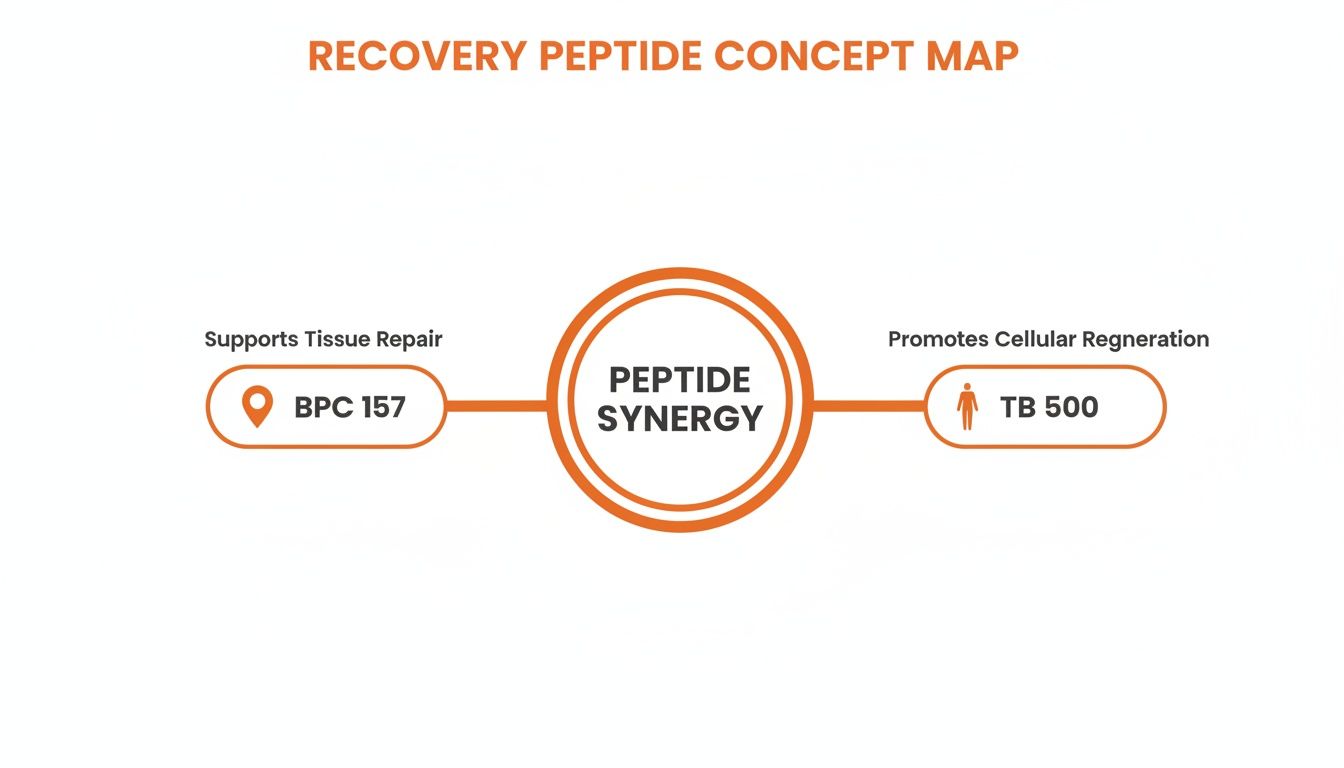
As you can see, one targets the injury directly while the other reinforces the body's overall ability to regenerate. It’s a powerful one-two punch for recovery.
The Power of Combined Action
When you bring BPC-157 and TB-500 together, the synergy is undeniable. You’re creating a healing environment that’s far more powerful than what either peptide could accomplish on its own. BPC-157 is there rebuilding the damaged structure, while TB-500 makes sure the repair crew has all the supplies it needs and that the entire system is optimized for healing.
This dual approach tackles recovery from every angle.
- Localized Repair (BPC-157): Works directly at the point of injury, accelerating the rebuilding of tissues like tendons, ligaments, and muscles.
- Systemic Support (TB-500): Lowers body-wide inflammation, improves cell delivery to the injury, and enhances the flexibility of all your connective tissues.
The real takeaway here is that you're not just putting a band-aid on a problem; you're fundamentally upgrading your body’s entire repair process. The focused foreman (BPC-157) and the big-picture logistics manager (TB-500) work in lockstep, ensuring the job gets done faster, better, and with more durable results.
Understanding this dynamic is crucial. It’s not about picking one peptide over the other. It’s about recognizing how their unique strengths complement each other to create a result that is truly greater than the sum of its parts. This is precisely why the BPC-157 and TB-500 stack has become a cornerstone for anyone serious about advanced recovery.
Real-World Benefits for Peak Performance
It's one thing to understand the science behind BPC-157 and TB-500, but seeing how that science translates into real-world results is what truly matters. This isn't just about what's happening at a cellular level; it's about getting you back in the game—or just back to your life—faster and stronger than you thought possible.
The combination of BPC-157 and TB-500, sometimes called the "Wolverine Blend," creates a powerful synergy for recovery. Think of it this way: BPC-157 acts like the on-site construction crew, rebuilding damaged tissue right where it's needed. At the same time, TB-500 is the logistical expert, managing the supply chain and making sure repair cells can get to the job site efficiently. This combined approach addresses healing from multiple angles at once. To dig deeper into this synergy, you can read more about how these core peptides work together on Barchart.com.
This teamwork leads to some very tangible improvements in your physical health.

Accelerated Injury Recovery
If you've ever dealt with a nagging injury, you know how incredibly slow the healing process can feel. This is where the BPC-157 and TB-500 stack can be a game-changer. BPC-157's knack for promoting angiogenesis—the creation of new blood vessels—is like building a superhighway directly to a torn ligament or strained tendon, flooding it with the nutrients needed for repair.
TB-500 then complements this by improving the mobility of the body's repair cells, ensuring they can navigate that highway and get straight to work. The result is a dramatically faster healing timeline for some of the most stubborn injuries.
- Tendon and Ligament Repair: It helps regenerate connective tissues, which are notorious for their slow healing time due to poor blood supply.
- Muscle Strains and Tears: The stack aids in repairing damaged muscle fibers, cutting down on the time you spend on the sidelines.
- Post-Surgical Healing: It can be a powerful ally in recovering from orthopedic procedures by supporting tissue regeneration and controlling inflammation.
Significant Reduction in Pain and Inflammation
Inflammation is a necessary evil; it's the body's first response to injury. But when it sticks around, it becomes chronic, causing constant pain and putting the brakes on your recovery.
This is another area where the stack’s two-pronged approach shines. TB-500 works systemically, helping to calm down widespread inflammation throughout the body—think general aches and stiffness. BPC-157, on the other hand, zeroes in on the injury site itself, reducing localized pain and swelling. It’s a comprehensive strategy for managing both acute and chronic inflammation.
By tackling inflammation at both the local and systemic levels, this peptide combination helps break the cycle of chronic pain, allowing you to engage in physical therapy more effectively and get back to your life sooner.
Improved Gut Health and Integrity
You might not immediately connect gut health with muscle recovery, but it’s the foundation for everything. BPC-157 was actually derived from a protein found in stomach acid, so it’s no surprise it has a profound ability to heal the gut.
It helps repair the lining of your digestive tract, which can take a beating from stress, a less-than-perfect diet, or certain medications. A healthy gut means you can actually absorb the nutrients from your food—a non-negotiable for rebuilding tissue and keeping your energy up. This makes BPC-157 a crucial part of the stack for anyone serious about optimizing their internal systems for recovery. For more on this, check out our guide on how to improve muscle recovery.
Enhanced Joint Mobility and Flexibility
Finally, a full recovery isn't just about being "healed"—it's about getting your full function back. TB-500 is key here, as it helps improve the flexibility and pliability of your soft tissues.
This is incredibly important for preventing the stiffness that often sets in after an injury, ensuring that newly repaired muscles and ligaments don't end up tight and restricted. When you pair that with BPC-157's structural repair work, you don't just get a healed joint; you get a more mobile, resilient one that’s less prone to future injury.
A Practical Guide to Your Protocol
So, you've learned what BPC-157 and TB-500 can do. The next logical question is, "How does this actually work in practice?" Moving from theory to a real-world protocol involves a few key steps, and this guide is here to walk you through the logistics.
But first, a critical point: this information is for educational purposes only. Any peptide protocol absolutely must be prescribed and managed by a qualified medical professional. They are the only ones who can tailor a plan to your specific body, goals, and health needs. Going it alone is not a safe option.
The First Step: Reconstitution
When you receive peptides like BPC-157 and TB-500, they arrive as a freeze-dried (lyophilized) powder. This solid form keeps them stable during shipping and storage. Before you can use them, you need to bring them back to a liquid state through a process called reconstitution.
This is done by mixing the powder with bacteriostatic water, which is sterile water containing a tiny amount of benzyl alcohol. That small addition is a big deal—it stops bacteria from growing, keeping your solution safe to use while it's stored in the fridge.
The process itself isn't complicated, but it demands care and a clean environment to avoid contamination.
- Gather Your Supplies: You’ll need your peptide vial, a vial of bacteriostatic water, alcohol swabs, and a sterile syringe for mixing.
- Prep the Vials: Wipe the rubber stoppers on both vials with an alcohol swab. This simple step sterilizes the surface where the needle will go in.
- Draw the Water: Use the syringe to pull up the exact amount of bacteriostatic water your provider prescribed. It's often 1mL or 2mL, but your specific protocol is what matters.
- Add Water to the Peptide: Gently inject the water into the peptide vial. The key here is to aim the stream of water against the inside wall of the glass, letting it slide down to the powder. Don't spray it directly onto the powder, as that can be too harsh for the delicate peptide molecules.
- Mix Gently: Never shake the vial. That will destroy the peptides. Instead, gently roll the vial between your hands or give it a slow swirl until all the powder has dissolved.
Once it's mixed, the peptide solution goes straight into the refrigerator for storage. For a more detailed walkthrough, our comprehensive peptide handling guidelines cover all the best practices to ensure you're doing everything correctly.
Dosing and Stacking Your Peptides
Figuring out the right dose is perhaps the most important part of the entire process, and it's exactly why you need to work with a doctor. Doses aren't one-size-fits-all; they're calculated based on your body weight, the specific condition you're addressing, your overall health, and other individual factors.
You might see dosage ranges mentioned in studies or online forums, but these are just general observations, not medical advice. A knowledgeable physician will analyze your unique situation to prescribe a dose that delivers results while keeping you safe.
Crucial Reminder: The dosing examples and schedules discussed here are purely hypothetical. They are meant to show you what a protocol could look like, not what you should do. Your personal protocol will be designed specifically for you by your prescribing physician.
To help you visualize how these two peptides can work together, here is a sample of a common stacking strategy.
Sample Stacking Protocol (For Informational Purposes Only)
This table shows a hypothetical dosing schedule to illustrate how BPC-157 and TB-500 are often combined in a cycle. It is not a recommendation but a tool for understanding the structure of a protocol.
| Peptide | Typical Daily/Weekly Dose | Frequency | Cycle Length |
|---|---|---|---|
| BPC-157 | 250-500 mcg per day | 1-2 times daily | 4-8 weeks |
| TB-500 | 2-5 mg per week | Split into 2-3 injections weekly | 4-8 weeks |
This kind of structure is pretty common. BPC-157 is often taken daily for its targeted, localized healing effects, while TB-500 is used just a few times a week to provide its broad, systemic benefits across the entire body.
Administration Best Practices
By far, the most common way to administer BPC-157 and TB-500 is through a subcutaneous injection. This simply means injecting the solution into the layer of fat right under the skin. It’s a straightforward method that allows for excellent absorption.
To make sure every injection is safe and effective, stick to these best practices:
- Hygiene is Paramount: Always wash your hands thoroughly before you start. Use a fresh alcohol swab on the injection site and the vial’s rubber stopper every single time. No exceptions.
- Site Rotation: Popular spots for injection are the abdomen, thighs, and glutes. It’s really important to rotate where you inject. Using the same spot over and over can lead to irritation, scar tissue, or a condition called lipodystrophy (a loss of fat in that one area).
- Proper Technique: Pinch about an inch of skin and fat, and insert the needle at a 45 to 90-degree angle. Push the plunger slowly and steadily to inject the solution.
- Safe Disposal: Needles are single-use only. Once you’re done, immediately dispose of the used syringe in a designated sharps container. This is a non-negotiable safety rule.
Following these steps with care and attention to detail will help ensure your protocol is as safe as it is effective.
Taking a Clear-Eyed Look at the Research
When you’re considering powerful compounds like the BPC 157 TB 500 stack, you have to look at the evidence from all sides. The research we have today is a fascinating mix of incredibly promising lab studies and a much smaller body of human clinical trials. Knowing the difference is crucial for making a smart decision.
The overwhelming bulk of the science on these peptides comes from animal studies. In those settings, both BPC-157 and TB-500 have shown some truly remarkable and consistent healing abilities. We’re talking about everything from mending torn tendons to calming an inflamed gut. This research forms the foundation of what we know and gives us a solid scientific reason to believe in how they work.
But let's be clear: large-scale, double-blind, placebo-controlled human trials—the gold standard in medicine—are still few and far between.
Why Is There an Evidence Gap?
So, what gives? Why the huge difference between all the animal research and the number of human trials? It really boils down to money and patents.
BPC-157 and TB-500 are modeled on amino acid chains that already exist in nature, which makes them very difficult to patent. Without the exclusive rights a patent gives them, a pharmaceutical company simply can't justify spending the hundreds of millions of dollars it takes to run massive human trials. It's a tough financial reality.
This has created a unique situation where we have to build the evidence from a few different places:
- Preclinical Studies: This is the foundational lab science, mostly in animals, that shows us how the peptides are supposed to work on a biological level.
- Anecdotal Reports: There's a huge amount of feedback from the real world—athletes, fitness enthusiasts, and biohackers who have been using and documenting their results for years.
- Clinical Application: Progressive doctors in regenerative medicine are already using these peptides with their patients, seeing firsthand how they perform under professional guidance.
To get the full story, you have to take a holistic view. You weigh the compelling lab data and years of user experience against the current lack of large-scale human studies.
Looking at it this way gives us a much more complete and practical picture of what the BPC 157 TB 500 stack can do.
What the Science Shows So Far
Even without those big human trials, the preclinical data is hard to ignore, especially when it comes to recovery and repair.
In lab models of tendon and ligament injuries, for example, BPC-157 and TB-500 really stand out. Studies on Achilles tendons have shown that BPC-157 can improve the tissue's tensile strength, help collagen fibers line up correctly, and just plain speed up the healing process. For anyone pushing their body to its limits, that's a big deal. You can dig into a more detailed analysis of these peptide efficacy and safety findings on GlobalRPH.com.
It's these specific, measurable results in the lab that give clinicians and researchers confidence. It tells us the peptides aren't just covering up pain—they appear to be actively helping rebuild tissue from the ground up. While peptides are very different from steroids, this ability to drive cellular repair is a huge part of why they've become so popular. If you want to understand this distinction better, check out our guide on the difference between peptides and steroids.
At the end of the day, the journey of these peptides from the research bench to the doctor's office is still unfolding. The smartest approach is to appreciate both the incredible potential shown in the science and the current state of human evidence, which makes getting professional medical guidance absolutely essential.
Navigating Safety, Legality, and Sourcing
When you start looking into a powerful combination like BPC 157 TB 500, questions about safety, legality, and where to get it are bound to come up. Frankly, they should come up. Asking these questions isn't just smart—it's the most important part of ensuring your path to recovery is both effective and responsible.
Let's cut through the noise and break down what you absolutely need to know.
From what we've seen in preclinical research, both peptides appear to have a pretty good safety profile. They're generally well-tolerated, and the side effects people report are almost always minor and temporary. We're talking about things like a little redness, itching, or discomfort right at the injection site, which tends to disappear quickly.
The big "but" here is the lack of large-scale, long-term human trials. That means we don't have the complete picture just yet, which is exactly why professional medical oversight is non-negotiable.
Understanding the Regulatory Maze
One of the biggest points of confusion is the legal status of these peptides. Here in the United States, neither BPC-157 nor TB-500 is approved by the Food and Drug Administration (FDA) for everyday medical use. You can't just walk into your local CVS with a script and pick them up.
So where do they fit in? They occupy a specific regulatory space. They're available for research, and more importantly for patients, they can be prescribed by a licensed doctor for a specific therapeutic need. The doctor then orders them from a specialized compounding pharmacy. This is often referred to as "off-label" use, a standard practice in medicine where a physician uses their professional judgment to prescribe a treatment they believe will help their patient.
The bottom line is this: legitimate, human-grade BPC-157 and TB-500 are only available with a prescription from a qualified healthcare provider. This is the only way to operate within both legal and medical guidelines.
Why Your Source Is Everything
This brings us to the single most critical factor: where you get your peptides. A quick search online will show you countless websites selling vials labeled "for research use only." Buying from these gray-market sources is like playing Russian roulette with your health.
Here’s why it’s such a bad idea:
- Zero Purity Guarantees: You have no idea if what's in the vial is pure. It could be under-dosed, packed with harmful contaminants, or it might not even be the right substance at all.
- Questionable Potency: Peptides are delicate molecules. If they aren't manufactured, stored, and shipped under strict conditions, they can degrade and become completely useless before they even get to you.
- No Medical Guidance: When you buy online, you're on your own. You're left guessing about dosing, how to administer it, and how long your cycle should be. This isn't just ineffective; it can be dangerous.
The only way to ensure you're getting a safe, pure, and potent product is by going through a medical clinic that partners with reputable compounding pharmacies. These pharmacies conduct third-party lab testing to verify what’s in every batch.
This physician-guided approach is the only responsible way forward. It guarantees the BPC 157 TB 500 you get is exactly what it's supposed to be. Working with a telehealth provider like Elite Bioscience takes all the guesswork and risk out of the equation, connecting you directly with medical experts who can legally prescribe and source high-quality peptides for you.
Common Questions About the BPC-157 & TB-500 Stack
When you're exploring powerful peptides like the BPC 157 TB 500 stack, a few practical questions always come up. Let's tackle some of the most common ones to give you a clearer picture.
How Long Until I See Results From This Stack?
This is probably the number one question, and the honest answer is: it depends. Factors like your individual biology, the nature of your injury, and your dosing schedule all play a role.
That said, many people start to feel a drop in pain and inflammation within the first one to two weeks. For deeper tissue repair—think tendons, ligaments, or muscle—you'll likely need to complete a full 4 to 8 week cycle to really feel a significant difference in strength and mobility. True healing takes time, so patience is part of the protocol.
Can BPC 157 and TB 500 Be Mixed in the Same Syringe?
Yes, absolutely. It's perfectly fine and very common to draw both peptides into the same syringe right before you inject. This is a simple and practical way to cut down on the number of injections you need.
What you should never do, however, is mix the two peptides together in a single vial for storage. This can mess with their chemical structure and make them less effective. Always prepare and store each peptide in its own vial.
The key is to combine them in the syringe just moments before administration, not for storage. This preserves the integrity of each compound while simplifying your routine.
Are There Any Known Long-Term Side Effects?
Since large-scale, long-term human studies are still in the early stages, we don't have a complete official list of long-term effects. But from the extensive preclinical data and real-world clinical use we do have, both peptides appear to be remarkably safe.
The most common issues are minor and temporary, like a little bit of redness or soreness right at the injection site. This is exactly why it’s so critical to work with a qualified medical provider who sources pure, third-party tested peptides. It’s the only way to ensure you’re getting a safe, effective, and legitimate product.
Ready to explore a medically-guided path to recovery and performance? Elite Bioscience provides access to high-quality, third-party tested peptide therapies prescribed by licensed physicians. Take control of your health journey by visiting https://elitebioscience.co to learn more.