When you combine BPC 157 and TB500, you’re essentially creating a one-two punch for healing. It’s a powerful, dual-action strategy that brings together BPC-157’s targeted, localized repair with TB-500’s systemic, body-wide support. Think of it as giving your body’s internal repair system a master toolkit designed to accelerate recovery from the ground up.
The Next Frontier in Recovery
In the world of regenerative medicine, few things get people as excited as peptide therapy. This guide breaks down the science behind two of the most popular peptides out there: BPC 157 and TB-500. We’ll get into how stacking these two compounds together can create a powerful synergy that turbocharges your body’s natural healing abilities.
Whether you're an athlete trying to break a new record, someone dealing with a nagging injury that just won't go away, or you're simply looking to make your body more resilient, getting a handle on this combination is crucial. We'll also touch on how telehealth services are now providing a safe, medically-supervised way to explore these advanced therapies.
Localized Precision Meets Systemic Support
The real magic of using BPC 157 and TB500 together is how they complement each other. They don't just do the same thing; they work like a perfectly coordinated team.
BPC 157 (The 'Body Protection Compound'): This peptide is like a specialized repair crew sent directly to the scene of an injury. It’s fantastic at promoting the growth of new blood vessels—a process called angiogenesis—which is absolutely critical for healing specific tendons, ligaments, and muscles. Its work is focused and precise.
TB-500 (Thymosin Beta-4): Think of this peptide as the project manager overseeing the entire healing operation. It works systemically, traveling throughout your body to tamp down inflammation, improve how cells move to where they’re needed, and support tissue regeneration everywhere. It creates the ideal environment for healing to happen on a broad scale.
By pairing targeted repair with systemic support, the BPC 157 TB500 stack attacks the problem of recovery from two different but critical angles. This dual approach is why it’s become such a hot topic for everything from acute sports injuries to chronic joint pain. You can learn more about the fundamentals in our comprehensive guide to peptide therapy.
This synergy—local action backed by systemic wellness—is the foundational principle behind the stack. It’s designed not just to patch up an injury but to enhance the body's entire regenerative capacity, leading to more robust and efficient healing.
The demand for these kinds of effective recovery tools is exploding. Peptide therapeutics, with powerhouses like BPC-157 and TB-500 leading the charge, are part of a global market valued at nearly $50 billion. That number is expected to climb to over $83 billion by 2034, largely driven by the need for better tissue repair and regenerative solutions.
To get started, let's look at a quick side-by-side comparison of what makes each of these peptides unique.
BPC 157 vs TB500 A Quick Comparison
The table below breaks down the key differences between these two peptides. While they both aim to promote healing, they go about it in very different ways. Understanding these distinctions is the first step in figuring out how they can work together.
| Feature | BPC 157 (The 'Body Protection Compound') | TB-500 (Thymosin Beta-4 Fragment) |
|---|---|---|
| Primary Action | Promotes localized healing at specific injury sites. | Provides systemic, body-wide anti-inflammatory and regenerative support. |
| Key Mechanism | Enhances angiogenesis (new blood vessel growth) and tissue repair. | Promotes cell migration, differentiation, and reduces overall inflammation. |
| Best For | Acute injuries like tendon, ligament, and muscle tears. Gut health issues. | Chronic inflammation, widespread injuries, and improving overall recovery. |
| Administration | Often injected subcutaneously near the injury site for targeted effect. | Typically administered subcutaneously, acting throughout the entire body. |
| Origin | A synthetic peptide derived from a protein found in stomach acid. | A synthetic fragment of the naturally occurring protein, Thymosin Beta-4. |
This snapshot gives you a good sense of their individual strengths. BPC 157 is your specialist for a specific problem area, while TB-500 is the general contractor improving the entire system. Together, they create a comprehensive healing environment that is tough to match.
BPC-157: The "Precision Strike" for Localized Healing
Let's start with BPC-157. Think of this peptide as a highly skilled surgical team that gets airlifted directly to an injury site. It doesn't waste time with a systemic, body-wide approach; instead, it goes to work with pinpoint accuracy right where the damage is.

BPC stands for "Body Protection Compound," and it’s a synthetic peptide derived from a protein found naturally in our own stomach acid. Its real claim to fame is its ability to zero in on a specific injury—a torn tendon, a strained muscle, or an inflamed joint—and accelerate healing right at that spot. This makes it a go-to for localized problems.
How Does It Work? The Power of Angiogenesis
The secret to BPC-157's effectiveness lies in a process called angiogenesis. It sounds complex, but the concept is simple: it’s the formation of new blood vessels.
Imagine trying to rebuild a damaged house in a remote area with no roads. You can't get materials like wood, concrete, or wiring to the site. BPC-157 essentially builds those new roads (blood vessels) directly to the injury, ensuring a fresh supply of oxygen, nutrients, and growth factors can get in to start the repair work.
This is especially critical for tissues like tendons and ligaments, which have notoriously poor blood flow and heal painfully slowly on their own. BPC-157 directly tackles that limitation.
This targeted action is why the "Body Protection Compound" has become so visible online, with videos tagged 'BPC-157' racking up over 50 million views on platforms like YouTube and TikTok. But it's not just hype. A systematic review of studies from 1993 to 2024 confirmed its ability to enhance growth hormone receptor expression and kickstart angiogenesis, both of which are vital for serious tissue recovery. You can review the research findings on BPC-157 to see the science for yourself.
Common Uses for BPC-157
Thanks to its focused repair mechanism, BPC-157 has become a staple for addressing several key areas.
Here's where it really shines:
- Tendon and Ligament Repair: For nagging injuries like tennis elbow, Achilles tendonitis, or sprained ligaments, BPC-157 helps deliver the blood supply needed to finally heal these stubborn tissues.
- Muscle Strains and Tears: Athletes and fitness enthusiasts use it to speed up the regeneration of torn muscle fibers, helping to reduce downtime and build stronger, more resilient tissue.
- Gut Health: Since it originates from gastric juice, it’s not surprising that BPC-157 shows remarkable benefits for repairing an inflamed or damaged gut lining.
- Joint Support: It helps manage joint pain and stiffness by reducing inflammation and supporting the repair of the surrounding connective tissues, improving overall joint function.
The bottom line is this: BPC-157 is all about precision. It finds the problem, builds the supply lines (new blood vessels), and provides the framework for focused, robust healing exactly where you need it.
When people talk about a BPC-157 TB-500 stack, this localized action is just one side of the coin. While BPC-157 is the specialist on-site, its partner, TB-500, gets the whole body primed for recovery. We'll get into that next.
Understanding TB-500: The Systemic Repair Modulator
While BPC-157 is like a laser-focused surgical tool, zeroing in on a specific injury, TB-500 works on a much grander scale. Think of it this way: if BPC-157 is the specialized crew sent to fix a single pothole, TB-500 is the city-wide infrastructure manager, coordinating repairs and improving traffic flow across the entire system.
TB-500 is the lab-created counterpart to a naturally occurring protein called Thymosin Beta-4. The key difference is that TB-500 acts systemically. Once administered, it doesn't just stay in one spot; it travels throughout your entire body, working to reduce inflammation, encourage cell movement, and support healing on a global level.
This broad, body-wide action is exactly what makes it such a powerful component in a BPC 157 TB500 stack. It essentially prepares the entire body for recovery, creating the perfect internal environment for BPC-157 to do its highly-targeted work.
The Actin Upregulation Engine
So, what’s the secret behind TB-500’s power? It all comes down to its ability to upregulate a critical protein called actin.
Actin is the primary building block of your cell's internal skeleton, or cytoskeleton. It’s what gives cells their shape, structure, and—most importantly—their ability to move from one place to another.
When you get injured, the first step in healing is getting the right repair cells to the damage site. By boosting actin production, TB-500 makes these crucial cells more mobile and efficient.
TB-500 essentially greases the wheels of your body's cellular repair machinery. It helps healing cells migrate to where they're needed most, differentiate into the correct type of tissue, and kickstart the regeneration process much more effectively.
This systemic influence leads to a host of benefits that perfectly complement BPC-157's focused approach. To get the full backstory on this protein, you can explore our guide that explains what Thymosin Beta-4 is.
Wide-Ranging Benefits of Systemic Action
Because TB-500 goes to work everywhere, its effects are felt across multiple systems, making it a game-changer for comprehensive recovery.
- Accelerated Muscle Repair: It helps mend strained or torn muscle fibers faster, which means less downtime after an injury or intense workout.
- Increased Flexibility and Mobility: By calming inflammation in connective tissues and promoting cellular repair, it can help improve range of motion and reduce joint stiffness.
- Enhanced Endurance: It plays a role in angiogenesis—the creation of new blood vessels—which can improve blood flow and nutrient delivery, ultimately supporting greater stamina.
- Reduced Systemic Inflammation: It helps dial down the chronic, low-grade inflammation that can sabotage recovery and contribute to countless other health problems.
This widespread influence hasn't gone unnoticed. The global market for TB-500 has exploded, currently valued at $145 million and on track to hit $340 million by 2033. North America is at the forefront of this demand, holding a commanding 38% market share, a trend fueled by advanced healthcare research and its popularity in professional athletics. For anyone looking to get back in the game faster, TB-500's unique ability to regulate actin is the main reason for its soaring adoption.
This market growth points to a clear shift in thinking. People are increasingly seeking solutions that support the body’s entire healing framework, not just one isolated part. When you combine this kind of systemic support with BPC-157's precision repair, you create a truly synergistic strategy for healing.
How To Stack BPC-157 and TB-500 for Synergistic Results
When it comes to advanced healing protocols, combining BPC-157 and TB-500 isn't just about using two good things at once. It’s about creating a powerful synergy where each peptide enhances the other's strengths, tackling repair from two completely different but complementary angles.
Let's think of it like repairing a house after a storm. BPC-157 is your specialized repair crew—the carpenters, plumbers, and electricians who go directly to the damaged areas to fix a leaky roof or a broken pipe. Their work is highly targeted, precise, and focused on the immediate problem.
But that crew can't do its job without supplies. That's where TB-500 comes in. It acts as the project’s logistics manager, ensuring the trucks carrying lumber, pipes, and tools can get to the site. It clears the roads (reduces inflammation), coordinates deliveries (improves cellular mobility), and makes sure the whole environment is primed for efficient work.
This combination of localized repair backed by systemic support is what makes stacking so effective.
The Power of a Dual-Pronged Attack
The real magic of stacking BPC-157 and TB-500 is in how they work on both the micro and macro levels of healing at the same time. While BPC-157 gets to work promoting new blood vessel growth (angiogenesis) right at the injury site, TB-500 is busy improving the function and movement of repair cells throughout your entire body.
In short, the specialized work of BPC-157 never gets held up waiting for resources. TB-500 ensures that the local repair site is constantly fed everything it needs to rebuild tissue quickly and effectively.
By combining BPC-157 and TB-500, many find they can significantly shorten healing timelines and improve the actual quality of the repaired tissue. It’s a comprehensive strategy for tackling complex injuries, stubborn inflammation, and accelerating post-workout recovery.
This concept map helps visualize the broad, systemic role TB-500 plays in creating the right environment for healing.
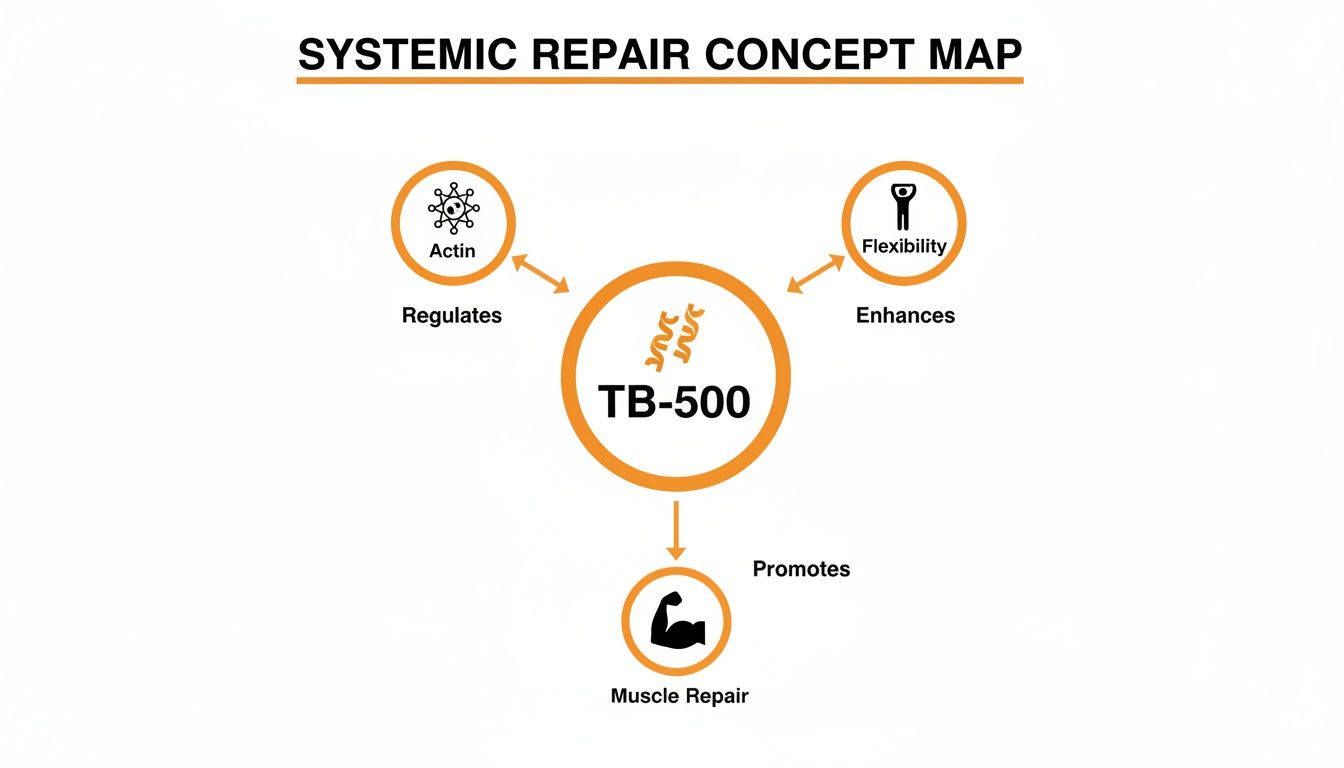
As the map shows, TB-500’s influence on actin—a key protein for cell structure and movement—is what drives better muscle repair, cellular mobility, and overall flexibility. This makes it the perfect systemic partner for BPC-157's focused, localized action.
Crafting a Stacking Protocol
First things first: a specific protocol must always be developed with a qualified medical professional. However, understanding the general strategies can give you a clearer picture of what to discuss with your doctor. The approach often differs based on whether you're dealing with an acute injury or aiming for overall wellness.
For Acute Injuries: Protocols often begin with a "loading phase" to quickly raise peptide levels in the body and jumpstart the healing process. This is usually followed by a lower-dose "maintenance phase."
For General Wellness: The strategy is typically more moderate. The focus is on consistent, lower-frequency administration to manage chronic inflammation and support long-term tissue health without the need for an aggressive loading period.
The table below gives you an idea of what these different approaches might look like. Remember, this is purely for informational purposes and is not a substitute for professional medical guidance.
BPC 157 & TB-500 Stacking Protocol Considerations
| Consideration | Typical Approach for Acute Injury | Typical Approach for General Wellness |
|---|---|---|
| Goal | Accelerate the healing of a specific, recent injury (e.g., muscle tear, tendonitis). | Manage chronic inflammation, support joint health, and improve overall recovery. |
| Duration | Often a 4 to 6-week cycle, followed by a break for assessment with your doctor. | Can be used in longer, lower-dose cycles as recommended by a physician. |
| BPC 157 Focus | Administered daily, often injected subcutaneously near the injury site for targeted action. | May be administered less frequently (e.g., 3-5 times a week) to maintain gut health and joint support. |
| TB-500 Focus | Often administered 2-3 times per week to provide continuous systemic support for repair. | Typically administered 1-2 times per week to maintain a baseline of anti-inflammatory support. |
At the end of the day, stacking BPC-157 with TB-500 creates a dynamic and comprehensive healing environment that one peptide alone simply can't match.
Getting Started With Peptide Therapy Safely
Diving into advanced peptides like BPC-157 and TB-500 isn't just about understanding what they do—it's about knowing how to use them safely and effectively. Getting this part right is absolutely critical for reaching your recovery goals while keeping potential risks to a minimum.

One of the first practical questions you'll face is how to administer these peptides. The two go-to methods are subcutaneous and intramuscular injections, and the one you choose can make a real difference in your results, especially for a localized healer like BPC-157.
Choosing the Right Administration Method
Subcutaneous injections, which go into the fatty layer just under the skin, are popular because they're simple and cause very little discomfort. For a peptide like TB-500 that works throughout the body, this method allows for a slow and steady release into the bloodstream, letting it get to work everywhere.
When it comes to BPC-157, a more targeted approach often yields better results. The common practice is to inject it subcutaneously as close to the site of injury as possible—think near a nagging shoulder tendon or a swollen knee. The idea is to concentrate its powerful healing properties right where you need them most, maximizing its effect on the damaged tissue.
- Subcutaneous (SubQ): The best choice for the systemic effects of TB-500. It's also great for BPC-157 when you can inject it near a specific injury.
- Intramuscular (IM): This involves injecting directly into a muscle, which leads to faster absorption. It's sometimes the preferred method for dealing with deep muscle injuries.
Ultimately, your doctor will help you decide on the best method based on your specific injury, your goals, and which peptide you're using. Following their advice is key to making sure your protocol is both safe and effective.
The Critical Importance of Sourcing
This is the big one. Maybe the single most important factor in your peptide journey is where you get them from. The internet is flooded with websites selling these compounds labeled as "for research use only," and buying from these unregulated sources is a huge gamble.
The real danger with unregulated online vendors is the complete lack of quality control. You could be getting a product that’s under-dosed, contaminated with who-knows-what, or completely degraded from poor storage. At best, it won’t work. At worst, it could be dangerous.
This is precisely where working with a reputable telehealth clinic makes all the difference. It provides a layer of safety and quality assurance that the grey market simply can't offer.
A legitimate clinic provides a medically supervised path that ensures:
- Professional Consultation: A licensed physician reviews your medical history and goals to see if a BPC-157 TB-500 stack is a good fit for you.
- Valid Prescription: You get a real prescription, making your therapy fully compliant and medically sound.
- Third-Party Tested Products: Peptides come from certified compounding pharmacies that follow strict purity and quality standards, all confirmed by independent lab tests.
- Proper Dosing and Guidance: You receive clear, personalized instructions on how much to take, how to administer it, and how long your cycle should be, taking all the guesswork out of the process.
At the end of the day, going the medically supervised route is the only way to be certain you're receiving pure, accurately dosed peptides. This professional oversight builds your entire recovery journey on a foundation of safety, efficacy, and trust. For more practical advice, check out our detailed peptide handling guidelines for essential tips on storage and preparation.
Your Medically Guided Path to Recovery
Getting a handle on the powerful effects of a BPC 157 TB500 stack is a great start. But the next step is the most important one: finding a safe, legal, and trustworthy way to use this therapy. This is exactly where medically supervised telehealth programs come in, taking all the guesswork and risk out of buying from unregulated online sellers.
Trying to figure this out on your own can be overwhelming and, frankly, a bit dangerous. A professional telehealth service becomes your trusted partner, turning a complicated process into a clear, secure, and completely private path toward your recovery goals.
The Telehealth Advantage
When you choose a medically guided program, you're not just buying a product; you're gaining a support system built around safety, personalized care, and quality you can count on. This approach puts healthcare professionals in charge of every detail of your therapy.
Here’s what that really means for you:
- Personalized Protocols: A licensed physician will actually review your health history and specific needs to design a dosing plan that's made just for you. No one-size-fits-all guesswork.
- Guaranteed Purity: You'll get peptides that come directly from certified compounding pharmacies. These facilities conduct rigorous third-party testing, so you know for a fact that what you’re getting is pure and precisely dosed.
- Ongoing Professional Support: Got questions? Need to check in? You’ll have direct access to a team of experts who can monitor your progress and make any necessary adjustments to your protocol.
- Complete Confidentiality: From your first consultation to the discreet package that arrives at your door, your health information is handled with the strictest privacy.
This entire structure is designed so you can focus on your recovery with confidence, knowing that medical expertise and strict quality control are backing you up every step of the way.
How a Medically Supervised Program Works
A top-notch telehealth service makes the whole experience surprisingly simple. It breaks it down into a few easy steps, bringing advanced recovery therapies right to your home without cutting any medical corners.
A medically supervised program isn't just about getting a product. It's about receiving a complete service that puts your health and your results first. It's simply the responsible way to explore what peptide therapy can do for you.
Here’s what the process typically looks like:
- Initial Health Assessment: First, you’ll fill out a confidential online health form. This gives the medical team all the background they need to understand your goals and current health status.
- Physician Consultation: Next, a licensed doctor reviews your information and has a consultation with you to make sure peptide therapy is a safe and appropriate choice.
- Prescription and Fulfillment: Once you're approved, the doctor writes a valid prescription. This is sent directly to a certified compounding pharmacy to be prepared specifically for you.
- Discreet Home Delivery: Your therapy—along with all the necessary supplies and easy-to-follow instructions—is shipped directly and discreetly right to your doorstep.
Frequently Asked Questions
Let's tackle some of the most common questions that come up when people are considering BPC-157 and TB-500. Getting clear, straightforward answers is the best way to feel confident and informed.
What Are the Potential Side Effects?
Based on the data we have, both peptides seem to be very well-tolerated. Most of the time, the only issues people report are minor things right at the injection site—think a little temporary redness, some mild irritation, or soreness that fades quickly.
Occasionally, some users might feel a bit of mild fatigue at the beginning as their body adjusts. The reality is, however, that comprehensive human safety data is still catching up. This is exactly why it’s so important to work with a medical professional who can set up a proper protocol and ensure you’re getting high-purity, third-party tested peptides to keep any risks to a minimum.
How Long Until I See Results From a BPC-157 and TB-500 Stack?
This is the classic "it depends" question, because every person and every injury is different. The timeline really comes down to you, the nature of your injury, and the protocol you're following.
That said, we do see some general patterns. For a more acute injury, it’s not uncommon for people to notice a real difference in pain and mobility within the first one to two weeks. If you're dealing with a stubborn, chronic issue or using the peptides for general wellness, it might take closer to four to six weeks of consistent use to see those deeper benefits emerge. Sticking to the plan your doctor lays out is the key to getting the best possible outcome.
Are BPC-157 and TB-500 Legal to Use?
The rules around peptides can be a bit of a maze. BPC-157 and TB-500 are not approved by the FDA for human medical use, which is why you see them all over the internet from unregulated suppliers slapped with a "research only" label. That's a huge safety risk.
The only truly safe and compliant way to access these therapies is through a licensed physician. A doctor can write you a valid prescription, which is then filled by a legitimate compounding pharmacy. This medically supervised path is the only way to ensure you're using them legally and for the right reasons.
Is This Stack Only for Elite Athletes?
Absolutely not. While it's true that athletes were among the first to catch on—for obvious reasons—the healing potential of a BPC-157 TB-500 stack is for anyone looking to recover better.
Think about it. This applies to so many people:
- Someone recovering from surgery who wants to get back on their feet faster.
- An individual struggling with chronic joint pain from everyday life or just getting older.
- Anyone who wants to improve their gut health and make their body's tissues more resilient.
At its core, this therapy is about enhancing the body's natural healing processes, and that’s something that benefits everyone, not just professional athletes.
Ready to explore a medically guided path to recovery with confidence and safety? The team at Elite Bioscience is here to help. We provide physician consultations and third-party tested peptide therapies delivered directly to you.