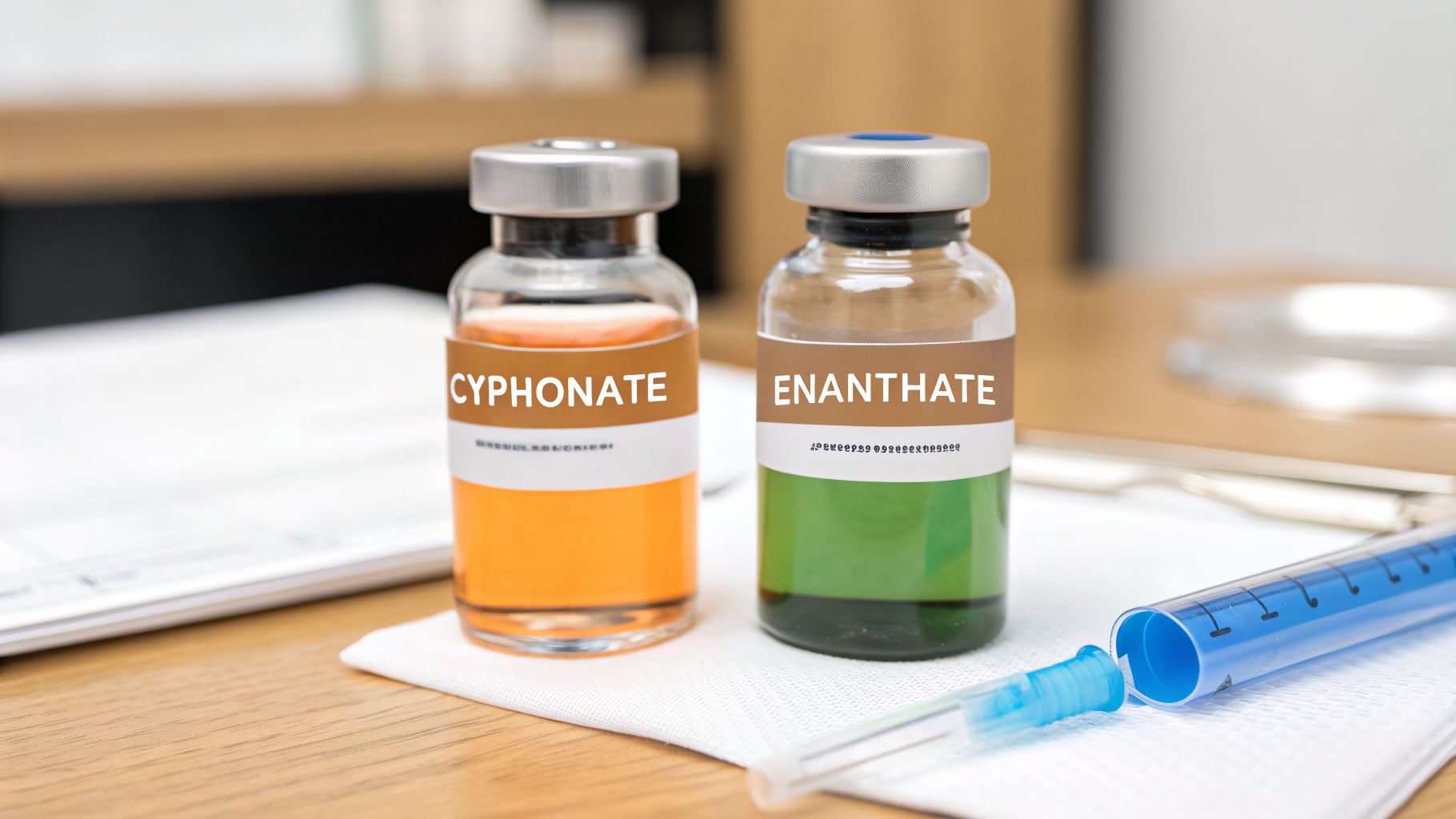
When it comes to choosing between cypionate vs enanthate, the honest truth is that for most men on Testosterone Replacement Therapy (TRT), the real-world difference is almost negligible. Both are highly effective, bioidentical forms of testosterone that deliver nearly identical outcomes. The debate really comes down to subtle distinctions in their chemical makeup, half-life, and the carrier oil they're suspended in.
Cypionate vs. Enanthate: The Definitive Comparison
For both patients and clinicians, understanding the practical differences between testosterone cypionate and testosterone enanthate is crucial for tailoring a treatment protocol. While they’re often used interchangeably, their minor variations can sometimes influence the patient experience. Let’s break down what truly matters when making a choice.

Quick Look: Key Differences Between Cypionate and Enanthate
At a glance, it's easy to see why these two compounds are so often compared—their profiles are remarkably similar. Milligram for milligram, their performance is nearly identical, but a few structural and logistical factors set them apart.
This table provides a quick, high-level overview of their most critical attributes.
| Attribute | Testosterone Cypionate | Testosterone Enanthate |
|---|---|---|
| Half-Life | Approximately 8 days | Approximately 7 days |
| Ester Chain | 8 carbons (slightly longer) | 7 carbons (slightly shorter) |
| Carrier Oil | Typically cottonseed oil | Typically sesame oil |
| Common Use | Predominantly used in the U.S. | More common in Europe and globally |
| Dosing | Weekly or twice-weekly injections | Weekly or twice-weekly injections |
While these differences seem minor, they can have very practical implications. For instance, the carrier oil is a non-negotiable factor for anyone with a specific allergy. A patient sensitive to sesame oil would naturally do better with cypionate, whereas someone allergic to cottonseed oil might prefer enanthate. The one-day difference in half-life is rarely noticeable with a standard injection schedule.
The Core Takeaway: Ultimately, the choice between cypionate and enanthate isn’t about which one is inherently "better." It's about which one best aligns with your body's specific needs, your location, and your doctor's protocol.
Market Preference and Availability
The preference for testosterone cypionate in the United States isn't just a clinical habit; it’s a market reality. Its long-standing history and widespread use by American providers have cemented its position as the go-to injectable for many TRT protocols.
Market analyses underscore cypionate's strong position, forecasting it to have the fastest compound annual growth rate (CAGR) from 2023 to 2033 within the TRT industry. The entire testosterone replacement market is projected to grow from USD 1.98 billion in 2023 to USD 2.93 billion by 2033. This trend is largely driven by cypionate's proven clinical track record, making it a favorite in a market dominated by injectables. You can learn more about these market dynamics in this full report on the testosterone replacement therapy market.
Thankfully, the rise of patient-focused telehealth clinics has made this regional preference less of an obstacle. Modern clinics can source either ester, ensuring your treatment plan is based on a proper clinical assessment, not just what's most common in your area.
Understanding the Science Behind Testosterone Esters

Before we can really get into the cypionate vs enanthate debate, we need to talk about what an "ester" actually is. When you inject testosterone, you aren't injecting the pure, raw hormone. Instead, it’s attached to a carbon chain—the ester—which controls how quickly the active testosterone is released into your system.
Think of the ester as a time-release mechanism. The testosterone molecule in both cypionate and enanthate is identical to what your body makes naturally. The ester is the only part that’s different, and it’s what dictates the release rate.
The Subtle Difference in Ester Chains
When you look at them on a molecular level, the difference between these two is almost negligible. It all comes down to a single carbon atom.
- Testosterone Cypionate: Features an 8-carbon ester chain.
- Testosterone Enanthate: Features a 7-carbon ester chain.
Because the cypionate ester is just a bit longer and heavier, your body takes a fraction longer to break it down. This gives testosterone cypionate a slightly longer half-life of about 8 days, compared to around 7 days for enanthate. Honestly, for most people on a regular injection schedule, this one-day difference is practically meaningless.
This is exactly why doctors consider them clinically interchangeable. Milligram for milligram, they deliver a nearly identical amount of active testosterone and produce the same results when dosed correctly.
Since both esters came on the market in the 1950s, testosterone cypionate has consistently been the more popular choice in the U.S. It's expected to hold that position in the global market, which is projected to grow from USD 2.06 billion to USD 3.04 billion by 2034, mostly because it just works so well.
Why Carrier Oils Might Matter More
Here’s a practical point that often gets lost in the chemistry discussion: the carrier oil. This is the sterile oil that the testosterone ester is dissolved in for injection, and it can be a much bigger deal for patients than the ester itself.
Typically, the standard formulations are:
- Cypionate: Suspended in cottonseed oil.
- Enanthate: Suspended in sesame oil.
For most people, the type of oil makes no difference whatsoever. But if you have an allergy or sensitivity, it’s the only thing that matters. A bad reaction or significant post-injection pain (PIP) from cottonseed oil immediately makes enanthate the right choice. The same goes for anyone with a sesame sensitivity—they'll need cypionate.
This real-world factor often makes the whole half-life debate irrelevant. It's one of the first things a good clinician will ask about. That said, some of cypionate's historical popularity may be tied to data showing it can create slightly higher peak testosterone levels of 500-1000 ng/dL after an injection, whereas enanthate peaks are often closer to 400-900 ng/dL. You can find more on this market dynamic from HTF Market Insights.
How Ester Choice Impacts Dosing and Blood Level Stability

The tiny chemical difference between testosterone cypionate and enanthate has a direct impact on how your body processes them after an injection. This is what shapes your entire experience on TRT, from your injection schedule to how you feel day-to-day. Getting this right is the key to a successful protocol that minimizes side effects.
On paper, the main difference you'll see is a slight variation in half-life—the time it takes for your body to clear half of the drug. Cypionate’s half-life is roughly 8 days, while enanthate's is just a touch shorter at around 7 days. While that one-day gap looks small, it's the reason we pay so much attention to injection timing.
Every injection creates a "peak" in your blood testosterone levels shortly after you administer it, followed by a "trough" as levels fall before your next dose. The real art of TRT is managing the distance between that high and that low to keep you feeling steady and consistent.
From Weekly Jabs to Stable Levels
Years ago, it was common practice to prescribe a single, large injection every one or two weeks. It was convenient, sure, but it often created a hormonal rollercoaster. You'd feel great for a few days after the shot, only to feel your energy, mood, and libido crash as your levels plummeted toward the trough.
This is where injection frequency completely changes the game. Modern, well-managed TRT protocols have moved toward more frequent, smaller injections. This approach, which works brilliantly for both cypionate and enanthate, is designed to mimic your body's own natural, steady output of testosterone.
A much better strategy is splitting your total weekly dose into two smaller injections. For instance:
- Instead of one 200mg shot on a Monday…
- You'd take two 100mg shots, one on Monday and the other on Thursday.
This simple adjustment makes a world of difference, dramatically smoothing out those peaks and troughs. By preventing your testosterone from spiking too high or dropping too low, you create a far more stable hormonal baseline. You can dive deeper into the specifics of testosterone enanthate's properties in our detailed guide.
Key Clinical Insight: The number one goal is a stable blood level. Splitting doses isn't just about feeling better; it's a powerful clinical strategy. By flattening out those extreme hormonal peaks, you can significantly reduce the conversion of testosterone to estrogen (aromatization), which often means you won't need an aromatase inhibitor.
Choosing an Injection Schedule
Because their half-lives are so close, the best injection frequency for cypionate and enanthate is pretty much the same. A twice-weekly schedule is now the gold standard for most men on TRT, offering an excellent balance of convenience and stability, no matter which ester you're using.
For those who are particularly sensitive to hormonal shifts or are using testosterone for performance enhancement, an even more frequent schedule might be better. Injections every other day or three times per week can create an almost perfectly flat line for blood levels, which is the ultimate goal.
At the end of the day, the cypionate vs. enanthate debate is far less important than the injection protocol itself. Both of these esters are fantastic when used correctly. The right approach is always one that's personalized with your clinician to fit your body's response, your lab work, and your lifestyle.
Managing Side Effects and Real-World Efficacy
When we talk about the results that actually matter—getting your energy back, boosting your libido, and helping you build muscle—testosterone cypionate and enanthate are two sides of the same coin. A dose of 100mg of cypionate will deliver the exact same therapeutic punch as a 100mg dose of enanthate. The active hormone is identical, so your body's response will be, too.
Yet, if you spend any time on internet forums or in gym locker rooms, you’ll hear endless debate about one ester being "wetter" or "drier" than the other. This anecdotal chatter suggests one is more likely to cause side effects like water retention or gynecomastia (male breast tissue). Frankly, this is a complete misunderstanding of how testosterone actually works in the body.
These side effects have nothing to do with the ester itself. They're driven by two things: the total testosterone dosage you're taking and your individual sensitivity to estrogen conversion, a process called aromatization. The more testosterone you introduce, the more of it your body will convert to estrogen. If your estrogen levels climb too high, that's when you start dealing with bloating, moodiness, and other estrogen-related problems.
Debunking Common Side Effect Myths
The idea that you can simply switch from cypionate to enanthate to fix a water retention problem is just plain wrong. The real fix is dialing in your protocol. Instead of swapping esters, the focus should always be on finding the right dose and injection frequency to keep your hormone levels stable and in your optimal range.
For instance, if a man is feeling bloated on 200mg of testosterone cypionate a week, he’s going to have the exact same problem on 200mg of enanthate. The ester isn't the culprit; the dose is simply too high for his body, leading to excessive aromatization.
The Core Principle of Modern TRT: Effective side effect management comes from a personalized protocol and consistent monitoring, not from the ester you choose.
This is where working with a knowledgeable clinician is non-negotiable. An expert will adjust your dose or, more commonly, have you split it into more frequent injections (like twice a week) to smooth out the hormonal peaks and valleys. This approach gets to the root cause of side effects, rather than just playing a shell game with two nearly identical medications.
Efficacy and Identical Outcomes
When it comes to real-world results, there's no winner in the cypionate vs enanthate debate because they deliver identical outcomes. Both are incredibly effective at fixing the symptoms of low testosterone.
- Libido and Sexual Function: Both will bring a healthy sex drive and erectile function back online.
- Energy and Mood: On either ester, patients consistently report huge improvements in their energy, mental clarity, and sense of well-being.
- Body Composition: Both will help you pack on more muscle and shed body fat, especially when you’re also eating right and training hard.
The testosterone molecule itself is doing all the heavy lifting, and that molecule is bioidentical in both forms. Your choice between them should really come down to practical things like carrier oil sensitivities, cost, and what's easily available where you live—not on debunked myths. And if maintaining fertility is a priority while on TRT, other therapies are often needed, and you can learn more about the role of HCG for men in our detailed guide.
Ultimately, a successful TRT journey is built on a solid diagnosis, a carefully managed protocol, and regular blood work to keep your levels optimized. The specific ester you choose is one of the least important factors in that entire equation.
Cost, Availability, and the Rise of Telehealth
When you get down to it, the tiny differences in chemistry between testosterone cypionate and enanthate often take a backseat to a much more practical question: Which one can you actually get, and what will it cost you? For years, where you lived played a surprisingly large role in that answer, but that's all changing.
There's long been a clear geographical divide, but it has nothing to do with which ester is "better." In the United States, testosterone cypionate has been the go-to for decades, making it the default for most doctors. Across Europe and other parts of the world, however, testosterone enanthate is often the standard, being more available and affordable.
Why the Market Looks the Way It Does
This split is purely a result of historical manufacturing trends and distribution deals, not clinical evidence. For patients in the U.S., this has meant that cypionate is usually easier to find at a local pharmacy and can be a bit more budget-friendly. To get a better handle on what goes into the price tag, our guide on how much a testosterone shot costs breaks it all down.
The numbers back this up. The global market for testosterone replacement therapy (TRT) hit a valuation of $1.9 billion in 2022, with the cypionate segment leading the charge. This is largely thanks to its widespread use by American doctors. You can dive deeper into these trends and discover more about the TRT market projections to see where things are headed.
How Telehealth Is Tearing Down the Walls
While your local pharmacy’s stock used to dictate your treatment, the growth of telehealth has made those old barriers almost meaningless. Online TRT clinics have completely changed the game by putting personalized treatment first.
Now, instead of being stuck with what’s available locally, you can get a protocol designed specifically for you, no matter where you are. This model puts convenience and access front and center.
Here's a quick look at how it typically works:
- Step 1: The Online Consult: Everything starts with a private online health evaluation and a virtual meeting with a qualified provider.
- Step 2: Convenient Lab Work: They’ll arrange for you to get lab tests done, either at a local facility or even with an at-home kit, to get a clear picture of your hormone levels.
- Step 3: Discreet Home Delivery: Once your prescription is finalized, your medication is tested for purity and shipped right to your home in plain packaging.
This modern approach cuts out the logistical nightmares and puts the power back into your hands, giving patients in the USA, Canada, and Australia access to the right medication for their specific needs.
A Shift in Focus: The best online clinics have changed the conversation from "what can I get?" to "what actually works best for me?" Your protocol is now driven by your lab results and how you feel, not by some pharmacy's supply chain.
At the end of the day, whether cypionate or enanthate is the right fit for your protocol, a good online clinic can get it for you. This lets you and your doctor focus on the things that truly matter—fine-tuning your dose, tracking your progress, and hitting your health goals without being held back by where you live.
After diving into the science, the big question is—which one should you actually choose? When it comes to the cypionate vs enanthate debate, there’s no single winner. The best choice is the one that fits your specific situation, pure and simple.
For most men starting Testosterone Replacement Therapy (TRT) in the United States, testosterone cypionate is the default for good reason. It’s readily available, typically costs less, and is what most clinicians reach for first. It’s incredibly effective, and the vast majority of patients thrive on it.
That said, the decision isn't always so straightforward. Certain individual factors can easily tip the scales toward enanthate.
A Practical Framework for Making Your Choice
Let’s set aside the minor chemical distinctions for a moment and focus on what really matters for your treatment. Walking through these scenarios with your doctor is the surest way to land on the right ester for you.
Here are the most common situations we see:
- You live in the U.S. and your top priorities are cost and convenience. In this scenario, cypionate is almost always the clear starting point. It's the most widely prescribed and generally the most budget-friendly option on the American market.
- You have a known allergy or sensitivity to cottonseed oil. This is a deal-breaker for cypionate. Since cypionate is most often suspended in cottonseed oil, a known sensitivity makes enanthate, which typically uses sesame oil, the immediate and necessary alternative.
- You’re a bodybuilder or athlete focused on performance. From a results standpoint, the two are identical. Milligram for milligram, you won't be able to tell the difference in a blind test. Your decision should come down to practical concerns like sourcing, lab-tested quality, and price—not a nonexistent performance edge.
This flowchart breaks down the decision process, showing how practical needs should guide your choice.

As you can see, real-world factors are what truly drive the decision between these two functionally interchangeable esters.
To make this even clearer, here's a table to help you match your primary goal to the right medication.
Decision-Making Framework: Choosing Cypionate or Enanthate
| Your Primary Concern or Goal | Recommended Ester | Reasoning |
|---|---|---|
| Lowest Cost & Easiest Access (U.S.) | Cypionate | It's the most common and cost-effective TRT prescription in the United States, making it the logical starting point. |
| Known Cottonseed Oil Allergy | Enanthate | A clear-cut medical reason to avoid cypionate. Enanthate's sesame oil base is the standard alternative. |
| Global Availability (Outside the U.S.) | Enanthate | It is more widely prescribed and available in Europe and other parts of the world. |
| Performance Enhancement | Either | They are bioidentical in effect. Choose based on batch quality, reliable sourcing, and price. |
| Minimizing Injection Volume | Cypionate | It is slightly more concentrated (70% testosterone by weight vs. 69%), but this difference is clinically insignificant. |
Ultimately, choosing the right ester is just the first step.
The truth is, the whole 'cypionate vs. enanthate' argument is far more academic than it is practical. Both are phenomenal medications that have helped countless men get their lives back. A well-designed protocol from a knowledgeable doctor will deliver great results with either one.
Your success on TRT hinges on accurate diagnosis, personalized dosing, and diligent monitoring—not on the minor differences between these two excellent medications.
Your conversation with your doctor is what truly matters. Be open about your budget, lifestyle, and any past sensitivities. Once you've settled on a formula, the real work begins: dialing in your dose, finding the right injection schedule, and consistently monitoring your labs to feel your absolute best.
Frequently Asked Questions About Testosterone Esters
All the science is great, but what does this mean for you? When you're looking at TRT, the practical, day-to-day questions are often what matter most. We get these all the time, so let's clear up some of the most common points in the cypionate vs. enanthate discussion.
Can I Easily Switch Between Cypionate and Enanthate?
Absolutely. Switching between these two is one of the easiest adjustments you can make in your TRT protocol. Because they're nearly identical twins in how they act in the body, the switch is a simple 1:1 swap.
If your weekly dose is 100mg of cypionate, you can switch right over to 100mg of enanthate. The most common reason for this is a minor reaction to the carrier oil, like swapping from cypionate’s cottonseed oil to enanthate’s sesame oil to get rid of some injection site irritation.
Is One Ester Better for Muscle Growth?
Nope. When it comes to building muscle, shedding fat, or any other benefit, there's no winner between cypionate and enanthate. The "magic" comes from the testosterone molecule itself, which is identical in both.
Any stories you hear about one being better for gains almost always come down to other things—like diet, training consistency, or simply a higher overall dose. Milligram for milligram, they provide the exact same raw material for muscle growth.
How Often Will I Need Blood Work on TRT?
Consistent lab work is non-negotiable for doing TRT the right way—it’s how we ensure your protocol is both safe and effective. Here’s what a typical schedule looks like:
- Baseline Labs: We run a full panel before you start to see where you're at.
- First Follow-Up: This usually happens around the 6-8 week mark. It's the first real check-in to see how your body is responding.
- Routine Monitoring: Once you're dialed in and feeling good, we'll check your labs every 6 to 12 months to make sure everything stays optimized.
This regular testing keeps your testosterone in the sweet spot while also keeping an eye on other key markers, like your hematocrit and estradiol.
Why Is Cypionate So Popular in the United States?
This one comes down to history and market forces, not medical superiority. Testosterone cypionate’s popularity in the U.S. is a legacy of how it was developed and marketed decades ago.
American pharmaceutical companies simply put more muscle behind producing and distributing it. As a result, generations of doctors were trained on it, and it became the go-to script. This momentum means it's often easier to find and sometimes a bit cheaper in U.S. pharmacies, cementing its status as the default choice for many clinics.
Ready to move beyond the debate and find a TRT protocol built around your unique health goals? At Elite Bioscience, we provide personalized hormone therapies with expert guidance and discreet home delivery. Explore our TRT solutions today and start your journey toward optimized health.