If you’ve ever suspected that standard hormone tests are only giving you a piece of the puzzle, you're onto something. The DUTCH (Dried Urine Test for Comprehensive Hormones) test is designed to show you the whole picture—one that other tests often miss. It’s a simple, at-home test that uses dried urine samples to map out not just your hormone levels, but how your body is actually using and breaking them down.
A Complete Picture of Your Hormonal Health
Think of your hormones like a complex orchestra. A single blood test is like hearing the violins play one note at one specific second—it tells you very little about the entire symphony. The DUTCH test, on the other hand, is your all-access pass, showing you how every instrument plays together throughout the day.
This guide will break down this advanced hormone panel, step by step. We'll show you how it measures not just your hormones but also their crucial byproducts, known as metabolites. This level of detail is exactly what’s needed to build a truly personalized health strategy.
Beyond a Simple Snapshot
The real game-changer with the DUTCH test is its ability to track your hormones over a full 24-hour period. Hormones, especially cortisol (your body's main stress hormone), aren't static. They follow a natural daily ebb and flow, called a diurnal rhythm.
A single blood draw captures just one moment in time. This can easily miss the bigger story about your adrenal function or how you're handling daily stress. By collecting multiple samples throughout the day, the DUTCH test maps out your entire hormonal rhythm, uncovering much deeper insights.
This comprehensive view helps us spot imbalances that a one-and-done blood test would almost certainly overlook. For instance, your cortisol might look perfectly "normal" in a 9 AM blood draw. But the DUTCH test could reveal that it plummets by mid-afternoon, finally explaining why you hit a wall of fatigue every day around 3 PM.
Turning Data Into Action
Consider this guide your roadmap to understanding how your body truly puts its hormones to work. We'll explore how this incredibly detailed information helps us create effective, targeted strategies for a range of health concerns:
- Fine-tuning TRT: For men on Testosterone Replacement Therapy, seeing the metabolic pathways is key. It helps optimize treatment and sidestep unwanted side effects.
- Addressing Female Hormones: Women can get much-needed clarity on issues like estrogen dominance, PMS, and the transition into perimenopause by understanding how they uniquely metabolize estrogen and progesterone.
- Managing Stress and Fatigue: Mapping the daily patterns of both cortisol and its inactive form, cortisone, can pinpoint the root cause of adrenal fatigue and burnout.
Our goal is to translate what looks like a complex page of numbers into clear, actionable insights. This empowers you and your Elite Bioscience provider to build a precise, effective plan for your health.
What a DUTCH Test Actually Measures
Imagine trying to understand a complex story by only reading one page. That's what standard hormone testing often gives you—a single, static snapshot. A blood test might tell you your testosterone level at 9 AM, but it won't tell you what your body does with that testosterone all day.
The DUTCH test is completely different. It gives us the whole story, revealing not just your hormone levels, but how your body produces, uses, and gets rid of them. It's less of a snapshot and more of a documentary about your unique hormonal biochemistry.
Think of it like this: a blood test shows you a car's speed right now. The DUTCH test shows you the engine's performance, how efficiently it's using fuel, and where all the exhaust is going. This depth is what allows for truly precise and effective health strategies.
Sex Hormones and Their Metabolites
One of the most powerful aspects of the DUTCH test is how it maps out your sex hormone pathways. We're not just looking at the big-name hormones; we're tracking what they become, which is often where the real issues lie.
-
Estrogens: We see all three main forms (Estrone, Estradiol, Estriol), but crucially, we see how you're breaking them down. Are you using protective, healthy pathways, or are you creating metabolites linked to higher risks? This is key for understanding issues like estrogen dominance.
-
Androgens: For hormones like testosterone, we see where it’s going. Is your body converting it into the highly potent DHT (dihydrotestosterone), which can affect things like hair loss and prostate health? Or is it being "aromatized" into estrogen? Knowing this is absolutely vital for managing hormone therapies.
-
Progesterone: Instead of a single, highly variable blood measurement, the test looks at progesterone metabolites. This gives us a much more stable and accurate picture of your overall production.
This kind of metabolic detail is non-negotiable for effective care. For example, the global market for testosterone replacement therapy (TRT) hit between USD 1.9 billion and USD 2.94 billion by 2025, and its success hinges on this level of insight. For our clients at Elite Bioscience, just knowing a testosterone number isn't enough. We need to see its metabolic fate to ensure we're optimizing vitality without causing unintended side effects. You can explore the full industry report here for more on market trends.
The Adrenal Hormone Story
Your adrenal glands are your stress-response command center, with cortisol as the main player. But a single cortisol reading from a blood draw is practically useless. Why? Because its levels are meant to swing dramatically throughout the day.
The DUTCH test captures this entire rhythm. You collect four or five samples over a 24-hour period, which allows us to map out your diurnal cortisol pattern. We see if your cortisol surges in the morning to get you going and then tapers off at night so you can sleep soundly.
This cortisol map reveals issues that other tests completely miss. We can spot HPA axis dysfunction (often called "adrenal fatigue") and see if you’re stuck in "on" mode with high cortisol, running on empty with low cortisol, or if the whole pattern is flipped upside down—finally explaining that persistent fatigue or anxiety.
The test also measures cortisone (the inactive version), showing us how well your body is pumping the brakes on the stress response. Plus, it includes DHEA, a foundational adrenal hormone that serves as a building block for testosterone and estrogen. If you want to dive deeper into these precursor hormones, check out our guide on the differences between Pregnenolone and DHEA.
Organic Acids and Other Key Markers
The DUTCH test goes even further, including a selection of Organic Acid Tests (OATs). Think of these as little breadcrumbs that lead us to other important clues about your health, adding critical context to the hormone results.
These extra markers can give us a heads-up on:
- Nutrient Gaps: They can flag potential deficiencies in key vitamins like B12 and B6.
- Neurotransmitter Activity: By measuring metabolites of dopamine and norepinephrine, we get a peek into your brain chemistry and mood regulation.
- Oxidative Stress: A marker called 8-OHdG reveals the level of cellular DNA damage, a major driver of aging and chronic illness.
- Melatonin Levels: We can also directly measure melatonin, your sleep hormone, to connect the dots between hormonal imbalances and poor sleep.
By weaving together sex hormones, adrenal patterns, and these functional markers, the DUTCH test hormones analysis gives us a truly comprehensive and dynamic picture. We move past just "high" or "low" numbers to understand how your entire hormonal symphony is playing together, which gives us a clear, actionable roadmap to get you feeling your best.
Urine Testing vs. Blood or Saliva Tests
When it comes to understanding your hormones, the type of test you choose dictates the story you'll uncover. Think of a standard blood test as a single photograph—it captures your hormone levels at one precise moment in time. It's a static, isolated snapshot.
A saliva test is a bit more like a short video clip. It can show a little more over a brief period but still offers a pretty limited view of the bigger picture.
The DUTCH test, on the other hand, is like a full-day documentary. It gives us a dynamic, comprehensive narrative of your body's hormonal activity, from the moment you wake up until you go to bed. This is where its real power lies. It doesn't just measure a single point; it maps out your hormonal fluctuations and metabolic pathways over a full 24-hour cycle, revealing the root causes of issues that snapshot tests often miss.
Revealing The Daily Rhythm Of Cortisol
One of the most important differences is how each test looks at cortisol, your main stress hormone. A single blood draw at 9 AM might show a "normal" cortisol level, but that reading completely misses the bigger story of how your adrenal glands are functioning throughout the entire day.
This is a massive blind spot. Cortisol is meant to follow a natural rhythm, what we call the diurnal pattern. It should be highest in the morning to give you that "get up and go" energy, then gradually taper off to its lowest point at night so you can get deep, restful sleep.
A one-time blood test can easily miss signs of HPA axis dysfunction (often called adrenal fatigue). It won't tell you if your cortisol is crashing mid-afternoon, causing that daily energy slump, or if it's spiking at night, leading to insomnia. The DUTCH test's multi-point collection maps this entire curve, turning ambiguity into a clear diagnosis.
By seeing the full 24-hour pattern, we can spot imbalances like an elevated, blunted, or even reversed cortisol curve. This information is a game-changer for getting to the bottom of chronic fatigue, anxiety, and sleep problems.
The Critical Importance Of Hormone Metabolites
Here's another area where the DUTCH test truly shines: its analysis of hormone metabolites. When your body uses a hormone like estrogen or testosterone, it breaks it down into various byproducts, or metabolites. These metabolites tell a crucial story that blood tests completely ignore.
For instance, knowing your total estrogen level is only half the battle. The DUTCH test shows us how your body is actually processing that estrogen. Is it favoring protective, healthy pathways, or is it creating metabolites linked to a higher risk of hormonal symptoms and long-term health issues? Answering this is fundamental for addressing problems like estrogen dominance.
This chart breaks down how the DUTCH test provides a multi-layered view, from core hormones down to their essential metabolites.
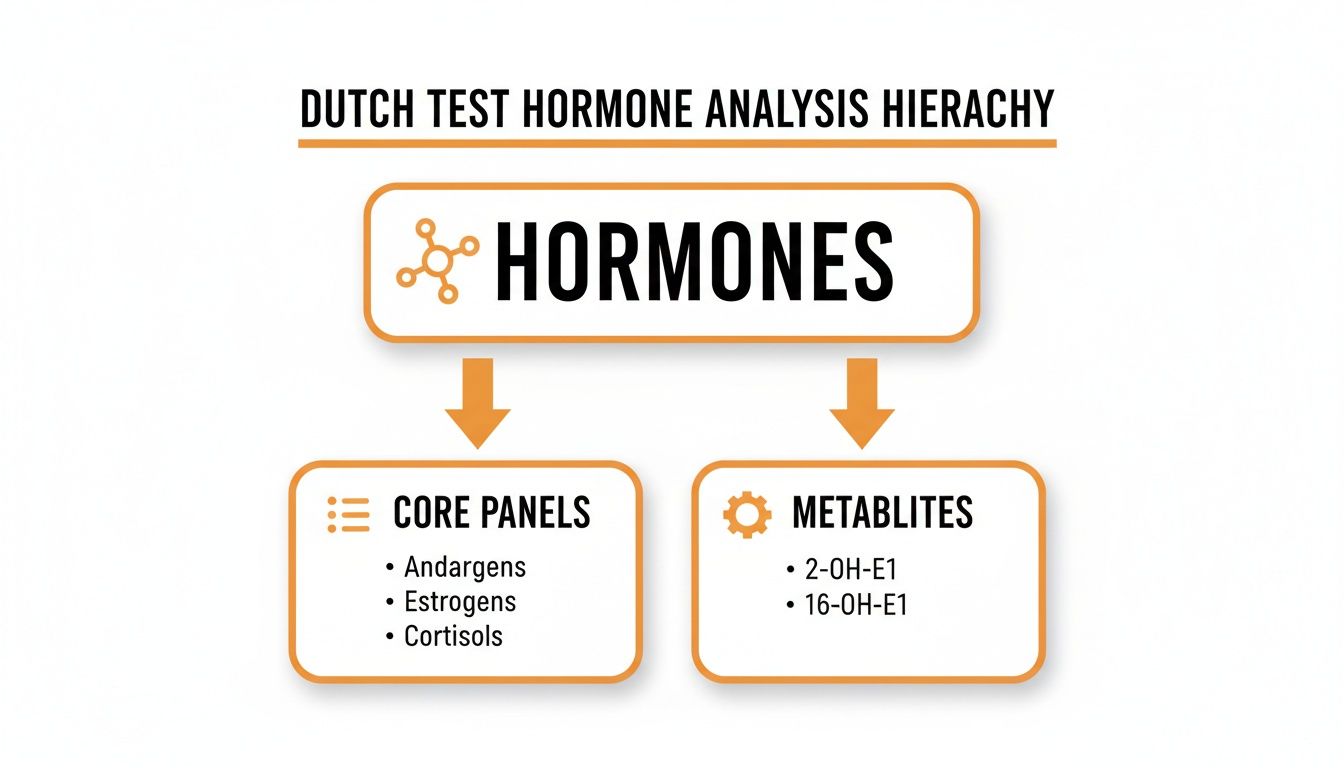
As you can see, understanding the metabolic byproducts provides a much deeper insight than just measuring the parent hormones alone.
Hormone Testing Methods Compared
To put it all together, let's break down how these testing methods stack up against each other. Each has its place, but for a truly comprehensive look at your hormonal health, one clearly provides a more complete picture.
| Feature | DUTCH Test (Urine) | Serum Test (Blood) | Saliva Test (Saliva) |
|---|---|---|---|
| Data Scope | Comprehensive view of hormones and their metabolites over 24 hours. | A single snapshot of hormone levels at one specific moment. | Measures "free" hormone levels and can track daily rhythms. |
| Key Advantage | Reveals hormonal rhythms and metabolic pathways, offering deep insights. | Considered the gold standard for measuring total hormone levels. | Non-invasive and good for tracking cortisol's daily pattern. |
| Primary Limitation | Does not measure circulating hormones directly in the bloodstream. | Misses the diurnal pattern and does not show metabolites. | Can be affected by oral hygiene and lacks metabolite data. |
| Collection Method | Simple, non-invasive at-home urine collection on filter paper. | Requires a needle stick and a visit to a lab or clinic. | Non-invasive at-home saliva collection in a tube. |
Ultimately, while blood and saliva tests have their uses, the DUTCH test provides a far more complete and actionable map of your hormonal health. It delivers the depth of data we need to build truly personalized and effective treatment plans.
Convenience Meets Comprehensive Data
Beyond its clinical depth, the DUTCH test is incredibly convenient, which is a perfect fit for telehealth. Instead of booking time off for a lab visit to get a blood draw, you collect all the samples you need right from the comfort of your home.
The collection process itself is simple and non-invasive—just a few urine collections on a strip of filter paper. This at-home method removes a major barrier to testing and empowers you to take a proactive role in your health. If you want to learn more about at-home testing, you can read our guide on how to check hormone levels at home.
How to Prepare for Your DUTCH Test

Getting accurate, reliable results from your dutch test hormones analysis all comes down to proper preparation. Think of it like tuning an instrument before a performance—a little bit of prep work ensures the final result is a true reflection of what’s going on inside your body.
The process is actually quite simple. The main goal is to collect a "clean" sample, one that hasn't been influenced by certain foods, supplements, or unusual activities. Following these guidelines creates the perfect baseline for the test to capture your real hormonal patterns. Let's walk through the steps to get you ready for a successful collection day.
Timing Your Test Correctly
The first—and most important—step is picking the right day to collect your samples. For women with menstrual cycles, this is especially critical to ensure we measure your hormones at the most representative point.
For Women with Regular Menstrual Cycles:
The ideal window for testing is between days 19 and 22 of a typical 28-day cycle. This is the mid-luteal phase, when progesterone should be at its peak, giving us a clear picture of your ovulatory health.
- If your cycle is longer, say 30 days, you’d test a bit later, around days 21-24.
- If your cycle is shorter, perhaps 26 days, you’d test a little earlier, around days 17-20.
For Men and Postmenopausal Women:
Things are much simpler here. If you're a man, postmenopausal, or a woman without regular cycles, you can collect your samples on any day that works for you.
No matter who you are, the key is to choose a typical day. Avoid testing when you're sick, traveling across time zones, or under unusual stress. These things can throw your hormones out of whack temporarily and skew your results.
Adjusting Foods and Supplements
To make sure the test measures your body's own hormone production, you’ll need to temporarily avoid a few things that could interfere with the results. You should start making these adjustments 48 hours before you begin your first collection.
Foods to Avoid:
For the two days leading up to your test, please steer clear of:
- Avocados
- Bananas
- Fava beans
These foods contain compounds that can artificially inflate some of the markers measured in the dutch test hormones panel.
Supplements and Medications:
This is a good time to chat with your Elite Bioscience provider about any medications or supplements you’re taking. While you may be asked to pause certain items, never stop any prescribed medication without direct medical guidance. Common supplements to discuss include things like DHEA, pregnenolone, or any hormone-based creams or gels.
Your Collection Day Schedule
On the day of your test, the game plan shifts to precise timing and careful fluid intake. The DUTCH Complete kit requires four or five dried urine samples collected over a 24-hour period. This is how we map your daily hormone rhythms, like the rise and fall of cortisol.
Fluid Intake Guidelines:
On the day before your first collection (the dinnertime one) and on your main collection day, try to limit your total fluid intake to no more than 64 ounces. That's about eight glasses of water. It's also best to avoid caffeine and alcohol completely during this time.
- Too much fluid can dilute your urine, which can make it difficult to get an accurate reading of your hormone concentrations.
- Too little fluid can do the opposite, making concentrations appear artificially high.
A typical collection schedule looks something like this:
- Sample 1: Late Afternoon/Dinnertime (around 5 PM)
- Sample 2: Bedtime (around 10-11 PM)
- Sample 3: Middle of the Night (only if you happen to wake up)
- Sample 4: Immediately Upon Waking
- Sample 5: About Two Hours After Waking
Just follow the instructions in your kit carefully. You'll either urinate directly onto the filter paper or dip it into a collection cup. Once you're done, let the strips air dry completely before you pack them up. That's it! Following these simple steps will help you provide a high-quality sample that leads to the most reliable and useful results.
How to Interpret Your DUTCH Test Results

When your DUTCH test results come in, you'll be looking at a multi-page report packed with charts, dials, and diagrams. It can look pretty complex at first glance. But this isn't just a jumble of numbers; it's the unique story of how your body works, and learning to read it is the first step toward taking control of your health.
Let's walk through how to make sense of the report's visual layout. The goal is to turn what looks like a complicated clinical document into your personal health roadmap, giving you and your provider a clear plan to get you feeling your absolute best.
Understanding the Visual Language of Your Report
The first thing you’ll notice is that the DUTCH report is highly visual. Instead of endless columns of lab values, it uses graphical dials and pathway charts to tell a story.
Think of the dials like the gauges on a car's dashboard. They give you a quick, intuitive snapshot of each hormone level. Every dial has a green section showing the "normal" range, so you can see in an instant whether a specific hormone is low, high, or right where it should be.
For example, your testosterone or progesterone levels are displayed on these dials, giving you an immediate sense of where you stand. This visual simplicity is your entry point into understanding your personal dutch test hormones profile.
Following the Hormone Pathways
Beyond the individual dials, you’ll find the pathway diagrams. These are arguably the most powerful part of the entire report. If the dials are your car's gauges, the pathway charts are the engine schematic, showing how all the parts work together.
These diagrams literally map out how your body produces and breaks down its key hormones. You can trace the journey of a hormone like testosterone from its creation to its final destination, seeing exactly how much is being converted into other potent forms like DHT or even being turned into estrogen.
This is the kind of detail that helps answer the critical questions a simple blood test just can't:
- Why is my estrogen high? The chart might show that your body is aggressively converting testosterone into estrogen.
- Am I handling stress well? The pathways reveal if your body is stuck making the active stress hormone (cortisol) instead of its inactive form (cortisone).
- Is my body detoxifying estrogen safely? You can see if you're using healthy, protective detoxification pathways or favoring ones that are less ideal.
The Power of Expert Interpretation
While the report is designed to be user-friendly, its real magic is unlocked when a trained clinician interprets it. The data in a dutch test hormones panel is incredibly rich, and an expert can connect the dots in ways that aren't immediately obvious, translating the raw data into a targeted health strategy.
Your Elite Bioscience provider acts as your interpreter. They turn the "what" (your hormone levels) into the "why" (the underlying metabolic patterns) and, most importantly, the "how" (your personalized treatment plan). This is where information becomes real transformation.
For instance, a clinician won’t just see "high cortisol." They'll see a specific pattern—like high cortisol at night paired with poor cortisol breakdown—which points to a particular type of adrenal imbalance. This deep insight allows them to recommend targeted stress management techniques, specific supplements, or lifestyle shifts that address the root cause, not just the symptom.
If you're looking to build your own skills in this area, you can learn more about the fundamentals of how to read lab results in our detailed guide.
From Data to Action: A Real-World Example
Let’s look at a common (anonymized) scenario to see how this works. A female patient comes in with classic symptoms of PMS and heavy periods. Her DUTCH report arrives, and the main "dial" for her estradiol level looks perfectly normal, which seems confusing.
But the pathway diagram tells the real story. It shows she has very poor Phase 1 estrogen metabolism. She isn't breaking down estrogen efficiently through the protective 2-OH pathway. Instead, her body is shunting it down the more problematic 4-OH and 16-OH pathways, which can directly contribute to her symptoms.
Armed with this specific metabolic insight, her provider can create a precise action plan:
- Dietary Changes: Add more cruciferous vegetables (like broccoli and cauliflower) to support healthier estrogen detoxification.
- Targeted Supplementation: Recommend nutrients like DIM (diindolylmethane) to encourage the body to use the protective 2-OH pathway.
- Lifestyle Support: Suggest strategies to improve liver health, since the liver does the heavy lifting of hormone metabolism.
This is the true power of the DUTCH test. It moves you past generic advice and provides a clear, personalized, and actionable roadmap based on your unique biochemistry.
Your Path To Optimized Health
We’ve peeled back the layers of hormonal health, moving far beyond a simple lab value. The DUTCH test is the first real step in crafting a wellness plan that’s uniquely yours. Rather than a single snapshot from blood, it paints a comprehensive portrait—one that captures hormone levels, their byproducts, and how your body handles them.
Here’s what sets it apart:
- The dutch test hormones analysis maps out each metabolic pathway.
- It reveals root causes behind fatigue, mood swings, stress overload, and more.
- Collection happens at home with a simple, non-invasive kit.
Stop Guessing And Start Measuring
Feel confident in your next move. When you switch from estimation to precision, you unlock insights that empower real change. No more questioning why you feel drained or anxious; the data tells the story.
Your health decisions should rest on facts, not hunches. This test lays the groundwork for concrete, personalized steps forward.
With clarity on your biochemical patterns, you and your Elite Bioscience provider can:
- Fine-tune hormone or adrenal support
- Shape a targeted HRT or TRT plan
- Pursue peak vitality with clear metrics
Your Invitation To A Healthier Future
Ready for a change? This is your green light to stop guessing and start measuring what truly matters. Connect with Elite Bioscience, order your DUTCH test, and begin charting a path toward lasting well-being.
One kit, one sample, a world of precise insights—your journey toward optimal health starts now.
Your Questions About the DUTCH Test, Answered
Hormone testing can feel complicated, and it's natural to have questions. Let's walk through some of the most common ones we hear about the DUTCH Test so you can feel confident about what it can do for your health.
Is the DUTCH Test a Medically Valid Test?
This is a great question. While the DUTCH test isn't FDA-cleared—which is actually pretty common for highly specialized lab tests like this—it has been extensively validated in scientific literature by its creators. Multiple studies have confirmed its accuracy for measuring hormones and their metabolites from dried urine.
Think of it this way: a blood test is a snapshot, but the DUTCH test is more like a panoramic photo. It’s a tool that provides a much wider, more detailed view of your hormonal landscape than traditional tests. That's why your provider will use it alongside your symptoms and health history to get the full picture.
Is This Test Just for Women?
Not at all. While the DUTCH test is fantastic for getting to the bottom of female hormone puzzles like PMS, perimenopause, or estrogen dominance, it's just as powerful for men.
Men often use the test to investigate symptoms of andropause (often called "male menopause") and get a handle on their overall vitality. It gives a detailed breakdown of things like:
- Testosterone Levels: Not just how much you have, but how your body is actually using it.
- Androgen Pathways: Is your testosterone converting into the more potent DHT, or is it turning into estrogen? This is a critical detail.
- Adrenal Health: It maps out your daily cortisol rhythm, which is key for tackling issues like chronic stress, fatigue, and burnout.
When you consider that research shows testosterone can decline by 1-2% every year after age 30, you can see why having this kind of detailed information is so valuable for proactive men's health.
Can I Figure Out My Own Results?
Your DUTCH report is designed to be user-friendly, with plenty of charts and dials that give you a quick visual sense of where your levels are. So yes, you can get a general idea on your own. But to really get the value out of it, you need a trained eye.
A trained provider doesn't just see a number on a page; they see the entire story. They understand how your sex hormones, adrenal function, and metabolic pathways are all talking to each other. This is what allows them to build an effective action plan that's truly based on your unique biochemistry.
That expert interpretation is what turns the raw data into a clear roadmap for feeling better.
How Long Until I Get My Results?
After you've collected all your samples and mailed the kit back to the lab, the analysis process begins. You can typically expect to see your full, detailed results within two to three weeks. From there, your Elite Bioscience provider will set up a consultation to go over every detail with you.
Ready to stop guessing and get a truly precise picture of what's going on with your hormones? Elite Bioscience makes it easy to get started.
Order your DUTCH test today and take the first real step toward a personalized strategy for optimal health. Visit https://elitebioscience.co to learn more.