Hormone therapy and hair loss are two sides of the same coin. The connection boils down to specific hormones—especially a powerful testosterone byproduct called dihydrotestosterone (DHT)—that can literally shrink your hair follicles.
So, while a treatment like Testosterone Replacement Therapy (TRT) might speed up this process if you're already genetically prone to balding, other hormone-based approaches can actually be used to fight back against thinning hair.
The Link Between Hormones and Your Hair
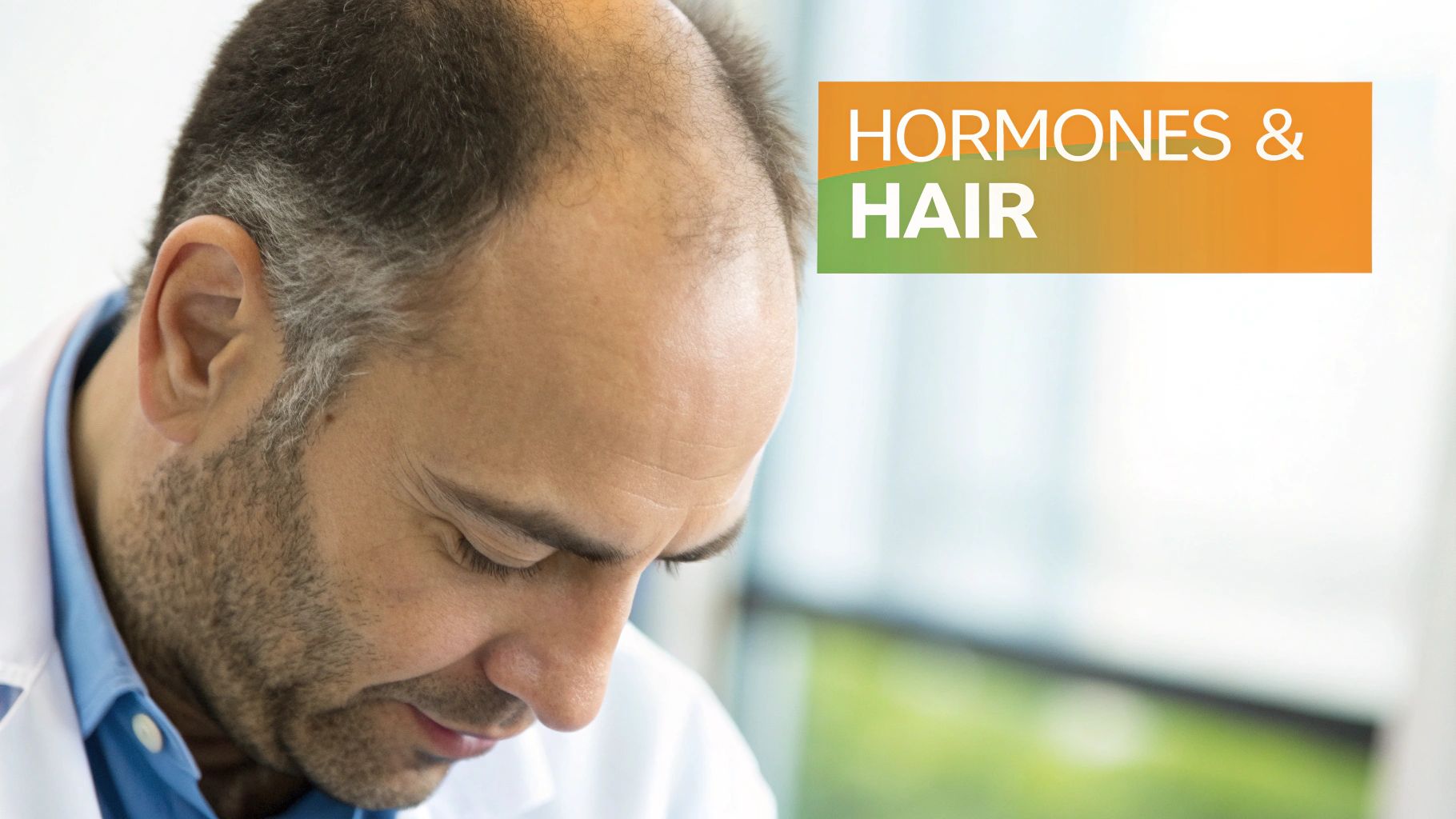
To really get what’s happening, think of your hair's growth cycle like a well-tended garden. There’s a growing season (the anagen phase), a transitional season (the catagen phase), and a shedding season (the telogen phase). In this analogy, your hormones are the gardeners, making sure each season happens on time and that the garden thrives.
When your hormonal "gardeners" are all working in harmony, the cycle ticks along perfectly, keeping your hair full and healthy. But if certain hormones get out of whack—either too much or too little—they can throw the entire system into chaos, and you'll start to see the results in the mirror.
The Key Players: Hormones and Follicles
The main villain in the story of hormonal hair loss is a potent androgen called dihydrotestosterone, or DHT. Testosterone often takes the heat, but it's really the conversion of testosterone into DHT that spells trouble for your hair.
This transformation happens thanks to an enzyme called 5-alpha reductase. Once DHT is made, it's significantly more powerful than testosterone and has a knack for binding to receptors in your scalp's hair follicles. For people with a genetic susceptibility to hair loss, this is where the problem starts.
Think of your hair follicle as having a specific lock on its door. DHT is the key that fits that lock perfectly. When DHT attaches to the follicle, it unlocks a process called "miniaturization."
This miniaturization process is exactly what it sounds like: the progressive shrinking of the hair follicle. With every new growth cycle, the follicle produces a hair that's shorter, finer, and weaker. The growing phase gets cut short, while the shedding phase lasts longer. Eventually, the follicle shrinks so much it can't produce a visible hair at all, leading to baldness.
Why Your Genes Call the Shots
It's absolutely critical to remember that hormones aren't the sole cause of hair loss. The real driver is your genetic makeup. Your DNA determines just how sensitive your hair follicles are to DHT's effects.
This is why one person can have high testosterone and a full head of hair, while another with normal hormone levels experiences significant thinning. It all comes down to that genetic sensitivity. It’s also why male and female pattern baldness tends to run in families.
If you've inherited these sensitive follicles, then adding more testosterone into your system via TRT can pour fuel on the fire, giving your body more raw material to convert into follicle-damaging DHT.
But this understanding also gives us a clear path forward for treatment. By targeting these hormonal pathways, we can intervene to protect the follicles. The goal isn't to get rid of vital hormones like testosterone, but to manage the DHT conversion and block its effects right at the scalp—letting you keep your hair while still optimizing your overall health.
How Different Hormone Therapies Affect Hair Health
Not all hormone therapies are created equal, and their impact on your hair can be worlds apart. The same hormone that helps one person might trigger thinning in another—it all comes down to the specific therapy, the dosage, and your own unique genetic makeup. Understanding these differences is absolutely crucial for protecting your hair while you work on your overall wellness.
The link between hormone therapy and hair loss isn't a straight line. Think of it more as a complex dance between specific hormones, the other hormones they transform into, and how sensitive your hair follicles are to their signals. Let's look at how some of the most common therapies for men and women fit into this picture.
Testosterone Replacement Therapy For Men
For men on Testosterone Replacement Therapy (TRT), one of the biggest questions is often about hair loss. It’s a completely valid concern, but to tackle it, we need to identify the real troublemaker. Spoiler alert: it's not testosterone itself.
The real issue is what testosterone can turn into: a much more potent androgen called dihydrotestosterone (DHT). This is the hormone that actually shrinks hair follicles.
- More Fuel for the Fire: TRT provides your body with more testosterone. This gives an enzyme called 5-alpha reductase more raw material to work with, which can lead to higher levels of DHT.
- The Genetic Factor: If you have the genes for male pattern baldness, your follicles are already highly sensitive to DHT. The higher DHT levels from TRT can then act like an accelerator, speeding up the hair loss process that was already in your DNA.
So, TRT doesn't create hair loss out of thin air. Instead, it can unmask or accelerate a predisposition that was already there. This is why a good TRT plan for at-risk men almost always includes a strategy for managing DHT.
Hormone Therapies For Women
A woman's hormonal world is incredibly intricate, with estrogen, progesterone, and androgens all playing distinct roles. Because of this, different therapies can lead to very different outcomes for your hair.
Menopausal Hormone Replacement Therapy
During menopause, Hormone Replacement Therapy (HRT) is often used to bring declining estrogen and progesterone levels back into a healthier range. When it comes to hair, the results can go either way.
On the one hand, estrogen is fantastic for hair—it helps keep follicles in their active growth phase for longer. By restoring estrogen, many forms of HRT can actually lead to thicker, healthier hair. The catch? Many HRT plans also include progestins (synthetic versions of progesterone), and some of these can act a bit like androgens, potentially causing hair thinning in women who are sensitive.
The key is balance. An HRT regimen that focuses on restoring estrogen and uses progestins known to be "hair-friendly" is far less likely to cause problems. You can explore a deeper explanation in our guide to bioidentical hormone therapy options.
To help clarify, here’s a quick summary of how common hormone therapies can influence your hair.
Hormone Therapy Effects on Hair Loss
This table breaks down some common hormone therapies and their general impact on hair follicles, along with the hormonal mechanism behind the change.
| Hormone Therapy Type | Primary Hormone Involved | Typical Effect on Hair Follicles | Who It Primarily Affects |
|---|---|---|---|
| Testosterone Replacement (TRT) | Testosterone (converts to DHT) | Can accelerate miniaturization if genetically predisposed | Men |
| Menopausal HRT (Estrogen) | Estrogen | Protective; extends the anagen (growth) phase | Menopausal Women |
| Menopausal HRT (Progestins) | Progestins (some types) | Can be androgenic, potentially causing thinning | Menopausal Women |
| Oral Contraceptives | Progestins (varied types) | Effect depends on androgenicity; can be harmful or helpful | Women of reproductive age |
| Anti-Androgen Medications | Spironolactone, etc. | Blocks androgen receptors, preventing follicle miniaturization | Women with FPHL |
As you can see, the specific hormone and its action at the follicle level are what truly matter. It’s never as simple as "more" or "less" of a single hormone.
Oral Contraceptives
Birth control pills work by managing hormone levels to prevent pregnancy, and their effect on your hair is tied directly to the type of progestin used in the formula.
- High-Androgen Index Pills: Some progestins are structured similarly to testosterone and can have androgenic effects. For women with a genetic tendency for hair loss, these pills can be a trigger.
- Low-Androgen Index Pills: Other pills use progestins with very low or even anti-androgenic properties. Doctors often prescribe these types specifically to help with hormonal issues like acne and hair loss.
It's also worth noting that simply starting, stopping, or switching birth control pills can sometimes cause a temporary shedding period called telogen effluvium, as your body recalibrates to a new hormonal state.
Anti-Androgen Medications
For women diagnosed with female pattern hair loss (FPHL), treatment often focuses on shielding the hair follicles from androgens. This is where medications like spironolactone come in.
Spironolactone works in two ways: it blocks androgen receptors on the follicles and helps lower the body's overall production of androgens. By stopping DHT from latching onto your follicles and doing damage, it can halt the shrinking process, reduce shedding, and often lead to a real, visible improvement in hair density. It's a perfect example of how we can use our understanding of hormone therapy and hair loss to create a positive outcome.
Proven Treatments for Male Pattern Hair Loss
When it comes to fighting male pattern hair loss—especially if you're on TRT—the game plan is actually quite straightforward: you have to shield your hair follicles from the damaging effects of Dihydrotestosterone (DHT). Luckily, there are proven medical treatments that do exactly that, giving you a powerful way to stop hair loss in its tracks and even stimulate new growth.
The most effective tools in our arsenal are a class of medications called 5-alpha reductase inhibitors. These are the heavy hitters, the go-to solution for managing the link between hormone therapy and hair loss.
So, how do they work? Think of the 5-alpha reductase enzyme as a small factory in your body that converts testosterone into the much more potent DHT. A 5-alpha reductase inhibitor's job is to walk in and shut down that factory's production line. By blocking this conversion, it drastically lowers DHT levels in your system, and most critically, in your scalp.
Finasteride: The Gold Standard DHT Blocker
When you hear about 5-alpha reductase inhibitors for hair loss, you're almost certainly hearing about Finasteride. It's the most well-known and widely prescribed medication in this class, and for good reason. It specifically targets the type of 5-alpha reductase enzyme found in hair follicles, making it incredibly precise and effective.
Taking finasteride essentially puts a protective barrier around your hair follicles. It doesn't mess with your testosterone levels—which is a huge plus for anyone on TRT—but it slashes the amount of follicle-shrinking DHT. This gives your hair a real fighting chance to recover, thicken, and thrive.
The clinical evidence backing finasteride is overwhelming, cementing its place as a cornerstone treatment. The data speaks for itself. After just one year on a daily 1mg dose, 48% of men saw noticeable hair regrowth, compared to only 7% of men taking a placebo. Even better, after two years, only 17% of finasteride users had any further hair loss, while a staggering 72% in the placebo group continued to lose hair. You can dig deeper into these compelling numbers in this guide to hair loss facts.
By directly lowering DHT levels in the scalp, finasteride addresses the root hormonal cause of male pattern baldness, effectively stopping the miniaturization process in its tracks.
This is what makes it so valuable for guys on TRT. It allows you to get all the benefits of optimized testosterone—more energy, better libido, increased muscle mass—without sacrificing your hair. It neatly transforms a potential side effect into a manageable part of your health plan.
Understanding the Results You Can Expect
When you start taking a DHT blocker, the goals are twofold: first, to stop any more hair from falling out, and second, to regrow hair in areas that have recently started to thin. The best results are usually seen on the crown and mid-scalp, where hair loss is often most active.
Here’s a rough timeline of what most people experience:
- The First Few Months (3-6): The first sign that it's working is less shedding. You probably won't see a ton of new growth just yet, but the hair loss itself should stabilize. That's a huge win.
- The Growth Phase (6-12 Months): This is when the magic starts to happen. You'll likely begin to see visible improvements as thinning patches start to look fuller. Those shrunken, weakened follicles are waking up and producing healthier, thicker hairs again.
- Long-Term Maintenance (1+ Years): Consistency is everything. The benefits of finasteride continue for as long as you take it, providing constant protection for your hair.
It's important to have realistic expectations. Finasteride is fantastic at reviving follicles that are dormant or miniaturized, but it can't bring back follicles that have been completely inactive for years. That's why starting treatment sooner rather than later almost always leads to the best possible outcome.
Hormonal Solutions for Female Pattern Hair Loss
When women experience hair loss, it usually looks different than it does for men. Instead of a receding hairline, you might notice a general thinning all over your scalp, particularly at the part line. This is the classic sign of Female Pattern Hair Loss (FPHL).
At its core, FPHL is often driven by a specific sensitivity to androgens—the group of hormones that includes testosterone and DHT. Even with normal or just slightly high androgen levels, extra-sensitive hair follicles can start to shrink. This process, called miniaturization, causes new hairs to grow back progressively finer and shorter until they eventually stop growing altogether. The key to turning things around is to address that sensitivity.
Anti-Androgens: Your First Line of Defense
For many women dealing with FPHL, the most direct strategy is to use medications that block androgen activity right at the hair follicle. Think of these treatments as a shield, stopping DHT from latching onto your follicles and causing damage. The goal isn't to get rid of androgens entirely, but simply to protect your hair from their effects.
Spironolactone and finasteride are two of the most trusted medications for this job. They work in slightly different ways, but both aim to lighten the androgenic load on your hair.
- Spironolactone: While technically a diuretic, this medication is a potent androgen receptor blocker. It essentially occupies the receptor on the hair follicle, so there’s no room for DHT to bind and do its damage. It also has a mild effect on reducing overall androgen production.
- Finasteride: More widely known as a men's hair loss treatment, finasteride can be very effective for women, particularly after menopause. It works by inhibiting the 5-alpha reductase enzyme, which is responsible for converting testosterone into the much more potent DHT.
These hormonal therapies can make a real difference. For instance, one study showed that spironolactone (at 100-200mg daily) stabilized or improved hair growth in nearly 75% of women. Another study found that 62% of premenopausal women saw improvement with finasteride when used with an oral contraceptive. You can read more about these findings on female hair loss treatments from the National Library of Medicine.
Creating a More Balanced Hormonal Picture
It's not just about blocking androgens. Restoring balance among your other key hormones is just as critical for healthy hair. Estrogen, for example, is a hair-protective hormone that helps keep strands in their active growth phase for longer. As estrogen levels drop during perimenopause and menopause, the relative influence of androgens naturally increases, which can speed up thinning.
Restoring hormonal harmony is fundamental—not just for your overall vitality and managing menopausal symptoms, but for maintaining strong, healthy hair. A truly comprehensive approach looks beyond just blocking DHT.
This is where a well-managed Hormone Replacement Therapy (HRT) plan can be a game-changer. By bringing estrogen levels back up, HRT can help push back against the effects of androgens and support a healthier growth cycle. To understand how other hormones play a part, our article on the benefits of progesterone for women offers some great insights.
Important Considerations and Next Steps
One crucial point: medications like finasteride are not given to women who could become pregnant unless they are using a reliable form of birth control. This is due to the serious risk of birth defects in a male fetus. A detailed consultation with a doctor is absolutely essential to figure out the safest and most effective path for you.
Your journey should always start with a proper diagnosis. This will likely involve blood work to check your hormone levels and a close examination of your scalp to confirm the pattern of loss. Getting this clear picture ensures your treatment plan is built around your specific hormonal profile and health needs. By understanding the link between hormone therapy and hair loss in your own body, you can find targeted solutions that help restore both your hair and your confidence.
Building Your Comprehensive Hair Restoration Plan
When you’re dealing with hair loss tied to hormone therapy, there’s rarely a single magic bullet. The most successful approach isn't about finding one perfect solution, but about creating a smart, multi-pronged plan that combines foundational hormonal treatments with other proven therapies. It's this synergy that really delivers the best, most lasting results.
Think of it this way: your hormonal treatment—whether it's finasteride or spironolactone—is your defensive line. It's there to protect your hair follicles from any further damage. The other treatments you add are your offensive players, actively working to stimulate new growth and improve the density of your hair. When you use them together, you're tackling the problem from every angle.
Combining Hormonal and Adjunct Therapies
One of the most common and effective strategies is to pair a hormonal treatment with a topical growth stimulant. These two work on completely different pathways, which is what makes them such great partners.
- Hormonal Treatments (The Shield): Medications like finasteride get right to the source of the problem by lowering DHT levels, which stops that destructive follicle-shrinking process in its tracks. This is your first line of defense.
- Topical Minoxidil (The Stimulant): This is a well-known, FDA-approved topical that acts as a vasodilator. It essentially widens the blood vessels in your scalp, boosting blood flow. That rush of oxygen and nutrients can be just what your follicles need to kick back into an active growth phase.
This duo is the classic one-two punch against hair loss. While your hormonal therapy is busy preventing more thinning, minoxidil is on the front lines encouraging new hairs to grow.
The real goal of a comprehensive plan is synergy. While one treatment shields the follicle from hormonal assault, another actively nourishes it and encourages it to grow back stronger. This kind of multi-pronged attack is always going to be more effective than relying on just one method.
Recent data shows just how open people are to a blended approach. When it comes to hair treatments, women often explore both medical and natural paths, with 75% preferring salon-based chemical treatments and 62% also opting for natural home remedies.
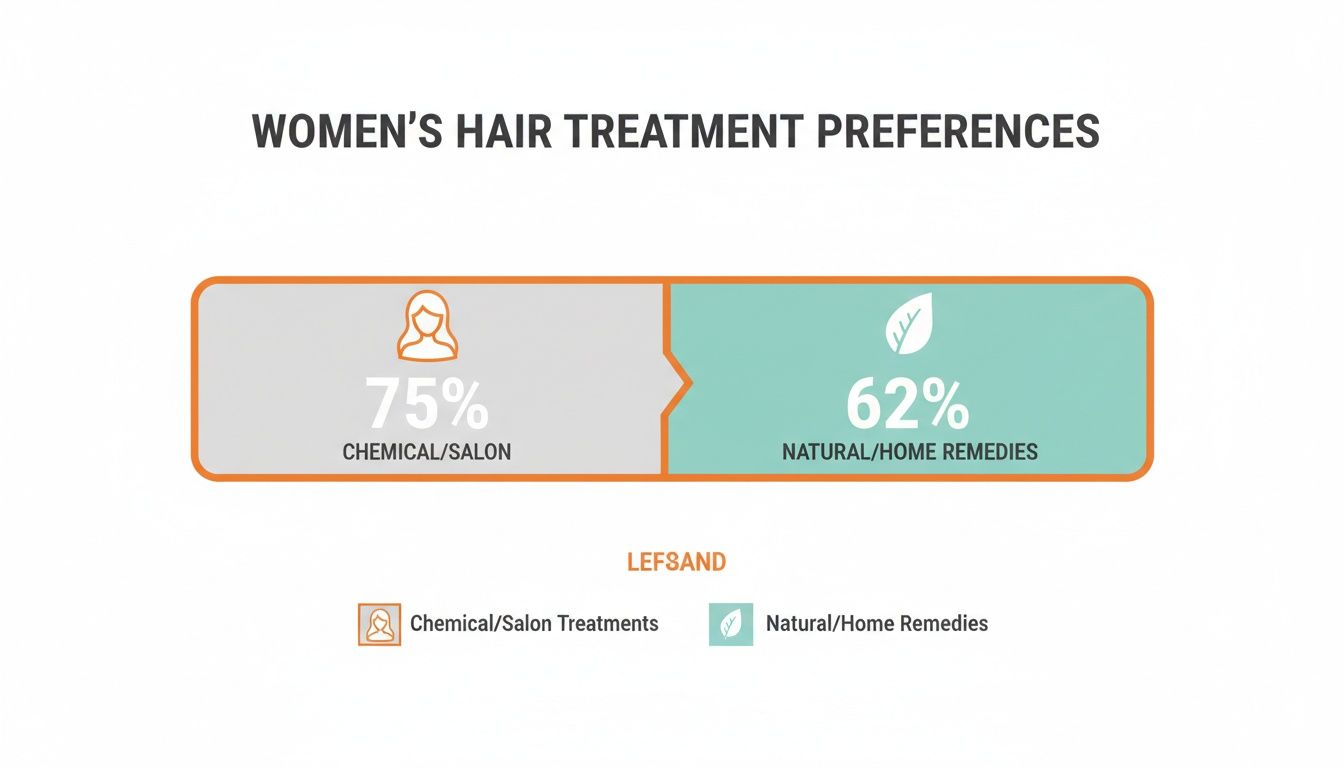
This really underscores the desire for a well-rounded strategy—one that combines scientifically proven options with supportive wellness habits to get the best possible outcome.
Exploring Regenerative and Light-Based Options
Beyond the basics, you can add even more power to your plan with some advanced therapies. These treatments are designed to kickstart the body's own natural healing and regenerative abilities.
Low-Level Laser Therapy (LLLT): This is a completely non-invasive option that uses red light to energize the cells inside your hair follicles. The idea is that this light enhances energy production, which can help extend the anagen (growth) phase and ultimately lead to better hair density. You can even do it at home with caps and combs.
Platelet-Rich Plasma (PRP) Therapy: This is a medical procedure where a small amount of your own blood is drawn, spun down to concentrate the platelets, and then injected back into your scalp. Why? Because those platelets are packed with growth factors that can wake up dormant follicles and spur new, thicker hair growth.
The evidence for these different approaches is quite compelling. For instance, comparative findings on hair loss treatments show that while oral finasteride can increase hair counts by 8.99% over 12 months, LLLT has demonstrated gains between 12.79% and 16.96% in just 26 weeks. Even more impressive, regenerative options like PRP have shown a density increase of around 28% to 29% after 23 weeks, highlighting just how powerful they can be.
Comparing Top Hair Loss Treatments
With so many good options on the table, it can be tough to know where to start. This table breaks down the leading treatments to give you a clearer picture of how they work and what they do best.
| Treatment | Mechanism of Action | Typical Effectiveness (Hair Count Increase) | Best For |
|---|---|---|---|
| Finasteride | Blocks the conversion of testosterone to DHT, protecting follicles. | ~9% increase over 12 months. | Men with male pattern baldness; some postmenopausal women. |
| Topical Minoxidil | Increases blood flow and nutrient delivery to follicles. | 12.3% increase (5% solution) over 48 weeks. | Both men and women seeking to stimulate new growth. |
| LLLT | Uses red light to stimulate cellular energy in follicles. | ~13-17% increase over 26 weeks. | Individuals looking for a non-invasive, at-home option. |
| PRP Therapy | Injects growth factors from your own blood to activate follicles. | ~28% increase in density over 23 weeks. | Patients wanting a potent, regenerative boost to their plan. |
Ultimately, there’s no one-size-fits-all answer. The best strategy is always going to be one that’s personalized for you.
That’s why talking to a medical professional is the most important first step. They can properly diagnose the root cause of your hair loss and help you build a plan that truly fits your hormonal profile, health history, and personal goals.
Taking the Next Step with a Medical Consultation
Feeling informed is one thing, but taking decisive action is how you truly regain control over your hair health. If you're connecting the dots between hormone therapy and hair loss, the path forward is clear: get a professional medical diagnosis. Trying to figure it out on your own often leads to wasted time and the wrong treatments, whereas a proper consultation gives you a personalized roadmap.
When you see a doctor in person, they'll start with a thorough evaluation. This usually begins with a physical check of your scalp to see the pattern and extent of the thinning. From there, blood work is almost always the next step to get a precise picture of what’s happening with your hormones.
What to Expect from Your Diagnosis
A solid diagnostic process is the only way to build a treatment plan that’s actually going to work for you. It’s not just a quick glance.
Here’s what you can generally expect:
- A Detailed Health History: You’ll talk through your symptoms, whether hair loss runs in your family, and any medications or therapies you're currently on.
- Hormone Level Testing: Blood tests are crucial. They measure key players like testosterone, DHT, and estrogen to pinpoint any imbalances that could be fueling the hair loss. For a deeper dive into advanced options, you can read our guide on the DUTCH hormone test.
- A Close Scalp Examination: The doctor will take a close look at your hair follicles, sometimes using magnification, to confirm if it’s androgenetic alopecia.
A professional diagnosis does more than just tell you that you're losing hair. It uncovers the specific hormonal reasons why. This insight is what allows for a targeted strategy instead of just trying a generic, one-size-fits-all product.
The Convenience of Telehealth Services
Getting expert medical care doesn't have to mean rearranging your schedule for a clinic visit. Telehealth has opened up a simple, private, and effective way to get the help you need, right from your own home.
The process is refreshingly straightforward. You'll typically start by filling out a confidential online health questionnaire, which is then followed by a virtual chat with a licensed doctor.
If a treatment like finasteride or spironolactone is right for you, a prescription can be sent directly to your pharmacy or even delivered discreetly to your door. This modern approach makes it easier than ever to take that first, crucial step toward protecting your hair.
Common Questions, Answered
Let's tackle some of the most common questions that come up when we talk about hormone therapy and hair. Think of this as a quick reference guide to clear up any lingering confusion.
Will TRT Definitely Make Me Go Bald?
Not at all. This is a huge misconception. Testosterone Replacement Therapy (TRT) doesn't create male pattern baldness out of thin air. Instead, it can speed up the process if you already have the genes for it.
Here's how it works: TRT boosts your testosterone, which your body can then convert into dihydrotestosterone (DHT). DHT is the real culprit behind the shrinking of hair follicles in genetically susceptible men. If you don't carry that genetic sensitivity, you might not see any difference in your hair. For those who are predisposed, pairing TRT with a DHT blocker like finasteride is a popular and effective way to get the benefits of testosterone without sacrificing your hair.
Can Hormone Replacement for Menopause Actually Help My Thinning Hair?
For many women, the answer is a resounding yes. Hair thinning is a very common complaint during menopause, and it's directly tied to declining estrogen levels. Estrogen is a "hair-friendly" hormone; it helps keep hair follicles in their active growth phase for longer.
When Hormone Replacement Therapy (HRT) reintroduces estrogen, it can often lead to noticeably thicker and healthier hair. It's important to note, though, that the type of progestin in the HRT formula matters. Some have androgenic (male hormone-like) effects that could work against your goal. A carefully chosen HRT regimen is key to getting the hair benefits you're looking for.
The Bottom Line: How your hair responds to hormone therapy is incredibly personal. It's a mix of your genetics, the exact hormones and dosages you're taking, and your overall hormonal picture.
Is Hair Loss from Hormones a Done Deal? Is It Permanent?
In most cases, no—especially if you catch it early. Hair loss driven by hormones usually involves the miniaturization of the hair follicle, not its complete death. This means the follicle is still alive, just dormant or producing a much weaker hair.
By taking steps to block DHT or restore your hormonal balance, you can often stop the thinning in its tracks. You can even wake up those dormant follicles and encourage new growth. The crucial part is sticking with your treatment. If you stop the therapy that's protecting your hair, the hormonal process that was causing the thinning can start right back up again.
Ready to get a clear picture of your hormonal health and how it impacts your appearance? Elite Bioscience specializes in personalized therapy plans to help you look and feel your best. Start your confidential health assessment today and see what a tailored plan can do for you.