So, how much does a testosterone shot actually cost? Let's cut right to the chase. You could be looking at a bill anywhere from $28 per month for a modern telehealth plan to well over $400 monthly if you go through a traditional in-person clinic.
That’s a huge range, and it’s because you're not just paying for a vial of testosterone. You're paying for a complete medical service that includes your doctor's expertise, essential lab work, and all the necessary supplies.
Your Quick Answer to Testosterone Shot Costs

Figuring out the cost of testosterone replacement therapy (TRT) feels a lot like buying a car. The final price tag depends on where you go (the "dealership," like a local clinic versus a telehealth provider), your insurance plan, and the specific "model" of testosterone you're prescribed. The initial quote you get is almost never the full picture.
The good news for patients is that treatment has become much more accessible and affordable over the years. The global market for injectable testosterone was valued at $2.3 billion in 2025 and is expanding, which has kicked up the competition. This is especially true with telehealth companies, who have driven prices down dramatically. Some now offer complete injectable TRT programs starting at just $28 per month, a steep discount from the $40 to $100 per shot you might see from other sources. You can read more about market trends and their effect on pricing for a deeper dive.
What Determines Your Final Price
The total cost of your therapy is a package deal, not just the price of a single vial. Think of it as a bundled service designed to make sure your treatment is safe, effective, and closely monitored by a professional.
Your total investment almost always covers these four key areas:
- Initial Doctor Consultation: The first, crucial appointment to determine if TRT is the right path for you.
- Ongoing Lab Work: Essential blood tests to track your hormone levels and ensure everything is working as it should.
- The Testosterone Medication: The actual core of your treatment, which comes in a few different forms.
- Medical Supplies: All the necessary gear, like syringes, needles, and alcohol swabs.
The big shift recently has been toward all-inclusive subscription models. Instead of getting separate bills for labs, appointments, and medication, many men now pay a single, predictable monthly fee that covers everything from doctor access to having supplies shipped right to their door.
In this guide, we’ll break down each of these costs piece by piece. My goal is to help you understand the "why" behind the numbers so you can make the smartest financial decision for your health.
What Am I Actually Paying For with TRT?

When you first look into the cost of testosterone replacement therapy (TRT), it's natural to think the price tag is just for the medication itself. In reality, that number represents a comprehensive medical program, not just a single product off a shelf.
Think of it this way: when you buy a high-performance car, you're not just paying for the engine. You're paying for the expert engineering, the precision assembly, the safety systems, and the integrated electronics that make it run smoothly and safely. The total price of TRT works the same way—it covers everything needed to get you results, safely and effectively.
Breaking Down the Bill
To really get a feel for the value, you have to look at all the moving parts. A well-managed TRT plan isn't a one-and-done purchase; it’s an ongoing partnership with a medical team.
Here's a straightforward breakdown of what’s typically included in the cost:
- Initial Medical Consultation: This is where it all begins. You'll meet with a doctor to go over your symptoms, medical history, and what you hope to achieve. This is the crucial first step to determine if TRT is even the right path for you.
- Comprehensive Lab Work: Before you start—and at regular intervals during treatment—you’ll need specific blood tests. This data is absolutely essential for your doctor to pinpoint your hormone levels, prescribe the correct dose, and track how your body is responding.
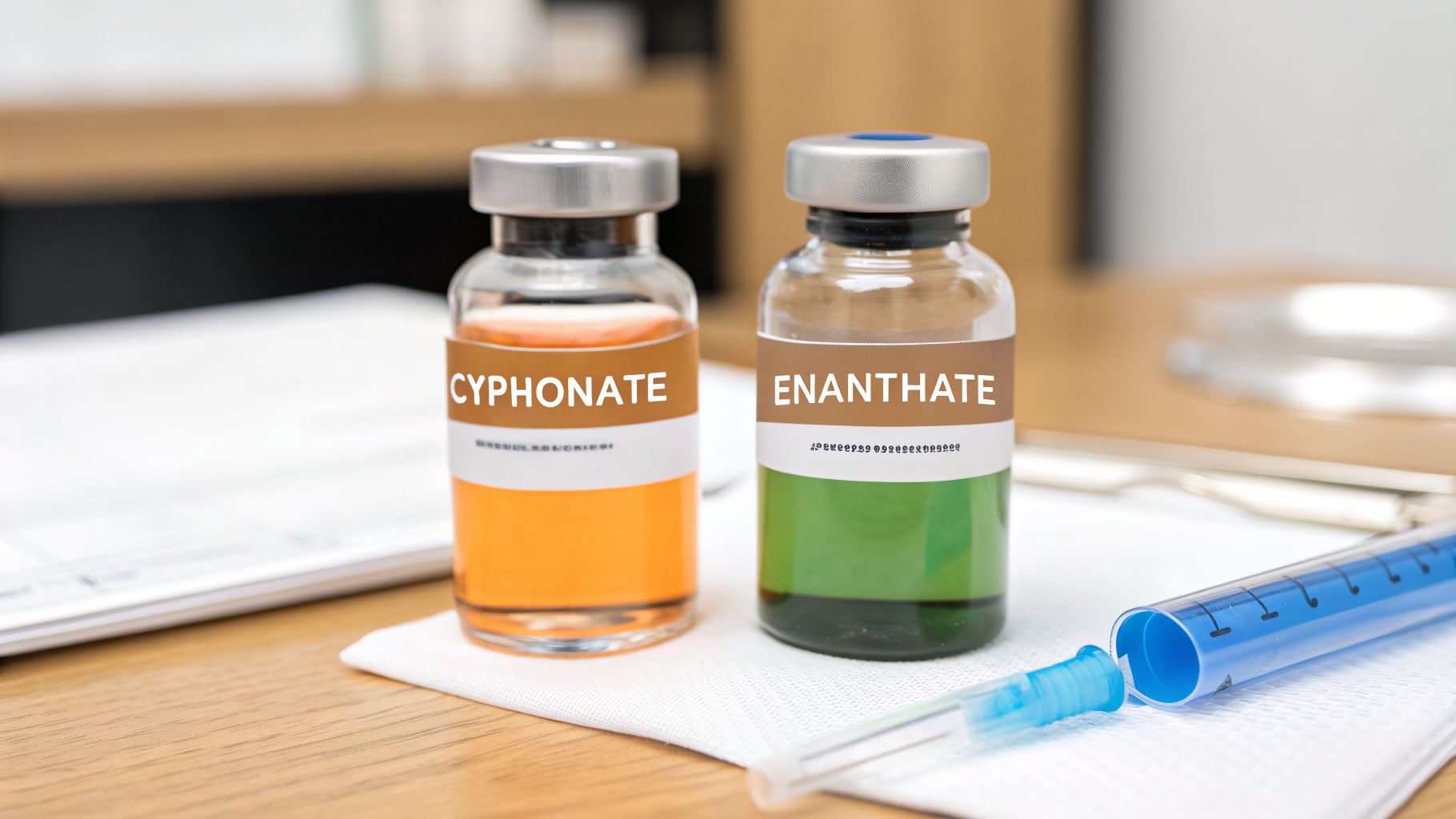
- Testosterone Medication: This is, of course, the core of the therapy. The cost here can vary depending on the specific type of testosterone, like cypionate or enanthate, and the dosage your doctor determines you need. Our guide on what is testosterone enanthate can give you a better idea of the different options available.
- Essential Medical Supplies: You can’t administer your medication without the right tools. The cost also includes all the necessary supplies for safe, sterile injections, such as syringes, needles, and alcohol swabs.
Think of modern TRT like a managed subscription service. Instead of getting nickel-and-dimed with unpredictable bills for every lab panel, follow-up call, and vial of medication, many programs now bundle everything into one consistent, easy-to-budget monthly fee. This gives you financial clarity and peace of mind.
The Value of Bundled Services
In the past, patients often had to navigate a frustrating and pricey system, paying for each part of their therapy separately. This à-la-carte approach meant costs could add up quickly and unexpectedly.
Thankfully, the TRT world has shifted toward greater transparency and affordability. Innovative telehealth companies, in particular, are challenging the old pricing models by offering all-inclusive packages. For example, some telehealth clinics now offer a month's worth of injectable testosterone for as low as $28 as part of a subscription that also covers all your medical support and supplies. It’s a huge difference compared to what men used to pay through traditional channels. You can learn more about how new providers are changing TRT pricing in this detailed analysis.
Why Your Testosterone Shot Cost Varies
Ever get confused when a friend mentions paying a totally different price for his testosterone therapy? You're not alone. When it comes to TRT, there’s no single sticker price. The final cost is a blend of several different factors, and understanding them is the key to figuring out what your own treatment will realistically cost.
Think about getting a car repaired. The final bill isn't just one number; it depends on the parts they use (brand-name or generic), how much work is needed, and even the shop's hourly rate. Pricing for TRT works the exact same way.
The Type of Testosterone Used
Right off the bat, the single biggest influence on your medication cost is whether you’re using a brand-name or a generic testosterone. Medically, they’re the same, but the price difference is staggering.
- Generic Testosterone: This is the workhorse of affordable TRT. Formulations like testosterone cypionate are widely available, effective, and incredibly budget-friendly. This is what most cost-conscious and effective programs are built on.
- Brand-Name Testosterone: On the other hand, a brand-name version like Depo-Testosterone® can easily cost three times more than its generic counterpart, even though you're getting the exact same active ingredient.
Choosing a generic option is the simplest, most immediate way to slash your monthly medication costs without sacrificing any quality in your treatment.
Your Prescribed Dosage and Frequency
Your specific medical needs are the next piece of the puzzle. It’s simple math, really: a man who needs a higher dose of 200 mg each week will use twice as much medication as someone on a 100 mg protocol. Over a month, that adds up.
Your injection schedule matters, too. Most guys are on a weekly or twice-weekly schedule. Ultimately, it’s the total amount of testosterone you use per month that determines your pharmacy bill. Your doctor will figure out the right starting dose based on your initial blood work and adjust it as you go.
The total cost of testosterone therapy isn't just a simple sticker price. It’s a dynamic figure influenced by your specific treatment plan, the provider you choose, and even where you live.
Provider Type and Geographic Location
Where you get your prescription and guidance from has a huge impact on your total bill. A traditional endocrinologist or a brick-and-mortar men's clinic has a lot of overhead—we’re talking rent for a fancy office, staff salaries, and other administrative costs. Those expenses inevitably get passed on to you.
A modern telehealth clinic, however, is built differently. They use a digital-first approach that cuts out the expensive overhead of a physical location. This leaner model allows them to provide the same expert medical care, lab work, and medication, but often at a much more competitive price. On top of that, pharmacy pricing and local regulations can vary from state to state, adding another layer of geographic price difference.
Comparing Costs Between Clinics and Telehealth
When you're ready to start testosterone therapy, one of the biggest choices you'll make is where you get your care. This decision directly shapes not just your experience, but also your total cost.
You essentially have two main paths: the traditional, in-person men’s health clinic or a modern telehealth platform. Each one structures its pricing and services in a fundamentally different way.
The Traditional Clinic: An A La Carte Menu
Think of a traditional clinic like ordering from an a la carte restaurant menu. You pay for every single item separately. There's a fee for the initial office visit, another charge for any follow-up appointments, and separate costs for the lab work.
If a nurse administers your shot, there's often a fee for that service, too. Then, you pay for the medication itself, which might come with a markup from the clinic’s preferred pharmacy. This piecemeal approach makes it tough to predict your final monthly bill, as costs can add up in unexpected ways.
The Telehealth Model: An All-Inclusive Package
Telehealth platforms completely flip that model around. They work more like an all-inclusive subscription service. You pay one flat, predictable monthly fee that covers everything.
This single payment typically bundles your medical consultations, all the testosterone medication you need, and the necessary supplies like syringes and alcohol swabs—all shipped right to your home.
Because these companies operate online, they don't have the massive overhead of a physical clinic. No rent, no front-desk staff, no waiting room magazines. Those savings are usually passed right on to you.

As you can see, the provider you choose is a major driver of your final cost, right alongside the type of testosterone and your specific dosage.
Let’s look at a side-by-side comparison to make the differences crystal clear.
TRT Provider Cost Comparison
| Expense Category | Traditional In-Person Clinic | Telehealth Provider |
|---|---|---|
| Consultation Fees | Paid separately per visit (~$150-$400+ initially) | Included in monthly subscription fee |
| Medication Costs | Paid separately, often at a pharmacy with potential markup | Included in subscription; shipped to your door |
| Supplies (Syringes, etc.) | Usually an extra, separate purchase | Included in subscription |
| Lab Work | Billed separately by the lab or clinic | Often included or offered at a reduced, pre-negotiated rate |
| Follow-Up Visits | Paid separately per appointment | Included in subscription |
| Pricing Structure | A la carte; unpredictable monthly total | All-inclusive subscription; predictable monthly fee |
This table really highlights the core difference: telehealth offers financial predictability, while the in-person model can leave you guessing about the true monthly cost.
This streamlined approach doesn't just offer clarity; it often makes TRT more affordable. Industry analysis shows that while typical injections can run $40 to $100 a month, telehealth subscriptions can start as low as $28 to $60 per month. You can dive deeper into these market trends in testosterone therapy costs to see how the industry is shifting.
Telehealth simplifies TRT by bundling services into a single monthly fee. You get transparent pricing for consultations, medication, and supplies, often at a lower total cost than a traditional clinic's separate charges.
For a growing number of men, the blend of convenience, privacy, and straightforward pricing makes telehealth an obvious choice. To explore your options further, check out our detailed guide on where you can get testosterone shots.
Navigating Insurance for Your Testosterone Therapy
On the surface, using your health insurance for testosterone therapy seems like a no-brainer. After all, isn't that what it's for? But as many men discover, the reality is often a frustrating maze of strict rules and hidden costs that can make paying cash look surprisingly appealing.
Insurance companies have a very narrow view of TRT. They aren't interested in helping you feel optimized or get an edge in the gym; they are in the business of treating diagnosed diseases. For them, testosterone therapy is only approved for one reason: clinical hypogonadism.
Meeting the Strict "Medical Necessity" Criteria
To get your insurance company to even consider covering your treatment, you have to prove that it's "medically necessary." This isn't a vague suggestion—it's a rigid checklist you must complete.
Most insurers require at least two separate blood tests showing your total testosterone is below their specific cutoff. These tests usually have to be taken first thing in the morning when your levels are naturally highest. The threshold is often somewhere under 300 ng/dL. If you don't hit that number, on two separate occasions, you're almost certainly out of luck.
This means if your goal is wellness, anti-aging, or just feeling like your old self again, your claim is going to be denied. Insurers see that as a lifestyle choice, not a medical problem they are obligated to fix.
Think of it like this: Your insurance provider is looking for a clear-cut diagnosis they can plug into their system. If your labs are borderline or you don't have the classic symptoms of a diagnosed condition, they'll simply reject the claim. You're then left holding the bag for the full cost anyway.
Understanding Your Real Out-of-Pocket Costs
Let's say you clear all those hurdles—you have a formal diagnosis and the insurance company approves your treatment. That doesn't mean you're done paying. In fact, this is often where the real financial confusion begins. Your actual costs are buried in the fine print of your plan.
You'll almost always be on the hook for:
- Deductibles: The amount you have to pay out-of-pocket before your insurance even starts to chip in. For many plans, this can be thousands of dollars.
- Copayments (Copays): That fixed fee you pay for every single doctor’s visit and every time you pick up your prescription.
- Prior Authorization: This is a notorious source of delay and frustration. Your doctor has to spend time formally justifying the treatment to your insurer, and you’re stuck waiting for the green light, which can take weeks.
Many guys are shocked when they do the math. After paying their high monthly premiums, hitting their deductible, and covering all the copays, the final "insured" price for their TRT isn't much lower than paying cash directly. Sometimes, it’s even higher.
This is especially true when you compare it to the all-inclusive packages offered by many telehealth clinics. Their transparent pricing models eliminate the guesswork and administrative headaches, giving you a clear, predictable monthly cost from day one.
Practical Ways to Make Your TRT More Affordable

Knowing what drives the cost of TRT is half the battle. Now, let’s get into the practical, actionable ways you can lower your monthly expenses without ever compromising the quality or safety of your treatment. It's all about being a smart patient.
A few key decisions can make a huge difference in your budget.
Choose Generic Formulations
This is one of the biggest and easiest wins. Always ask for the generic version of your testosterone. For example, generic testosterone cypionate is medically identical to the brand-name Depo-Testosterone®, but it can be up to 70% less expensive.
You're getting the exact same active ingredient and the same therapeutic benefit. There's really no reason to pay a premium for the brand name on the box, and making this simple request can slash your medication costs.
Optimize Your Provider Choice
As we've seen, where you get your TRT from is a massive factor in the final price. While a traditional local clinic might be the first thing that comes to mind, modern telehealth platforms are often designed from the ground up for affordability.
Because they have lower overhead, online clinics can pass those savings on to you. Many offer an all-in-one subscription that covers your medication, supplies, and doctor consultations for a single, predictable monthly fee. You can see exactly how this works by exploring the benefits of completing your TRT therapy at home and how it simplifies budgeting.
A modern telehealth provider can bundle consultations, medication, and supplies into one transparent monthly fee, often resulting in significant savings compared to paying for each service separately at a traditional clinic.
Additional Cost-Saving Tips
Beyond the two big ones, a few other smart habits can chip away at your total costs over time. Don't overlook these smaller strategies:
Buy Supplies in Bulk: If your program doesn't include supplies, don't buy them one at a time from the corner pharmacy. You can find syringes, needles, and alcohol swabs much cheaper online or at a medical supply store when you purchase them in larger quantities.
Use Prescription Discount Cards: Never pay the full cash price at the pharmacy without checking a discount service first. Apps and websites like GoodRx or SingleCare provide free coupons that can drastically cut the cost of your testosterone vial—sometimes even beating your insurance copay.
Answering Your Top Questions About TRT Costs
When men start looking into testosterone therapy, a few key questions about the real-world cost always come up. Let's break down the answers to the concerns I hear most often, so you can get a clear picture of the investment.
Is It Really Cheaper to Inject Testosterone Myself at Home?
Without a doubt, yes. Opting for self-administered injections at home is almost always the most cost-effective path.
Think about it: traditional clinics often charge an injection fee every time you come in. That fee, which can run from $25 to $75 for a nurse to administer the shot, gets tacked on top of the medication cost. If you're injecting weekly, that can add hundreds, if not thousands, of dollars to your bill over a year.
At-home TRT programs, especially the kind offered through modern telehealth platforms, are built to avoid that. They bundle everything you need—the testosterone, the supplies, the support—into a single, predictable cost. You skip the recurring office fees and gain significant savings in the long run.
Why Is It So Hard to Get Insurance to Cover My Testosterone Shots?
This is a major source of frustration for many guys, and the reason is simple: insurance companies aren't in the business of funding wellness or lifestyle improvements. They exist to treat diagnosed diseases.
To get your therapy covered, you need an official diagnosis of clinical hypogonadism. This isn't based on how you feel; it has to be proven with multiple blood tests showing testosterone levels below their rigid cutoff, which is often under 300 ng/dL. If you're trying to get TRT to tackle symptoms like low energy or brain fog but don't meet that strict medical threshold, your claim will almost certainly be rejected as "not medically necessary."
This is a big reason why so many men discover that a straightforward, cash-pay program is a much better fit.
The truth is, for many men, a transparent cash-pay program ends up being less of a headache and can even be more affordable than wrestling with insurance deductibles, co-pays, and the endless wait for prior authorizations.
How Much Should I Expect to Pay for the Initial Lab Work?
If you were to walk into a lab and pay entirely out-of-pocket, a complete and detailed hormone panel could set you back anywhere from $150 to over $500. While your insurance might eventually cover some of that cost after you’ve hit your deductible, you’ll likely be paying that money upfront.
Here’s where modern TRT providers have changed the game. Many telehealth clinics have negotiated partnerships with major national labs, allowing them to offer these essential tests at a steep discount. In many programs, the cost of this crucial first lab panel is simply rolled into the price of your initial consultation or bundled with your first month's subscription, making it far more manageable and predictable from day one.
At Elite Bioscience, we believe hormone therapy should be accessible and easy to understand. Our all-inclusive TRT packages give you everything you need—from medical consultations to your medication and supplies—at one clear, affordable price. Take control of your health today by exploring our TRT programs at https://elitebioscience.co.