
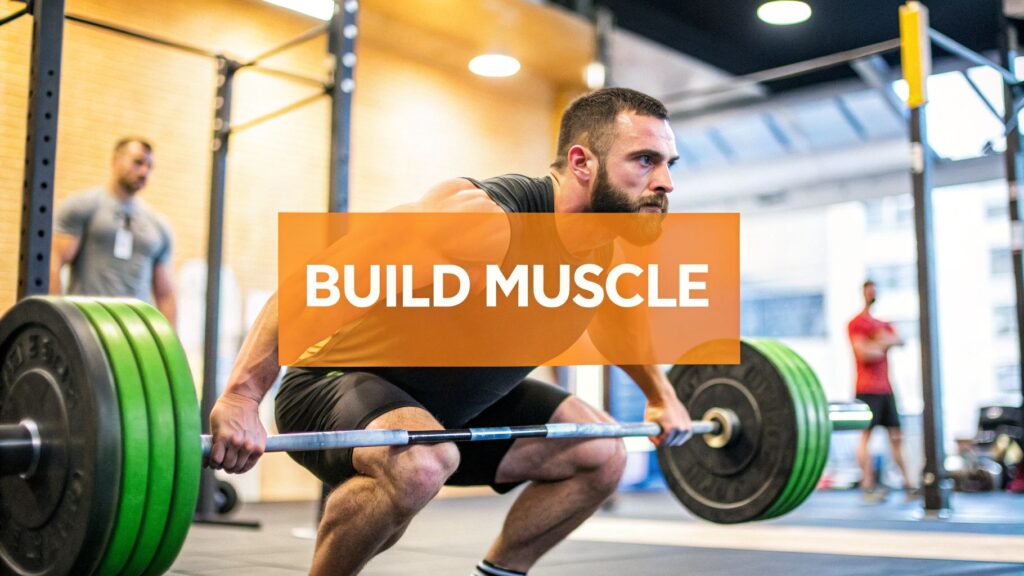
If you want to pack on serious muscle, you have to get a few key things right. It really boils down to a simple, effective strategy: consistently challenge your muscles with resistance training, eat slightly more calories than you burn, and make sure you’re getting enough protein. That's the core formula, but your success hinges on how well you execute these pieces day in and day out.
The Blueprint For Building Serious Muscle
Forget all the noise and fads you see online. Building muscle isn't some complicated secret. At its heart, it comes down to mastering three fundamental pillars.
Think of it like this: your body is a construction site. You need a powerful signal to start the project, a steady supply of building materials, and enough downtime for the crew to get the job done right. Get any one of these wrong, and the whole project stalls.
To put it simply, you can't build muscle without all three of these pillars firmly in place. They are the non-negotiables for growth.
Here is a quick breakdown of what you need to focus on.
Core Pillars of Muscle Hypertrophy
| Pillar | Primary Goal | Key Action |
|---|---|---|
| Stimulus | Signal the body to build new muscle tissue. | Consistently lift weights and make your workouts harder over time. |
| Fuel | Provide the energy and raw materials for muscle repair. | Eat in a slight calorie surplus with adequate protein intake. |
| Repair | Allow the body time to recover and build muscle. | Prioritize 7-9 hours of quality sleep and manage stress levels. |
Each pillar is essential. You can't just pick one or two and expect to see the results you're after. They all work together to create the perfect environment for muscle growth.
The Critical Role of Progressive Overload
Just showing up and going through the motions won’t cut it. Your body is an incredibly efficient machine; it has zero interest in changing unless you give it a damn good reason to. That reason is a principle called progressive overload.
Progressive overload is just a technical way of saying you have to continuously make your workouts harder. To get bigger and stronger, you must find ways to increase the challenge over time.
This is the absolute cornerstone of building muscle. Without it, you’ll hit a wall—a plateau—and your progress will grind to a halt.
Think about it. If you bench press 135 pounds for 8 reps this week, your body adapts. If you come back next week and do the exact same weight for the same reps, you’re not giving it any new reason to grow.
How These Pillars Work Together
Let’s say you have the perfect training program but you’re not eating enough food. You’re sending the signal to grow, but you're not giving your body the building materials it needs. The result? You'll spin your wheels with little to no muscle gain.
On the flip side, you could be eating all the protein and calories in the world, but if your workouts are too easy, there’s no signal for your body to use those nutrients to build muscle. Instead, those extra calories are more likely to be stored as body fat.
This blueprint is all about synergy. Each pillar amplifies the others, creating an environment where muscle growth is almost inevitable. The rest of this guide will give you the exact, actionable steps to put this blueprint into practice, turning these principles into a concrete plan you can follow.
Crafting Your Muscle-Building Workout
Alright, enough with the theory. Let's get down to what you'll actually be doing in the gym. A well-structured workout is the spark that ignites muscle growth. This is where we build the evidence-based plan that will force your body to adapt and get bigger.
The foundation of any serious mass-building program is built on compound exercises. Forget fancy machines for a moment. We're talking about the big, multi-joint movements that work several muscle groups at once. They give you the most bang for your buck, stimulating more muscle fibers and triggering a powerful hormonal response for growth.
Your workouts should revolve around these staples:
- Squats: The undisputed king for building your quads, glutes, and hamstrings.
- Deadlifts: For developing raw, total-body power, especially in your back, glutes, and hamstrings.
- Bench Presses: The classic builder for the chest, shoulders, and triceps.
- Overhead Presses: The single best lift for creating broad, powerful shoulders.
- Rows: Essential for building a thick, dense back.
Focusing on these lifts allows you to move the heaviest weights, which is a critical driver for making consistent progress.
Reps, Sets, and Rest: The Nuts and Bolts of Growth
Just showing up and doing these lifts isn't enough; how you do them is what separates real progress from spinning your wheels. When it comes to hypertrophy (the scientific term for muscle growth), there's a sweet spot.
For most of your lifts, aim for the 6-12 repetition range. This is the proven zone that balances heavy mechanical tension with enough metabolic stress to tell your muscles they need to grow.
As for volume, a solid starting point is 3-4 sets per exercise. This ensures you're doing enough total work to trigger an adaptation without completely running yourself into the ground.
Pro Tip: Don't neglect your rest periods. For your heavy compound lifts, you need to rest for 2-3 minutes between sets. This gives your nervous system time to recover so you can hit the next set with max strength. For smaller, isolation-type movements, 60-90 seconds is plenty.
How to Structure Your Training Week
Your training split—how you organize your workouts throughout the week—is highly personal. It needs to fit your schedule and your ability to recover. There are a couple of highly effective ways to set this up.
- Full-Body Routines: You train your entire body three times a week, typically with a day of rest in between (think Monday, Wednesday, Friday). This is a fantastic approach for beginners because the high frequency ensures you’re constantly stimulating growth.
- Body-Part Splits: This is where you dedicate entire workouts to specific muscle groups. A popular and effective option is the Push/Pull/Legs split. You’d have one day for "push" muscles (chest, shoulders, triceps), one for "pull" muscles (back, biceps), and a dedicated leg day.
There's no single "best" split. A full-body plan offers more frequent muscle stimulation, while a split allows for more volume and focus on each muscle group. The right choice is always the one you can follow consistently.
This whole process is a three-part system. You can see how the pieces fit together here.

As you can see, training is just the stimulus. The real growth happens when you support that hard work with smart nutrition and quality recovery.
The Real Secret: Progressive Overload in Action
We've talked about progressive overload, but what does it actually look like week to week? It simply means you're constantly finding ways to make your workouts a little bit harder over time.
Here’s how you put it into practice:
- Add More Weight: This is the most obvious path. If you squatted 225 lbs for 8 reps last week, your goal this week is to squat 230 lbs for 8 reps. Even a tiny jump is a win.
- Do More Reps: Can't add weight just yet? No problem. Stick with 225 lbs on the squat, but fight for 9 or 10 reps instead of the 8 you got last time.
- Add Another Set: Another great way to increase total volume is to simply add a set. If your plan calls for 3 sets of pull-ups, try doing 4 sets next week.
The key is to not try and do all of these at once. Pick one method of progression for an exercise and stick with it. The journey to build serious muscle is a marathon, not a sprint. The improvements in your strength and work capacity are also fundamental to how you can improve your athletic performance in any sport. Get a workout log, write down your numbers, and make it your mission to beat that logbook every time you walk into the gym.
Fueling for Growth: Your Nutrition and Calorie Playbook
All the hard work you put in at the gym is just one side of the coin. Think of your training as flipping a switch—you're sending the "build muscle" signal to your body. But for that signal to actually create new muscle, you have to deliver the raw materials. That’s where nutrition comes in.

You can't build a house without bricks, and you sure can't build muscle without the right fuel. This playbook will show you exactly how to eat for quality gains, packing on lean mass without a ton of unwanted body fat.
It all starts with a calorie surplus. Simply put, you must eat more calories than your body burns. If you don't provide that extra energy, your body has no resources to build new tissue, no matter how hard you train.
Finding Your Calorie Sweet Spot
This isn't an excuse to crush pizzas and ice cream every night. A massive calorie surplus will just lead to rapid fat gain, and that's not the goal. We're aiming for a controlled, lean bulk.
A modest surplus of 300 to 500 calories above your daily maintenance level is the sweet spot. This gives you just enough energy to fuel muscle repair and growth (muscle protein synthesis) while keeping fat storage to a minimum.
Not sure what your maintenance calories are? A simple, effective starting point is to multiply your body weight in pounds by 15.
For example, a 180-pound man would need roughly 2,700 calories just to maintain his weight. To get into a productive surplus, he’d aim for 3,000 to 3,200 calories per day. Give that a try for a couple of weeks, watch the scale, and adjust. The goal is a slow and steady gain of about 0.5-1 pound per week.
The Three Macronutrient Musketeers
Calories are just the beginning of the story. Where those calories come from—your macronutrients—is what truly shapes your body composition. Let's get into the roles of protein, carbs, and fats.
Protein: The Master Builder
There’s no debate here: protein is the absolute king of muscle growth. Its amino acids are the literal building blocks your body uses to patch up and rebuild muscle fibers stronger after a tough workout. Skimp on protein, and you're leaving gains on the table.
When it comes to building muscle, the evidence points to a clear target: aim for 1.6 to 2.2 grams of protein per kilogram of body weight. That’s about 0.7 to 1.0 grams per pound.
For that same 180-pound guy, this means he needs to eat between 126 and 180 grams of protein every single day. To hit that number, you'll want to prioritize high-quality sources:
- Lean meats (chicken breast, lean beef, turkey)
- Fish (salmon, tuna, cod)
- Eggs and egg whites
- Dairy (Greek yogurt, cottage cheese)
- A quality protein powder (whey, casein, or a plant-based blend)
Carbohydrates: Your Performance Fuel
Carbs have gotten a bad rap over the years, but for anyone serious about getting bigger and stronger, they are essential. Carbohydrates are your body's preferred energy source, directly fueling your performance during those tough, heavy lifting sessions.
Eating enough carbs keeps your muscle glycogen topped off—think of it as the high-octane fuel stored directly in your muscles. When those stores are full, you can train harder and longer, creating a much stronger stimulus for growth. A good target is 3 to 5 grams of carbs per kilogram of body weight.
Fats: The Hormone Regulators
Dietary fats do more than just provide energy. They play a vital role in regulating and producing key anabolic hormones like testosterone, which is absolutely critical for building muscle. If your fat intake is too low, you could be hamstringing your body's natural muscle-building machinery.
After you've calculated your protein and carb needs, fats should make up the rest of your daily calories. This usually lands somewhere around 20-30% of your total calorie intake.
Make sure you’re getting them from healthy sources:
- Avocados
- Nuts and seeds
- Olive oil
- Fatty fish (like salmon, which pulls double duty for protein and fat)
Does Nutrient Timing Really Matter?
You’ve probably heard about the "anabolic window"—the frantic rush to chug a protein shake within 30 minutes of your last rep. While there's a kernel of truth to timely nutrition, the urgency has been blown way out of proportion.
What matters most is hitting your total daily calorie and protein targets, day in and day out. Consistency is king.
That said, structuring your meals around your workout is a smart and practical strategy. A meal with both protein and carbs 1-2 hours before you train ensures you've got the energy to perform at your best. Following up with a similar meal 1-2 hours after you train helps kickstart the recovery process by restocking glycogen and delivering those crucial amino acids for repair.
Don't stress about a 30-minute window. Just focus on having solid pre- and post-workout meals as part of your daily routine.
Optimizing Recovery With Sleep And Stress Management
You can have the most dialed-in training plan and a perfect diet, but if you're not recovering, you're just spinning your wheels. The work you do in the gym is the stimulus for growth, not the growth itself. The real muscle-building happens when you rest, and a lot of lifters completely drop the ball here.
Think of it this way: training is like tearing down a building. Recovery is when the construction crew comes in to rebuild it bigger and stronger. If you neglect recovery, you’re just leaving a pile of rubble.

The Anabolic Power Of Sleep
Sleep is, without a doubt, your most powerful recovery tool. It's free, and it's where your body does the heavy lifting of tissue repair. When you enter deep sleep, your body gets to work, releasing key hormones that are absolutely essential for muscle growth.
The big one is human growth hormone (HGH), which your pituitary gland secretes to repair damaged muscle fibers. At the same time, good sleep is crucial for maintaining healthy testosterone levels. Research has shown that chronic sleep deprivation can crush your testosterone by as much as 10-15%. That's a massive hit for anyone serious about building mass.
If you take one thing away from this, it's this: Aim for 7 to 9 hours of solid, uninterrupted sleep every single night. Anything less, and you're actively creating a hormonal environment that encourages muscle breakdown, not growth.
Getting your sleep hygiene in order isn't complicated:
- Stick to a Schedule: Try to go to bed and wake up around the same time daily, even on weekends. Your body loves routine.
- Black Out Your Room: Make your bedroom as cool, dark, and quiet as possible. Think "cave."
- Power Down Early: Cut out screens—phones, laptops, TVs—at least an hour before bed. The blue light messes with your sleep signals.
Making sleep a non-negotiable part of your program is one of the quickest ways to amplify your results. For those looking to take recovery even further, it can be worth exploring the best recovery supplements for athletes that work alongside a solid sleep foundation.
Defeating The Silent Gains-Killer: Stress
Chronic stress is the silent enemy of muscle growth. Whether it’s from a demanding job, personal issues, or even just training too hard for too long without a break, constant stress puts your body in a state that’s counterproductive to building muscle.
When you're stressed, your body releases a hormone called cortisol. In short bursts, cortisol is fine. But when it’s chronically high, it becomes catabolic—meaning it breaks down tissue. It signals your body to break down hard-earned muscle for energy and encourages fat storage, especially around your stomach.
You simply can’t be in a highly anabolic (muscle-building) state and a highly catabolic (muscle-wasting) state at the same time. Getting your stress under control is non-negotiable for keeping your body primed for growth.
Here are a few practical ways to manage it:
- Mindfulness or Meditation: You don't have to become a monk. Just 5-10 minutes a day using an app like Calm or simply focusing on your breath can significantly lower cortisol.
- Program Deloads: Plan a "deload" week every 4-8 weeks. Reduce your training intensity and volume to give your body and mind a much-needed break.
- Find an Off Switch: Engage in low-stress hobbies that have nothing to do with the gym. Go for a walk, read a book, or do some light stretching.
By taking your recovery as seriously as your training, you create the perfect environment for all your hard work in the gym to pay off in real, noticeable muscle.
Advanced Therapies for Accelerating Gains
So, you've been doing everything by the book. Your training is on point, your nutrition is dialed in, and you're getting enough sleep. But the scale isn't moving, and your lifts have stalled. It’s a frustrating place to be.
For some guys, especially as you get older or if there are underlying health factors at play, the real barrier isn't a lack of effort—it's your own biology. This is where you might start looking into medically supervised therapies. Think of them not as a shortcut, but as a way to fix a physiological problem that’s holding you back.
These aren’t for beginners or someone just starting their fitness journey. This is a serious step for dedicated individuals who have truly maxed out all other options or have a confirmed hormonal issue that’s preventing them from seeing the results of their hard work.
A Word on Testosterone Replacement Therapy (TRT)
Let’s talk about the big one: Testosterone Replacement Therapy (TRT). Testosterone is the primary driver of muscle growth in men. As we age, our levels naturally start to drop. For some, this decline is more severe, leading to a condition called hypogonadism.
When your testosterone is clinically low, building muscle feels like trying to push a boulder uphill. You’re constantly tired, you have zero motivation, you’re gaining fat easier, and no matter how hard you train, you just can’t get stronger. For men in this situation, getting on a doctor-prescribed TRT program isn't about getting a 'roid-like' advantage; it's about bringing your hormone levels back into a healthy, normal range.
The science backs this up. For men with confirmed low testosterone, a 10-week TRT protocol led to a 4.5 kg increase in body weight, almost all of it being lean muscle. MRI scans even showed a 12% increase in the size of their triceps. When you pair that with a solid lifting program, those gains can jump to around 6 kg. Some studies also suggest that intramuscular TRT is particularly effective, boosting fat-free mass by 5.7%, a big jump compared to the 1.7% from gels or creams. You can find more data on testosterone and muscle building over at TRTed.org.
Safety First: Medical Oversight Is Non-Negotiable
Let me be crystal clear: self-diagnosing and using black-market testosterone is a recipe for disaster. A qualified doctor is the only person who should be managing this. They'll run comprehensive blood panels to see if you actually have a deficiency, figure out the right dose, and monitor your health to stay ahead of any potential side effects.
A Look Into Peptide Therapies
Beyond TRT, you're probably hearing more and more about peptide therapies. Peptides are just short chains of amino acids that act like messengers, telling your cells what to do. Some specific peptides can give your body a nudge to produce more of its own growth hormone.
This can offer a few key benefits for anyone serious about building muscle:
- Faster Muscle Repair: By supporting growth hormone, peptides can help you bounce back quicker between tough workouts.
- Leaner Physique: Some peptides have a knack for encouraging fat loss while helping you hold onto your hard-earned muscle.
- Deeper Sleep: Quality sleep is everything for recovery and hormone production, and certain peptides are known to significantly improve your deep sleep cycles.
Just like TRT, peptides aren't a magic fix. They amplify the results of a great training and nutrition plan; they don't replace it. If you want to go deeper on this topic, our guide on the best peptide for muscle growth breaks down the different options.
The Right Way to Approach Treatment
If you're considering going down this road, your first and only stop should be a medical professional who specializes in these therapies. Don't even think about it otherwise.
The process should always start with a proper consultation and a deep dive into your health markers. You'll sit down with a doctor to talk through your goals, symptoms, and medical history.
From there, you'll do a comprehensive blood draw. This is the most important part. It gives the doctor a clear picture of your testosterone levels, growth hormone markers, and overall health to see if a therapy is even right for you.
If you are a good candidate, your doctor will write a prescription and map out a specific protocol for you, including dosage and timing. This isn't a one-and-done deal, either. You’ll have regular follow-ups and more blood work to make sure the treatment is working and to tweak your protocol as needed. This is the only way to do it safely, legally, and effectively.
Answering Your Biggest Muscle-Building Questions
Even the best-laid plans run into questions. It’s inevitable. You'll be a few weeks in, staring in the mirror or at your training log, and you'll start to wonder. Am I doing this right? Is this normal?
Let's get ahead of that. I want to tackle the questions I hear all the time from people trying to get bigger and stronger. Getting clear, no-nonsense answers is what separates the people who stick with it from those who get frustrated and quit.
Think of this as your field guide for troubleshooting your own progress.
How Much Muscle Can I Realistically Gain?
This is the big one, isn't it? Everyone wants to know how fast the needle will move. The honest answer is, it's a sliding scale based on your training history. If you're new to lifting, you're in for a treat. The "newbie gains" phenomenon is very real, and your body will respond incredibly fast.
But that initial surge doesn't last forever. As you become more experienced, the gains slow down. It’s a game of diminishing returns.
Here’s a rough but realistic look at what you can expect per month, assuming your training and nutrition are on point:
- Beginner (0-1 year of proper training): 1-1.5% of your body weight
- Intermediate (1-3 years of proper training): 0.5-1% of your body weight
- Advanced (3+ years of proper training): 0.25-0.5% of your body weight
So, for a 180-pound person just starting out, a gain of 1.8 to 2.7 pounds of pure muscle in a month is entirely possible. An advanced lifter at that same weight might fight tooth and nail for 0.4 to 0.9 pounds. It highlights just how crucial consistency becomes over the long haul.
Remember, these are just estimates. Factors like genetics, age, and how dialed-in your nutrition and recovery are will all play a significant role in your personal rate of progress.
Are Free Weights Better Than Machines?
Ah, the classic gym debate. The truth is, it's not a competition. Thinking of them as "free weights vs. machines" is the wrong approach. They're different tools in your toolbox, and a smart lifter uses both.
Free weights (your barbells and dumbbells) are the foundation. Nothing beats them for building raw strength and a coordinated, powerful physique. They force dozens of stabilizer muscles to fire with every rep, which is why big compound lifts like squats and overhead presses are so effective for packing on mass.
Machines, on the other hand, are specialists. They are phenomenal for isolating a specific muscle group. By providing stability, they let you put 100% of your focus into contracting a muscle without having to worry about balance. This makes them perfect for adding extra volume and pushing a muscle to complete failure safely.
So how do you use them? A great approach is to start your workouts with heavy, compound free-weight exercises. Then, once you've done the heavy lifting, move to machines to finish off those muscle groups with targeted isolation work.
How Do I Know If I Am Gaining Muscle Or Just Fat?
This is a totally valid concern, especially when you're intentionally eating in a calorie surplus. The bathroom scale can be a liar—it only tells you your total weight, not the quality of that weight.
To really know what's going on, you need to be a better detective and look at multiple pieces of evidence:
- Progress Photos: Nothing tells the truth like a photo. Take pictures every four weeks from the front, side, and back. Use the same lighting and poses. The visual changes (or lack thereof) will be far more revealing than any number.
- Body Measurements: Grab a flexible tape measure. Once a month, track the circumference of your chest, arms, waist, and thighs. If your arm and chest measurements are going up but your waist is staying the same or only increasing slightly, you're on the money.
- The Logbook: Are you getting stronger? If you are consistently adding weight to the bar or doing more reps with the same weight on your key lifts, it's an undeniable sign that you're building functional muscle tissue.
When the scale is creeping up by about 0.5-1 pound per week while your measurements, photos, and strength are all improving, you can be confident you're building quality muscle with minimal fat gain.
If you've optimized your training, nutrition, and recovery but are still hitting a wall, it might be time to look deeper. At Elite Bioscience, we help you understand your body's unique biochemistry to unlock your full potential. Our medically supervised therapies can address underlying issues that may be holding you back. Explore our personalized treatment options and take the next step in your journey by visiting us at https://elitebioscience.co.