
Learning to inject your own testosterone can feel a little daunting at first, but it's a skill that puts you squarely in control of your Testosterone Replacement Therapy (TRT). For most guys, it quickly becomes a simple, routine part of managing their health—no different than any other part of their week. The whole point is to skip the constant trips to the clinic and handle your prescribed treatment on your own time.
With a little guidance from your doctor, you'll find it’s a perfectly safe and manageable process.
Why More Men Are Self-Injecting Testosterone at Home
The way men approach their health is changing, and TRT is a huge part of that. The days of blocking out your calendar for weekly clinic visits just to get a testosterone shot are thankfully behind us. It was a major hassle that disrupted work and personal life. Now, more and more men are choosing the freedom and convenience of doing their own injections right at home.
This isn't about taking shortcuts. It’s about adopting a smarter, more private approach to your own wellness. Thanks to modern telehealth, you can get expert medical advice, your prescription, and all the supplies you need sent discreetly to your door. This model puts you in the driver's seat of your own therapy.
The Draw of Convenience and Privacy
It really boils down to three things: convenience, privacy, and control. When you handle your own injections, you cut out the travel time, the waiting rooms, and the co-pays. But for many, the bigger win is being able to manage a personal health issue in the privacy of their own home, which just feels more comfortable.
When you have this level of control, it's far easier to be consistent with your treatment schedule. The first step for many guys on this path is understanding their levels, which you can learn more about by checking out our guide on how to perform a home testosterone test.
The numbers back this up. The global market for testosterone injectables was valued at over USD 2.16 billion and is expected to climb to USD 3.55 billion by 2037. Here in the U.S., treatment rates have shot up over the last 20 years as awareness about low T has grown. The at-home option also helps solve a major problem in TRT: poor adherence. Studies show up to 50% of users struggle to stick with their protocol, and making it easier is a huge step in the right direction.
Key Takeaway: The ability to self-inject testosterone is a powerful blend of medical effectiveness and personal convenience. It’s no wonder it's becoming the go-to choice for men on TRT.
This guide is here to walk you through it, step-by-step. We'll tackle the common worries and give you clear, practical advice. With the right know-how and support from your doctor, you’ll see that this is a safe and effective way to get back to feeling your best.
Gathering Your Essential Supplies for Injection Day
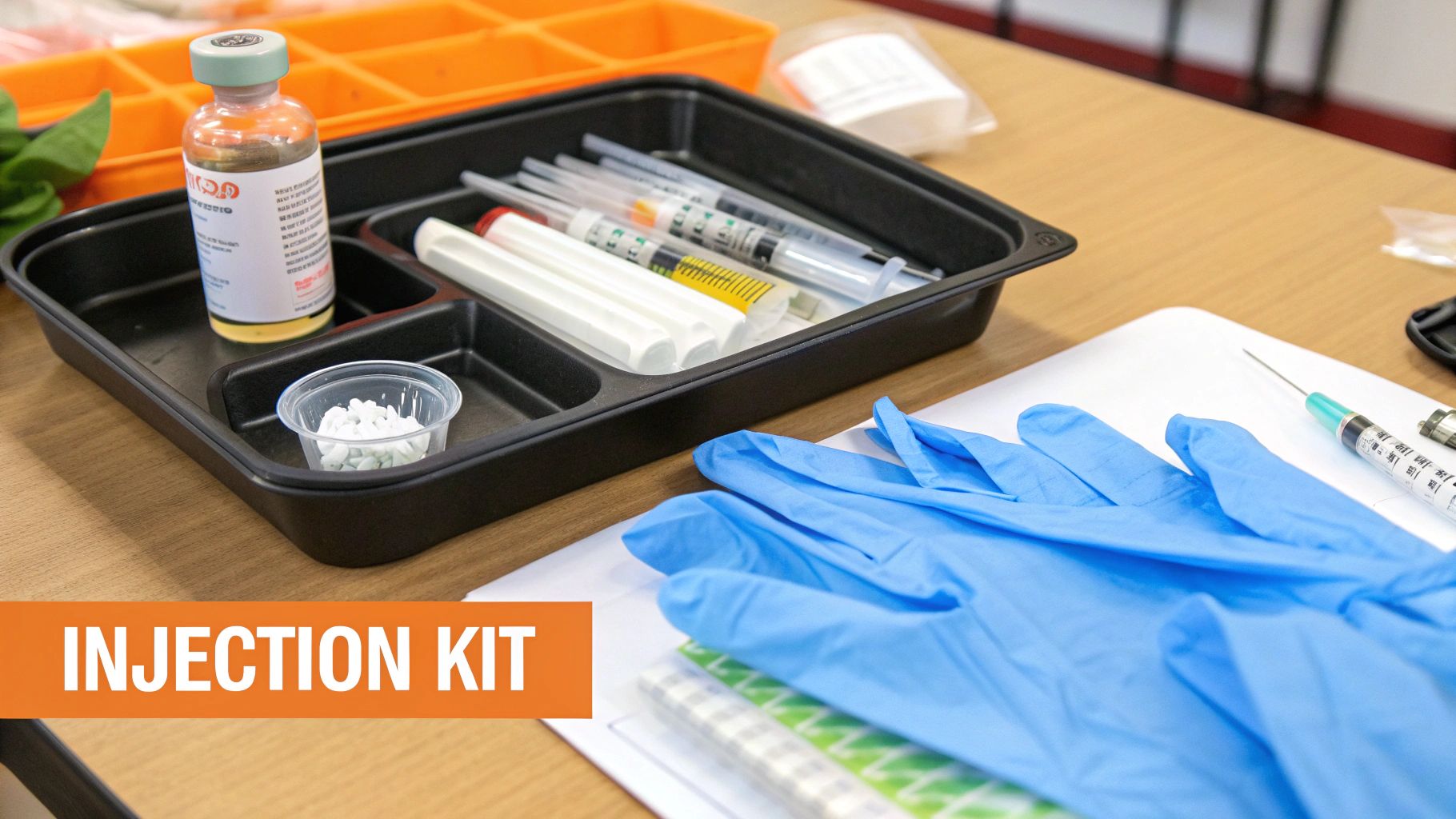
Confidence on injection day starts long before the needle ever touches your skin. It begins with having everything you need laid out, organized, and ready to go. Think of it like a chef prepping their station before service—a little organization makes the whole process smoother, safer, and a lot less stressful.
When you can walk up to a clean, well-stocked area, you eliminate any chance of last-minute fumbling or anxiety. This isn't just about having the right gear; it's about understanding why each piece is there and how it contributes to a sterile, successful injection every single time. Let's get your personal workstation set up.
Your Core Injection Kit
First things first, find a clean, flat surface like a countertop or table. Give it a good wipe-down with a disinfectant, then lay out a fresh paper towel to serve as your sterile field. This simple step is crucial for preventing any unwanted bacteria from crashing the party.
Having all your supplies in one place is key. Here's a rundown of everything you should have within arm's reach before you even think about starting.
Essential Supplies Checklist for Testosterone Self-Injection
This checklist covers every item you'll need for a safe and successful testosterone injection at home. Review it before each injection to make sure you're fully prepared.
| Supply Item | Purpose and Key Considerations |
|---|---|
| Prescribed Testosterone Vial | Your medication. Always check the expiration date and ensure the oil is clear, not cloudy, and free of any floating bits. |
| Sterile Syringes | The vehicle for your dose. These are typically 1mL or 3mL syringes, depending on your prescription. |
| Drawing Needle | A thicker needle (usually 18G to 21G) used only to draw the testosterone from the vial. Its larger opening makes pulling the thick oil much easier. |
| Injecting Needle | A thinner, often shorter needle (usually 23G to 27G). You'll swap to this one for the actual injection to minimize discomfort. |
| Alcohol Prep Pads | You'll need at least two: one for the rubber top of the vial and another to sterilize your skin at the injection site. |
| Sterile Gauze or Cotton Ball | Used to apply light pressure to the injection site afterward to stop any minor bleeding. |
| Adhesive Bandage | To cover the site once you're done and keep it clean. |
| FDA-Cleared Sharps Container | This is non-negotiable. Never, ever throw used needles or syringes in the regular trash. It's a huge safety risk. |
Taking the time to assemble these items turns what could be a clinical chore into a controlled, confident part of your routine.
It’s no surprise that this move toward patient autonomy is a big deal. In North America, the self-injection market, largely driven by TRT, was valued at USD 21.51 billion and is expected to climb to USD 46.78 billion by 2032. While intramuscular (IM) injections still hold a 56% market share for their time-tested reliability, subcutaneous (SubQ) shots are gaining ground because they tend to be less painful and easier to self-administer. You can dig into these trends and the shift to at-home care in this detailed industry report.
Why Different Needles Matter
You might wonder why you need two different needles. Using one to draw and a separate one to inject is a pro-level technique that makes a real difference. Puncturing the vial's rubber stopper, even just once, can slightly dull the needle's tip in a way you can't see. A dull needle is going to cause more friction and tissue trauma, which means more pain for you.
Pro Tip: By swapping to a fresh, sterile needle for the injection, you guarantee the sharpest possible point. This leads to a much smoother entry and a more comfortable experience overall.
This two-needle method is a small habit that pays off big in minimizing post-injection soreness. It’s absolutely worth adopting from your very first shot.
Inspecting Your Testosterone Before You Start
Always give your medication a quick once-over. Your testosterone should be a clear, slightly yellowish oil. If you spot any of the issues below, do not use the vial. Set it aside and get in touch with your pharmacy or doctor right away.
- Cloudiness or Murkiness: The solution needs to be completely transparent.
- Crystals: Sometimes, if the oil gets too cold, it can "crash" and form tiny crystals. You can often fix this by gently warming the vial between your hands or in a cup of warm (not hot) water for a few minutes. If the crystals don't dissolve, don't use it.
- Particles or Debris: There should be absolutely nothing floating around in there.
This quick visual check is your first and most important safety step. When you’re meticulous about your prep, you’re not just following instructions—you're taking full control of your health.
Intramuscular vs. Subcutaneous: Which Injection Site Is for You?
When you and your doctor map out your TRT plan, one of the first big decisions is how you'll inject. Will it be deep into the muscle, known as an intramuscular (IM) injection? Or will you use a tiny needle to inject into the fatty tissue just under your skin, a method called subcutaneous (SubQ)?
This isn't just a medical footnote—it’s about finding what works for your body, your schedule, and your comfort level. There’s no single "best" way. The right choice is the one that makes your therapy feel manageable and effective, so you can stick with it for the long haul. Let’s get into the practical differences to help you have a more informed chat with your clinician.
The Classic Approach: Intramuscular (IM) Injections
The IM route is the old-school, tried-and-true method for testosterone delivery. When you inject into a large muscle, the rich blood supply goes to work, absorbing the testosterone oil steadily over the next few days. This is why many guys on an IM protocol only need to inject once or twice a week.
The most common and accessible spots for an IM shot are:
- Ventrogluteal (Hip): Many clinicians consider this the gold standard for safety, as it's far from major nerves and blood vessels. It can feel a bit awkward to reach at first, but with a little practice, it often becomes the go-to site.
- Deltoid (Shoulder): This one's easy to see and reach. Since it's a smaller muscle, it’s best suited for lower volume injections—think 1 mL or less—to keep soreness to a minimum.
- Vastus Lateralis (Thigh): The big muscle on the outside of your thigh is another straightforward option, making it a favorite for self-injections.
An IM shot usually feels like a quick pinch followed by a dull pressure. It's common to feel a bit of an ache for a day or two afterward, something we often call post-injection pain (or PIP).
The Modern Method: Subcutaneous (SubQ) Injections
SubQ is a newer, but increasingly popular, way to go. Here, you use a much smaller and shorter needle (like those used for insulin) to inject the testosterone into the layer of fat under the skin. The belly and thighs are the most common spots.
Fat has less blood flow than muscle, so the testosterone gets absorbed more slowly and gradually. For many men, this leads to more stable hormone levels throughout the week. It can help smooth out the "peak and trough" feeling that some experience with less frequent IM shots, better mimicking the body's natural rhythm.
This user-friendly method is a major reason the Testosterone Replacement Therapy market has grown to USD 2.94 billion globally. Formulations like testosterone cypionate are perfect for flexible, at-home dosing, which is a huge plus for the millions of men over 40 managing low testosterone. The fact that SubQ injections are less intimidating is a key driver behind the market's 5.5% annual growth rate, as it helps people stick to their treatment plans. You can learn more about these trends in this detailed industry overview.
Comparing Intramuscular (IM) and Subcutaneous (SubQ) Injections
Deciding between IM and SubQ really comes down to weighing the pros and cons of each. This table breaks down the key differences to help you see how they stack up.
| Feature | Intramuscular (IM) | Subcutaneous (SubQ) |
|---|---|---|
| Needle Size | Larger gauge, longer needle (e.g., 23-25G, 1-1.5 inches) | Smaller gauge, shorter needle (e.g., 27-30G, 0.5 inches) |
| Injection Feel | More potential for an initial pinch and post-injection soreness (PIP). | Generally less painful with minimal to no lingering soreness. |
| Absorption Rate | Faster absorption due to high blood flow in muscle tissue. | Slower, more gradual absorption from fatty tissue. |
| Dosing Frequency | Typically once or twice per week with larger doses. | Often requires more frequent, smaller doses (e.g., every other day). |
| Hormone Stability | Can sometimes lead to more noticeable peaks and troughs in levels. | Tends to create more stable, consistent blood levels. |
| Ease of Use | Can be more intimidating for beginners due to needle size. | Generally easier and less intimidating to self-administer. |
| Potential Issues | Higher risk of hitting a nerve or blood vessel; potential for scar tissue. | Risk of creating small lumps of oil under the skin; skin irritation. |
Ultimately, there's no right or wrong answer here, just what’s right for you. Your lifestyle plays a big part in the decision.
A Real-World Scenario: A guy who travels constantly for work might prefer a simple, once-a-week IM injection. In contrast, someone who is really sensitive to hormonal shifts might feel much better with more frequent SubQ injections to keep his levels smooth and steady.
The choice between IM and SubQ should always be a team decision made with your healthcare provider. They can look at your body composition, your specific dose, and your personal comfort to guide you. And remember, nothing is set in stone. Don't be afraid to try one method and switch if it’s not working out. Finding a routine you can live with is a huge part of long-term success on TRT.
Mastering Your Injection Technique from Start to Finish
Alright, this is where all the prep work comes together. I know moving from reading about it to actually doing it can feel like the biggest hurdle, but trust me, this process will become second nature faster than you think. We're going to walk through the entire procedure for how to self inject testosterone in a way that feels less like a clinical task and more like a simple, manageable part of your routine.
The goal here is to build muscle memory and confidence. Following these steps ensures every injection is clean, correct, and as comfortable as it can be. Think of this as your pre-flight checklist.
This flowchart breaks down the decision-making process for your injection, whether you're aiming for deep muscle or the fatty tissue just under the skin.
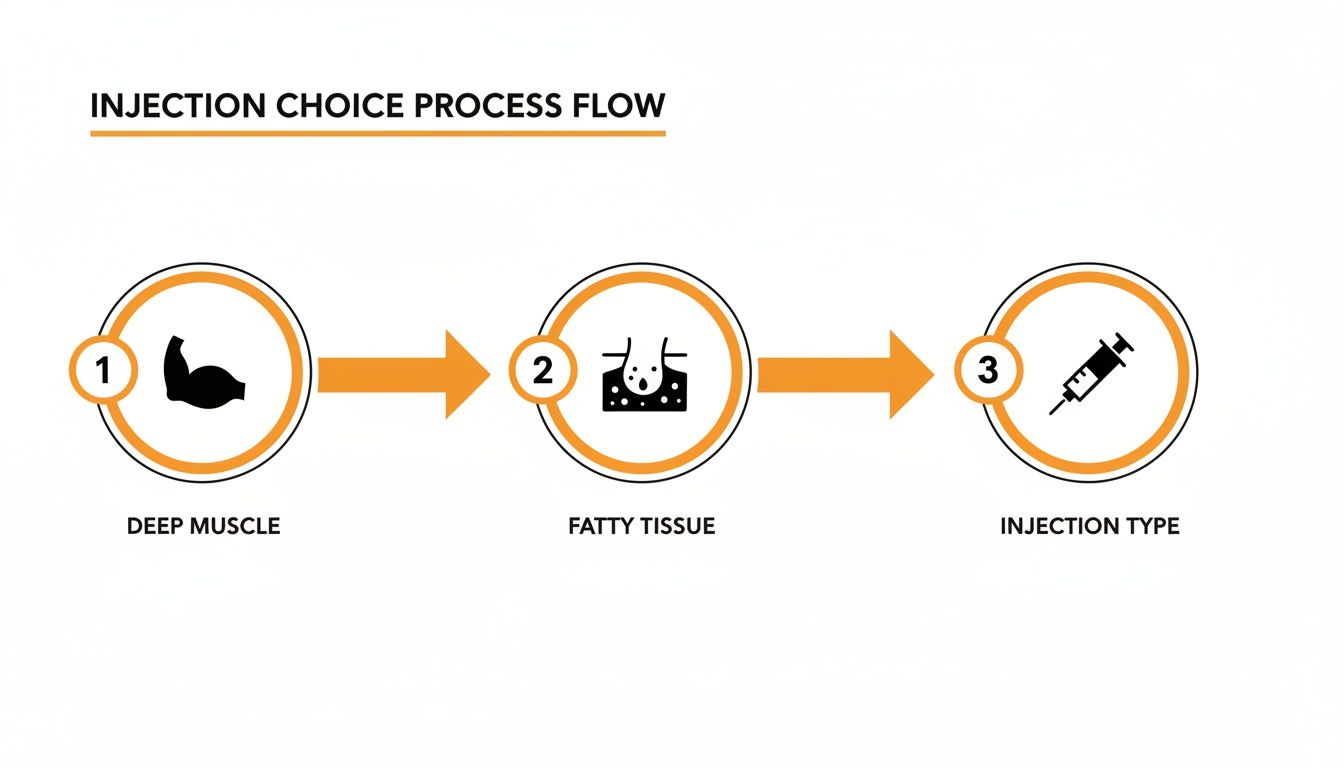
It clearly maps out the two main paths, helping you visualize the right technique based on your chosen injection site.
Preparing Your Dose: Aseptic Technique is Everything
First things first, wash your hands. Don't just rinse them—use soap and warm water and scrub for at least 20 seconds. This is your non-negotiable first line of defense against infection. Once your hands are clean and totally dry, you can lay out your sterile supplies.
Grab an alcohol prep pad and give the rubber stopper on your testosterone vial a vigorous scrub for about 15 seconds. This little step gets rid of any surface contaminants. Set the vial down on your clean surface and let the alcohol air dry completely. Don't blow on it or wipe it; patience is key for sterility.
Now, let's draw your dose.
- Attach your thicker drawing needle (like an 18G or 20G) to the syringe.
- Pull the plunger back, drawing in an amount of air equal to your prescribed testosterone dose. If your dose is 0.5 mL, pull the plunger to the 0.5 mL mark.
- With the vial on a flat surface, push the needle straight through the center of the rubber stopper.
- Inject the air into the vial. This simple action pressurizes the vial, which makes drawing out the thick testosterone oil a whole lot easier.
- Flip the vial upside down and carefully pull back the plunger, drawing slightly more testosterone than you need. That little bit extra will help you deal with any air bubbles.
Removing Air Bubbles and Swapping Needles
Air bubbles are totally normal and easy to fix. While keeping the vial upside down with the needle tip still in the oil, just tap the side of the syringe. You'll see the bubbles rise to the top.
Once they're all gathered at the top, gently push the plunger just enough to squirt the air back into the vial. Keep pushing slowly until the top of the plunger's black seal is perfectly lined up with your correct dose mark. Voilà—a perfectly measured, bubble-free dose.
Pull the needle out of the vial. Now for a pro tip that makes a huge difference in comfort: swap the needle. The one you used to puncture the rubber stopper is already slightly dulled. Carefully recap it using the one-handed "scoop" method (never bring your other hand toward the needle) to avoid an accidental poke. Twist it off and drop it straight into your sharps container.
Twist on your fresh, sterile, and much thinner injecting needle (like a 25G or 27G). You're now ready to go.
Performing the Injection with Confidence
Pick your spot and clean a two-inch circle of skin with a new alcohol pad. Again, let it air dry completely. That stinging sensation people sometimes feel? It's often from injecting through still-wet alcohol.
For Intramuscular (IM) Injections:
Many doctors suggest the Z-track method to prevent the oil from leaking out. Use your non-dominant hand to pull the skin and the fatty tissue underneath it slightly to the side. With a firm, quick motion—think of it like throwing a dart—insert the needle at a 90-degree angle deep into the muscle. Going in quickly is actually less painful than hesitating.
A Quick Note: You may have heard of "aspirating" (pulling the plunger back to check for blood). This is an outdated practice that's no longer recommended for self-injections in common sites like the deltoid or glute. The risk of hitting a major blood vessel is incredibly low.
Inject the testosterone slowly and steadily. Pushing the plunger too fast can cause more tissue trauma and post-injection soreness. Once the syringe is empty, just hold it in place for about 10 seconds to let the oil start to settle in.
For a deeper dive into best practices, a comprehensive hormone and testosterone injections safety guide is always a great resource to have on hand.
After the 10 seconds are up, pull the needle out quickly at the same 90-degree angle. As soon as it's out, let go of the skin you were holding. The tissue layers will slide back into place, creating a "Z" path that traps the medication deep in the muscle.
For Subcutaneous (SubQ) Injections:
The technique is similar but a bit gentler. Lightly pinch a one-to-two-inch fold of skin. Insert the smaller needle at either a 90-degree angle (if you have a good bit of tissue to pinch) or a 45-degree angle (if you're leaner). Slowly inject the oil, pull the needle out, and then let go of the skin.
The Final Steps: Aftercare
As soon as the needle is out, place a sterile gauze pad or cotton ball over the site and apply gentle pressure for about 30 seconds. A single drop of blood is perfectly normal, so don't worry.
Do not massage the injection site. I see this mistake all the time. Massaging can actually force the oil back out of the injection track or just cause extra bruising. Let your body do the work of absorbing it.
Pop a small bandage over the site, and you're almost done. Immediately dispose of the entire needle and syringe into your FDA-cleared sharps container. Never, ever try to recap the injecting needle.
And that's it. You've just completed your first self inject testosterone procedure. I promise, after you do it a few times, it just becomes another simple part of your week.
Post-Injection Care and How to Troubleshoot Common Issues
Alright, the injection is done and your sharps are safely tucked away in their container. But you're not quite finished yet. What happens over the next 24 to 48 hours is just as important for ensuring your TRT journey is a smooth one.
Most of the time, you'll slap a bandage on and forget about it. It's completely normal, though, to have questions about the little things that can pop up—a bit of soreness, maybe a small bruise. Let's walk through what to expect, how to handle these minor bumps in the road, and most importantly, how to spot the difference between "normal" and "call your doctor."
Managing Post-Injection Pain and Minor Issues
The most common thing you'll feel, especially after an intramuscular (IM) shot, is a dull ache right where you injected. We call this Post-Injection Pain (PIP), and it usually just feels like you did a single, very specific rep at the gym. It's almost always mild and gone in a day or two.
You might also see a little redness, some minor itching, or a small bruise. This is just your body's response to a needle passing through the skin and is rarely anything to worry about.
- For Soreness: A simple cold compress on the area for 10-15 minutes can work wonders. Resist the urge to use a heating pad right away, as that can sometimes increase inflammation.
- For Bruising: This just means you nicked a tiny, invisible blood vessel on the way in. It’s harmless and will fade just like any other bruise.
- For Itching: A little itchiness as the skin heals is common. As long as it isn't a full-blown rash, it’s typically just part of the process.
The single best piece of advice to keep all these issues to a minimum? Rotate your injection sites. Seriously. Never inject the exact same spot twice in a row. A simple rotation—left glute, right glute, left delt, right delt—gives the tissue plenty of time to fully heal. This is crucial for preventing the buildup of scar tissue over the long haul.
Recognizing Warning Signs That Need Attention
While most of what you'll experience is minor, the most important skill you can develop is spotting a real problem. Infections and allergic reactions are rare, but they happen, and catching them early is everything.
You need to get in touch with your doctor or healthcare provider immediately if you see any of the following at or around the injection site.
Crucial Safety Information: Do not wait to seek medical advice if you notice significant swelling, intense pain that worsens over time, skin that is hot to the touch, a fever, or drainage of pus from the site. These are potential signs of an infection that requires prompt medical treatment.
You also need to be on the lookout for a potential allergic reaction. An allergy to testosterone itself is almost unheard of, but people can have reactions to the carrier oil it's suspended in, like cottonseed or grapeseed oil.
Keep an eye out for these symptoms:
- A widespread rash or hives that pop up shortly after your injection.
- Difficulty breathing or wheezing.
- Swelling of your face, lips, or tongue.
These are red flags for a serious systemic reaction. Don't hesitate—seek emergency medical help.
When to Relax and When to Call Your Doctor
Learning to self inject testosterone is all about gaining confidence, and a huge part of that is knowing when to chill out and when to pick up the phone. Think of it like this: a little soreness is just your body talking to you; sharp, increasing pain is your body yelling for help.
Here’s a quick reference to help you tell the difference.
| Experience | This is Likely Normal If… | Call Your Doctor If… |
|---|---|---|
| Pain | It's a dull, localized ache that improves after 24-48 hours. | The pain is sharp, throbbing, or gets significantly worse over time. |
| Redness | It's a small pinkish area, about the size of a quarter, right at the injection site. | The redness spreads, forms streaks, or the area feels hot to the touch. |
| Lumps (SubQ) | A small, pea-sized lump of oil forms under the skin and disappears within a few days. | The lump is extremely painful, grows larger, or shows signs of infection. |
Your TRT is a partnership between you and your provider. By mastering your aftercare and knowing these critical warning signs, you're taking an active, responsible role in your own health. It's how you ensure your therapy is both safe and successful for years to come.
Answering Your Questions About Self-Injecting Testosterone
Even when you've got the technique down pat, questions are bound to come up as you get into the swing of things. That's completely normal. Here, we've gathered some of the most common queries we hear from men starting out, with straightforward answers to help you feel confident on your TRT journey.
What Should I Do If I Hit a Vein and See Blood in the Syringe?
Seeing a flash of blood in the syringe can be alarming, but it’s usually not a reason to panic. The old-school technique of aspirating (pulling back the plunger to check for blood) isn't standard practice anymore for most injection sites. But if you do it and see blood, the solution is simple: pull the needle out.
Don't try to salvage the dose. You'll need to discard that needle, syringe, and the testosterone inside. It's much safer to start fresh with new supplies in a totally different spot. This prevents the rare chance of injecting the oil directly into a blood vessel, which can cause a temporary but unpleasant reaction like a coughing fit or a feeling of tightness in your chest.
What if you don't aspirate and just see more than a tiny speck of blood after you've pulled the needle out? No need to worry. That just means you nicked a small capillary, which happens all the time. Just grab a sterile gauze pad and apply firm, steady pressure for a minute or two until it stops.
Is It Normal to Feel Lumps Under the Skin After a Subcutaneous Injection?
Yes, finding a small, firm knot under your skin after a subcutaneous (SubQ) shot can be perfectly normal, especially when you're new to it. That little lump is simply the testosterone oil, pooled in the fatty tissue, waiting to be absorbed by your body.
These spots should be mostly painless and usually go away on their own within a few days, sometimes up to a week.
Want to keep them to a minimum? Here’s how:
- Slow your roll. Pushing the plunger too fast creates a larger, more concentrated pool of oil under the skin. A slow, steady pace is key.
- Rotate, rotate, rotate. This is non-negotiable. Giving each injection site a proper break allows the tissue to fully heal and absorb the previous dose.
- Mind the volume. SubQ injections are really meant for smaller amounts of fluid, typically 0.5 mL or less.
A quick heads-up: if a lump becomes very painful, feels hot, looks red and inflamed, or doesn't seem to be getting smaller after a week, that’s your cue to call your doctor. It could be a sign of significant irritation or a localized infection that needs attention.
How Can I Minimize Scar Tissue and Post-Injection Pain?
Keeping scar tissue and post-injection pain (PIP) at bay is all about consistency and good habits. The single most effective strategy is diligent site rotation. Think of it like a map: left hip, right hip, left delt, right delt. Keep a simple log on your phone or in a notebook so you never hit the same spot too often.
Your gear matters, too. Using a thinner needle, like a 25G or 27G, causes less trauma to the tissue, which translates directly to less pain afterward. If you're consistently dealing with symptoms, it might be a good time to learn more about the signs of low free testosterone in our detailed guide.
Finally, a few small tweaks to your technique can make a world of difference. Always let the alcohol dry completely on your skin before injecting; this prevents that sharp stinging sensation. Push the plunger with slow, steady pressure, and resist the urge to massage the area afterward. Many guys also find that warming the vial in their hands for a minute or two helps thin the oil, making the injection feel much smoother.
At Elite Bioscience, we provide the highest quality therapies and support to help you take control of your health with confidence and privacy. Explore our tailored TRT programs and get started today at https://elitebioscience.co.