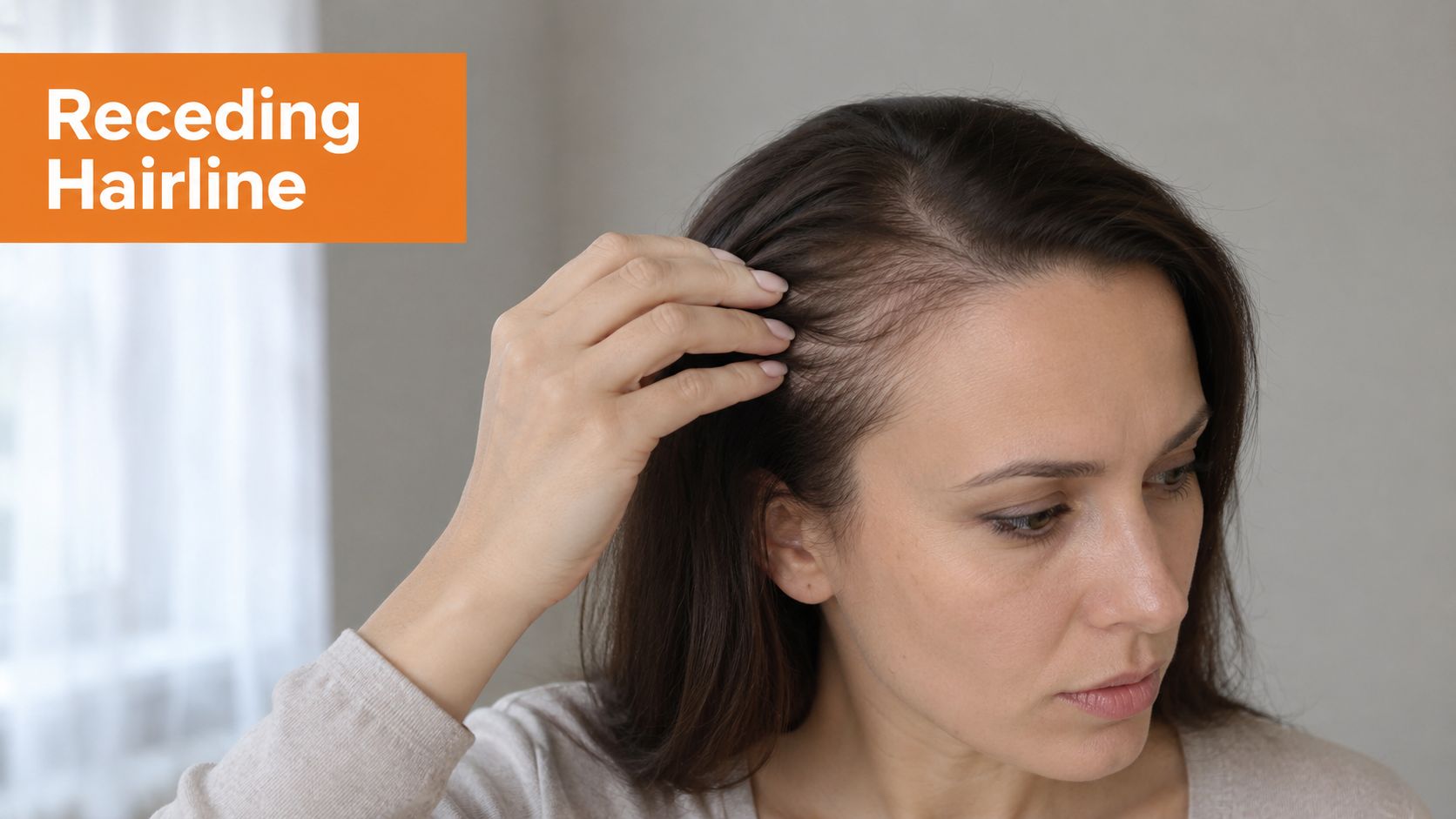
You catch it in ordinary light first. Not under a clinic lamp, not in a magnified photo. Just in the bathroom mirror, while pulling your hair back or changing your part. The temples look more visible. The front edge seems softer, thinner, less defined. For many women, that moment is unsettling because female hairline change rarely gets explained clearly.
A lot of women with receding hairline concerns assume the same thing at first: “This must be stress,” or “Maybe it's just aging,” or “I'm probably overreacting.” Sometimes it is temporary shedding. Sometimes it is not. The important part is that a changing hairline in women is a pattern worth taking seriously, not something to dismiss or self-diagnose from social media.
Understanding Your Changing Hairline
One reason this feels so isolating is that women's hair loss is often discussed in vague terms. In clinic, the story is usually more specific. A woman notices her ponytail feels smaller. She starts using more powder at the temples. She compares recent photos to older ones and sees that the front corners have crept back, or that the hairline looks see-through instead of solid.
That experience is common enough that it shouldn't be brushed off as unusual. A review in PMC reports that female pattern hair loss is the most common cause of hair loss in women, affects about 40% of women by age 50, and rises from roughly 12% in women aged 20 to 29 to over 50% in women over 80 according to this review on female pattern hair loss in PMC.
Why the mirror can be misleading
Hairline change in women doesn't always look like the classic male “M” shape people expect. It may show up as:
- Temple thinning that makes the forehead look broader
- Diffuse frontal softening where the edge loses density
- Part widening that makes the front scalp easier to see
- Breakage around the margins that mimics true recession
These patterns matter because the right treatment depends on what is happening underneath the surface.
Hair loss at the front of the scalp is a symptom pattern, not a diagnosis.
A receding hairline can be reversible in some women, partially improvable in others, and permanently scarring in a smaller group. That range is exactly why proper assessment matters. Anxiety pushes people toward quick fixes. Good care starts by slowing down long enough to identify the pattern.
The Primary Causes of Female Hairline Recession
In women, the phrase “receding hairline” covers several very different conditions. That's where many articles go wrong. They list causes in a flat way, as if each one behaves the same. They don't.
A woman whose follicles are shrinking from androgen sensitivity needs a different plan from a woman whose braids have been pulling at the front hairline for years. A woman with inflammatory scarring loss needs faster specialist attention than either of them. This distinction is central. As explained in this clinical overview of hairline recession in women, a receding hairline in women often reflects distinct diagnoses such as androgenetic alopecia, traction alopecia, or frontal fibrosing alopecia, and the cause determines whether the process is reversible or progressive and scarring.
Androgenetic alopecia
This is the most common background diagnosis in women with frontal thinning, although it often looks less dramatic than male-pattern recession. Think of a healthy follicle like a strong root system in good soil. In androgen-sensitive hair loss, the follicle gradually miniaturizes. It still produces hair for a time, but each new strand tends to come back finer, shorter, and less pigmented.
The visible clues often include:
- A wider part
- Reduced density behind the hairline
- Less volume through the top of the scalp
- Temples that look sparse rather than completely bald
Hormones matter here, but “hormonal” is too broad to be useful on its own. Menopause, ovarian hormone shifts, and inherited follicle sensitivity can all shape the pattern. If you're trying to understand that connection, this overview of whether estrogen may help hair loss is a useful background read.
A true female hairline recession from androgenetic loss usually unfolds gradually. It doesn't typically appear overnight.
After the pattern becomes clearer, this video gives a patient-friendly overview of how clinicians think about frontal thinning and treatment decisions.
Traction alopecia and telogen effluvium
These two are often confused, but they behave differently.
Traction alopecia comes from chronic pulling. Tight ponytails, glued styles, braids, extensions, and repeated tension at the same frontal points can inflame and weaken follicles. Early on, this may be reversible. If the tension continues long enough, the loss can become permanent.
Telogen effluvium is more of a shedding shift than a true receding process. Women often notice more hair coming out after illness, stress, medication changes, childbirth, or poor nutritional status. The frontal edge may look thinner because many hairs entered the shedding phase at once.
A few clues help separate them:
- Traction tends to localize at the margins and temples.
- Telogen effluvium tends to diffuse across the scalp.
- Traction often includes breakage and shorter damaged hairs.
- Telogen effluvium often includes heavy shedding from the shower, brush, or pillow.
Frontal fibrosing alopecia and other important causes
Frontal fibrosing alopecia deserves attention because it can mimic ordinary recession at first, yet it behaves very differently. This is a scarring process. The hairline may look smoother, paler, and progressively farther back. Some women also notice eyebrow thinning or scalp symptoms such as irritation.
Practical rule: If the hairline is actively moving backward, the skin looks shiny or unusually smooth, or the area feels inflamed, don't treat it like routine shedding.
Other contributors can include thyroid disease, nutritional deficiency, autoimmune conditions, medication effects, and compulsive hair pulling. The pattern at the hairline is the clue. The diagnosis comes from matching that pattern to the biology behind it.
How to Get a Clear Diagnosis From a Specialist
Most women don't need more guessing. They need a focused workup.
A strong consultation starts before you enter the room. Bring a timeline. Write down when you first noticed the change, whether shedding has been heavy, which medications or supplements you take, whether you've had recent illness, pregnancy, weight change, cycle changes, or menopause symptoms, and what hairstyles you wear regularly. Those details often matter more than people realize.
What a specialist looks for
During the exam, the clinician usually studies the distribution of loss first. Is it concentrated at the temples, spread diffusely through the frontal scalp, or sitting in a band-like pattern across the entire hairline? They also look for miniaturized hairs, broken hairs, redness, scale, tenderness, and signs of scarring.
Many consultations include some combination of:
- Scalp and hairline inspection to map the pattern
- Hair pull assessment to gauge active shedding
- Dermoscopic examination to look at follicle openings and hair shaft variation
- Medical history review to identify triggers or hormonal context
When bloodwork and biopsy enter the picture
Blood testing is useful when the pattern suggests a trigger outside the scalp, or when the history points toward deficiency or endocrine change. That's especially relevant if the hair loss started alongside fatigue, cycle changes, sudden shedding, or broader wellness symptoms. For women sorting out that side of the workup, this guide on getting hormones tested can help frame the conversation.
A scalp biopsy isn't needed for every patient. It becomes more important when the diagnosis is uncertain, when scarring alopecia is on the table, or when the visible pattern and the history don't fit neatly together.
The right diagnosis saves time twice. It avoids treatments that won't help, and it catches the conditions that need early intervention before follicles are lost for good.
If you leave a consultation with only “it's probably hormones” and no discussion of pattern, scalp findings, or treatment logic, that's not a complete evaluation.
Evidence-Based Medical Treatments for Hair Regrowth

A woman comes in worried about her temples, convinced she needs a stronger shampoo or a better serum. In clinic, the more useful question is different. Are those frontal hairs shedding, miniaturizing, inflamed, or permanently lost? Treatment depends on that pattern.
For female pattern hair loss affecting the hairline, the best-established first-line treatment is topical minoxidil. Australia's Healthdirect, in its guidance on female pattern hair loss, identifies topical minoxidil as the main first-line therapy and notes that anti-androgens such as spironolactone may be used in selected women when androgen influence is part of the picture.
Minoxidil and anti-androgens
Minoxidil remains the backbone of medical treatment because it has the strongest track record for helping follicles stay in the growth phase longer. At the frontal hairline, that usually means preserving miniaturizing hairs and, in some women, thickening hairs that have become finer over time.
The trade-offs are practical:
- Daily or near-daily use matters. Sporadic application rarely gives a fair trial.
- Visible change takes time. Hair cycles move slowly, especially around the front.
- An early shed can occur. That phase is unsettling, but it does not automatically mean the treatment is wrong.
- The formula matters. Some women tolerate foam better than liquid, especially if irritation or scale develops along the hairline.
Spironolactone is often added when the pattern suggests androgen-sensitive thinning. That is common in women who notice recession at the temples with widening of the part, or who also have acne, increased facial hair, or a history suggesting polycystic ovary syndrome. It can be a useful partner to minoxidil because the two treatments address different parts of the process. Minoxidil supports growth activity. Spironolactone reduces the hormonal signaling that can push follicles toward miniaturization.
This is not a one-size-fits-all prescription. Spironolactone requires medical review, especially for blood pressure, kidney function, pregnancy risk, and possible medication interactions.
Where HRT fits, and where it doesn't
HRT is often left out of hair-loss discussions or reduced to a yes-or-no menopause question. The actual answer is narrower and more clinically useful.
For postmenopausal women, estrogen decline can be part of the background that makes frontal thinning more noticeable. That does not make HRT a dedicated hair-regrowth treatment. It means HRT may have a supporting role when hair change appears alongside hot flushes, sleep disruption, genitourinary symptoms, or other menopausal concerns that already justify a broader conversation about treatment.
I would frame it this way in practice. HRT may help the scalp environment in some women, but it should never be started only to chase temple density. The decision belongs in menopause care, where risks, benefits, timing, and contraindications are reviewed properly. For the right patient, HRT can sit beside hair-specific treatment. It does not replace minoxidil, and it does not reverse every case of recession.
Emerging peptide therapies and realistic expectations
Peptide therapies are getting attention because patients want options that feel more targeted than standard topicals or tablets. The interest is understandable. The evidence for female hairline recession is still limited.
That matters because the front hairline is a difficult area to treat well. It is often the first place patients notice change and one of the slowest places to show convincing regrowth. Peptide-based approaches, including interest in compounds such as GHK-Cu, are being used by some clinicians as adjuncts aimed at repair signaling and scalp quality. At this stage, they are best discussed as evolving supportive therapies rather than established first-line care.
Elite Bioscience is one example of a telehealth clinic that offers medical access to hormone, peptide, and vitamin-based support. That kind of service can help selected patients access follow-up care. It does not replace an in-person scalp assessment when the diagnosis is uncertain, the recession is patchy, or scarring alopecia is a concern.
In female hairline recession, the first treatment goal is often stabilization. Regrowth matters, but protecting vulnerable follicles before more density is lost usually gives the best long-term result.
What deserves skepticism? Generic hair oils, tonic-style products, and supplement claims that are sold without a diagnosis. Correcting iron deficiency, thyroid disease, or a hormonal trigger can absolutely help. That is very different from saying every over-the-counter product can reverse a receding hairline.
Advanced Procedural and Cosmetic Options
Some women want more than topical or oral treatment alone. That's reasonable, especially when the front hairline is the area that bothers them most cosmetically. Procedural options can help in selected cases, but they differ a lot in purpose, effort, and predictability.
Comparing in-office procedures
The evidence for procedures is more mixed than many clinics advertise. Healthdirect notes there isn't enough evidence that laser treatments, plasma injections, hair tonics, or supplements are effective. That doesn't mean no patient ever benefits. It means results are less certain, and the quality of evidence varies.
Here's a practical comparison:
| Treatment | How It Works | Best For | Sessions Required |
|---|---|---|---|
| PRP | Uses a platelet-rich preparation from your own blood and injects it into the scalp | Women with non-scarring thinning who want an adjunct to medical therapy | Usually multiple sessions, then maintenance if helpful |
| Microneedling | Creates controlled micro-injury in the scalp to support healing pathways and sometimes improve topical penetration | Selected patients already on a structured treatment plan | Repeated sessions are typically needed |
| Low-level laser therapy | Uses light-based devices aimed at follicle stimulation | Women who want a non-drug home or office adjunct and accept variable outcomes | Ongoing use is usually necessary |
| Hair transplant | Moves follicles from a donor area to the hairline or temples | Women with stable loss patterns and sufficient donor density | Surgical procedure with follow-up rather than routine sessions |
Who may benefit most
PRP is usually framed as a biological stimulator. Some patients like it because it avoids daily medication changes. The drawback is that it requires repeated appointments, and outcomes aren't uniform.
Microneedling is most useful when it's part of a broader plan, not when it's sold as a one-off answer. If the underlying loss is still active, stimulation alone may not be enough.
Laser therapy appeals to women who want something noninvasive. The trade-off is uncertainty. Some users report stabilization or mild improvement. Others see little change despite months of commitment.
When transplant makes sense, and when camouflage is smarter
Hair transplantation is often the most definitive option for restoring a frontal edge, but only in the right patient. The pattern needs to be stable enough that transplanted hairs aren't placed into a still-active, poorly controlled process. Donor density also matters. Women with diffuse thinning throughout the scalp may not be ideal candidates.
For many women, especially early on, cosmetic camouflage offers immediate relief while medical treatment works in the background.
Useful options include:
- Hair fibers for dry, color-matched coverage at the temples or part
- Scalp powders to reduce contrast between hair and skin
- Part changes to disguise asymmetry
- Soft fringe or layered styling to conceal frontal sparseness without traction
These aren't vanity fixes. They're practical tools that reduce distress while the slower biology of treatment catches up.
Supporting Hair Health Through Lifestyle and Care

Lifestyle won't reverse every type of hairline recession, but it can absolutely protect vulnerable follicles from avoidable damage. In women with receding hairline concerns, small daily habits often decide whether a borderline situation stabilizes or keeps worsening.
Reduce mechanical stress first
If you only make one immediate change, make it this one. Stop pulling on the frontal hairline.
That means rethinking:
- Tight ponytails and buns that strain the same margins every day
- Braids and extensions that create persistent frontal tension
- Heavy styling products or adhesives that irritate the edge
- Aggressive brushing and heat styling focused on fragile temple hair
A useful rule is simple. If a hairstyle hurts, leaves scalp tenderness, or creates bumps of tension along the hairline, it's too tight.
Support the scalp and the body
Scalp care should be gentle, not timid. Keep the scalp clean. Treat scale or inflammation if present. Avoid harsh friction under the assumption that “stimulating” the area harder will wake follicles up. Irritated follicles usually don't reward rough treatment.
Internal health matters too. Hair is metabolically active tissue. When iron stores are low, protein intake is poor, illness has recently occurred, or another deficiency is present, the hair often shows it. If deficiency is a concern, this guide on testing for vitamin deficiency can help you understand what to discuss with a clinician.
A healthy scalp routine supports treatment. It doesn't replace treatment when the underlying diagnosis is androgenetic loss or scarring alopecia.
Simple habits tend to help most:
- Choose looser styling on ordinary days, not just “recovery days”
- Use a wide-tooth comb or gentle brush instead of repeated tugging
- Prioritize dietary protein and balanced nutrition if intake has been inconsistent
- Address dandruff, itch, or inflammation rather than ignoring it
Patients often want a miracle product. More often, they need fewer damaging habits and a plan that matches the diagnosis.
Frequently Asked Questions About Female Hair Thinning
Can a receding hairline in women be fully reversed
Sometimes, but not always.
If the cause is early traction, a shedding event, or a reversible trigger, substantial improvement may happen once the trigger is removed and treatment supports regrowth. If the follicles have been miniaturizing for a long time, improvement may be partial rather than complete. If scarring alopecia is present, the goal is usually to stop progression and preserve what remains.
How long do treatments take to work
Longer than commonly expected.
Minoxidil usually takes months, not weeks. Anti-androgen strategies also require time because the hair cycle is slow. Procedural treatments are rarely instant either. The most realistic early goal is reduced shedding or stabilization, followed later by visible thickening if the follicles are still capable of stronger growth.
Do supplements and hair vitamins really work
They help when they correct a real deficiency. They usually disappoint when used as a catch-all answer for every type of hair loss.
That's why testing and diagnosis matter. A woman with low iron or another deficiency may improve when that problem is corrected. A woman with frontal fibrosing alopecia will not solve the problem with a gummy vitamin.
Why does female hair loss still feel under-researched
Because in many ways, it is.
Recent attention has highlighted that women with androgenetic alopecia have historically been an underserved group in treatment research, and a 2025 Phase II trial report described menopause-focused hair loss as a “historically excluded” population, as noted in this discussion of menopause-focused hair loss research. That doesn't mean there are no useful treatments. It means women deserve more precise research, especially around menopause, hormonal transitions, and therapies often borrowed from male hair-loss care.
If your hairline is changing and you want a more medical, structured next step, Elite Bioscience offers online access to hormone, peptide, and vitamin therapy pathways that may be relevant for some women as part of a broader care plan. The right place to start is still the same: get the pattern identified, rule out scarring or deficiency, and build treatment around the actual cause rather than the fear.